TIMES, TIME, AND HALF A TIME. A HISTORY OF THE NEW MILLENNIUM.

Comments on a cultural reality between past and future.

This blog describes Metatime in the Posthuman experience, drawn from Sir Isaac Newton's secret work on the future end of times, a tract in which he described Histories of Things to Come. His hidden papers on the occult were auctioned to two private buyers in 1936 at Sotheby's, but were not available for public research until the 1990s.


Saturday, January 26, 2013

Interview: Generation Y: Real World Praise, Virtual Control


I am pleased today to interview Matthew Duhamel. He is a writer and animator who recently wrote an opinion piece (here) at the Website Kotaku. The piece is entitled: All My Life I Was Told I Was Special. It Was A Lie.

Matthew, thank you for doing an interview with Histories of Things to Come to follow up on your Kotaku piece. You spoke in general terms about your age group. Your background chimes with some of the experiences commonly associated with Millennials. Therefore, I’ll include some generational questions, even though obviously an individual perspective can’t pinpoint group attitudes.

Friday, January 25, 2013

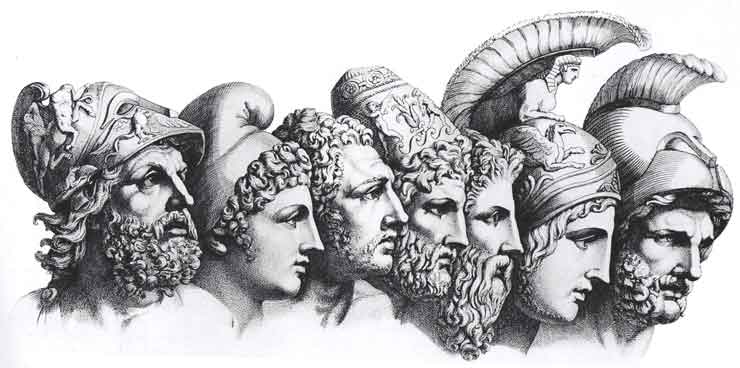
Reservoir Gods


Image Source: Armenian History.

I was thinking about my posts on the collapse of heroism in Postmodern and post-Postmodern fiction and cinema, especially the Revolving Door of Death, in which heroes in pop culture over the past 25 odd years have been killed off for thrills and then brought back to life. Peter Chung explored that cat-came-back trope with his animated character, Aeon Flux, around 1991. Chung used that trope to comment on its moral nihilism.

Each age in the Great Year brings new standards of heroism as the Precession turns.

In the Age of Aries, classical heroes were not immortal. Whether they were warriors or prophets, their deaths in myths and religious legends were a huge breaking point in the heroic story.

In the Age of Pisces, the classical hero became a religious saviour through sacrifice, transcendence and immortality. He could come back from the dead, which made the human hero must become divine.

In the Age of Aquarius, heroes can come back from the dead; they are immortals, like vampires or zombies, but they still bear the daily drudgery, weaknesses and flaws of real human life. Humans don't become gods, gods become humans.

Thursday, January 24, 2013

Quote of the Day: Neil Gaiman


Gaiman's character Tim Hunter in the Faerie Market © DC Comics. Image Source: Best Comics Quest!

The quote of the day comes from Neil Gaiman in the Books of Magic, Vol. 1 (Jan. 1990):
"Science is a way of talking about the universe in words that bind it to a common reality. Magic is a method of talking to the universe in words that it cannot ignore. The two are rarely compatible."
The Books of Magic are one of the sources from which J. K. Rowling likely lifted her original Harry Potter ideas. Gaiman's series was listed in 500 Essential Graphic Novels.

Wednesday, January 23, 2013

Going Post-Political in the Siberian Forest


Image Source: Vice.

It is hard to believe how many people subscribe to simplistic political explanations of the way the world works, when the world is plainly so messed up that it defies easy labels. That discrepancy between reality and the explanations which we (and the media) project onto reality inspires cognitive dissonance, moral confusion and misunderstandings.

Tuesday, January 22, 2013

Thank you


Modern Forest Villa at dusk, Artechnic Architects, Japan. Images Source: Architecture Buildings.

The blog passed 1 million hits today! Thank you very much to everyone who spends some time here and reads the posts at Histories of Things to Come. The research and writing are gifts in themselves, but readers who write in always enlighten me and expand the blog's content. I have also met some great fellow writers within the blogosphere, who are changing the world for the better. I hope you will continue to follow this blog's exploration of what it means to live through the turn of a Millennium.
 

Secrets of the Vitruvian Man


Vitruvius, Roman engineer and architect, wrote: "“No temple can be put together coherently unless it conforms exactly to the principle relating the members of a well-shaped man.”

Last year, Bloomberg reviewed a book by Toby Lester on the origins of the basic principles of classical architecture, which derived from the male body; in the ultimate act of anthropomorphizaton, these principles were later applied to cosmology:
In “Da Vinci’s Ghost,” the journalist Toby Lester peers closely at Leonardo’s “Vitruvian Man” -- its origins, its meaning and the circumstances of the artist who drew it.

It’s called “Vitruvian Man” because the idea for it came from “Ten Books on Architecture,” written by a Roman military engineer named Marcus Vitruvius Pollio. For the Romans, architecture meant proportion, which meant the body.

... Vitruvius wrote ...: “If a man were placed on his back with his hands and feet outspread, and the point of a compass put on his navel, both his fingers and his toes would be touched by the line of the circle going around him.”

Similarly, for a perfectly proportioned man with feet together and hands outspread (a posture that later would inevitably betoken the crucified Christ), “you would find the breadth the same as the height, just as in areas that have been squared with a set square.”

Over time, the notion of the body as the locus classicus of proportion became tied to the relationship between the body and the cosmos -- the microcosm and the macrocosm. The 12th-century mystic Hildegard of Bingen put it this way:

“The firmament, as it were, is man’s head; sun, moon and stars are as the eyes; air as the hearing; the winds are as smell; dew as taste; the sides of the world are as arms and as touch.”
 
The core geometric archetypes, the triangle, the circle, the square, were mapped onto the male body. Buildings conceived on these patterns symbolized the spiritual, mental and physical gifts of the ideal human male.

Although I have previously questioned the health of global societies which have for the past two thousand years relied upon male divinity as the measuring stick of civilization, it is also true that diminished masculinity is a cause for concern.

The post-World War II media, technological and communications revolutions have spawned a lot of cyber Cassanovas and deskchair quarterbacks. These not-men cultivate the anti-heroism of our age, who contradict everything to which Theodore Roosevelt referred in his famous 'Man in the Arena' speech at the Sorbonne in Paris on 23 September 1910:
It is not the critic who counts; not the man who points out how the strong man stumbles, or where the doer of deeds could have done them better. The credit belongs to the man who is actually in the arena, whose face is marred by dust and sweat and blood; who strives valiantly; who errs, who comes short again and again, because there is no effort without error and shortcoming; but who does actually strive to do the deeds; who knows great enthusiasms, the great devotions; who spends himself in a worthy cause; who at the best knows in the end the triumph of high achievement, and who at the worst, if he fails, at least fails while daring greatly, so that his place shall never be with those cold and timid souls who neither know victory nor defeat.
 
We, by contrast, live in a crumbling patriarchy whose points of reference are the sensitive vegetarian vampire or drone-assisted democracy. There is a world of difference between real masculine virtues and patriarchal domination based on masculine weakness.

Are men really becoming less manly? This development caught the attention of the bloggers at The Art of Manliness, who observe that testosterone levels have been falling in America over the past decades; in fact, this problem is happening worldwide.

Saturday, January 19, 2013

Retrofuturism 24: 1968 On the Way to 2019


Real smog in Beijing.

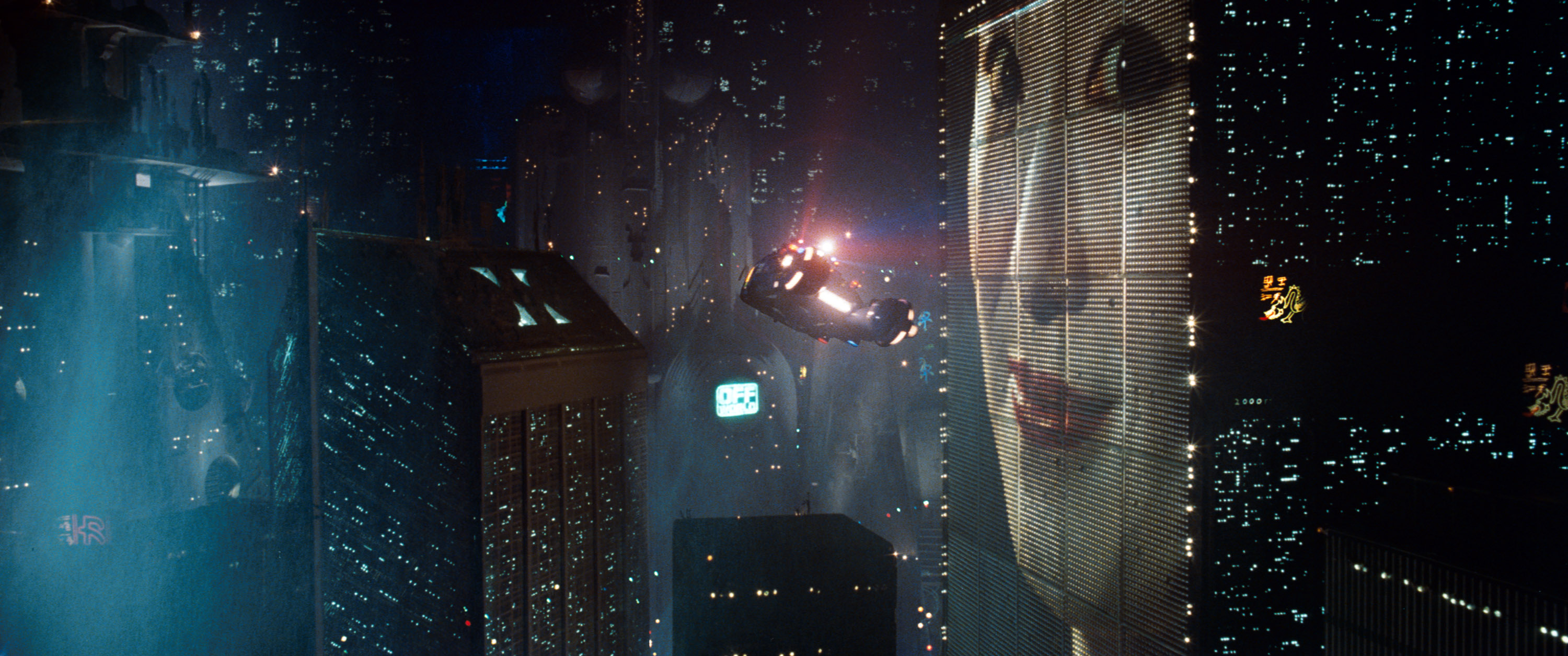
This week, Beijing accumulated hazardous, record levels of smog. From Total Dick-Head: "Dear Readers, that's not a still from Blade Runner you're looking at. That's the smog in Beijing, and some crazy building, and, like, a video billboard." See more pictures of the city this week, here. Real life dystopia, real life noir.

Real smog in Beijing. Image Source: Kotaku.

Blade Runner cityscape.

Go inside to escape the smog and complete the Future Noir mood. From @paleofuture aka Matt Novak: "So got me those Blade Runner whiskey glasses for Christmas and I'm basically the luckiest guy I know." One of my friends, M., was so interested, he tracked them down on the Internet. You can buy them here.

Image Source: @paleofuture.

From the glass seller, Firebox:
We’ve seen things you people wouldn’t believe. Attack ships on fire off the shoulder of Orion. We’ve watched C-beams glitter in the dark near the Tannhauser Gate. But we haven’t seen anything half as cool as the Blade Runner Whiskey Glass.

Yes, Blade Runner fans, now you can relax after a stressful day ‘retiring’ replicants by getting to grips with the very same tumbler used by Rick Deckard in the seminal 1982 sci-fi movie. And when we say the very same we mean it because the moody Blade Runner’s glass wasn’t just a prop, it was a hand-made crystal glass, mouth-blown by artisans at boutique Italian company, Arnolfo di Cambio – and so is this!
Blade Runner still with Harrison Ford playing Deckard (1982) © Warner Bros. Image Source: Live for Films.

You can watch Ridley Scott's legendary film here. The fantastic Vangelis soundtrack is here. All the book covers for different publications of Philip K. Dick's original 1968 story, Do Androids Dream of Electric Sheep? are here. In the original story, Rachael's dissociative responses are explained by her being raised on a spaceship during a botched colonization attempt of Alpha Centauri. The story opens with the death of a 200 year old turtle.

If you've never seen this film, you are lucky to be able to see it for the first time. Do not be one of the newbies on Youtube who cluelessly misses the point to this dystopic Techno-Creation Story: "Just finished watching it!!!!....possibly the worst movie ever...how did this movie get so much priase...smh."

Or:
"Can somebody help me understand why this movie is #1 on sci fi lists? i am a huge Sci fi fan and i just watched this movie due to all the glowing reviews...I was hoping for an amazing film..i must admit i found it incredibly boring with little substance...I could not get into it at all...for me the coolest part of the movie was that pyramid building and the opening scenes of the future skyline lol...yea i get it harrison ford may be a cyborg,,i am shocked that people like this so much...."
Dick's original story, written in 1968, described human alienation from the Freudian Self and from the external environment; the flip side of that alienation was the growing role of technology in propagating the Egotist as Creator. It is almost as though Dick envisioned the 20th century's ultimate dilemma, bloodbaths notwithstanding.

That dilemma was the point at which the Id, the Ego and the Superego would fracture and become separate agents, or whole groups, in society. In light of Blade Runner's continuity from 1968 to 2019, this post continues my series (begun here and here) on the ideas developed by the Silent Generation and Baby Boomers in their youths and explores what became of those ideas.

Moon Calendar


This moon phases calendar is produced by Rendij Studio and is available on etsy (Hat tip: Tara Mohr).