TIMES, TIME, AND HALF A TIME. A HISTORY OF THE NEW MILLENNIUM.

Comments on a cultural reality between past and future.

This blog describes Metatime in the Posthuman experience, drawn from Sir Isaac Newton's secret work on the future end of times, a tract in which he described Histories of Things to Come. His hidden papers on the occult were auctioned to two private buyers in 1936 at Sotheby's, but were not available for public research until the 1990s.


Showing posts with label Philosophy of Time. Show all posts

Tuesday, January 26, 2021

Pivot Point for the Great Awakening: Unconscious Collectivism


Fake political news is growing, so how can you spot the misinformation? (26 January 2021). Video Source: Youtube.

I have a new post up at The Dragonfly:

The Miracle of Context

It concerns how one can recognize hidden truths in the post-truth world, where information is controlled, manipulated, denied, erased, and suppressed.

Leonardo DiCaprio Deep Fake Face (21 January 2021). Video Source: Youtube. 


While there are legitimate concerns over technological manipulation and dissemination of unverified information, the establishment are making a mistake if this is the sword they want to die on. 

Our leaders seek to monopolize the right to discuss information publicly, based on their power and expertise. As I have said in a previous post:
"It is not good enough, in the Age of Information, to state something and be believed just because one is authoritative. Purveyors of information must be telling the truth."
If our public figures abuse their power to hide information which challenges that power, they will be exposed. Of course, they will crack down on the free Internet before that happens.

I will soon be exploring practical responses to censorship for my $1 patrons on Patreon, with reports on how you can invest in decentralized social media platforms.

Become a Patron!

Whether truth is shared inside networks or is observed in the real world, it has a meaning which cannot be controlled or measured. Secrets cannot really be hidden; forbidden knowledge cannot be eradicated. This point has come to a head partly because the Internet takes us into virtual reality, which is a platform for Carl Jung's collective unconscious. We don't need to know something consciously in order to be aware of it unconsciously. And that knowing extends beyond our own individual unconsciousnesses into a collective, objective reality. This is definitely not the type of collectivism that the technocrats want!

The Principle of Causality Confronts the Principle of Synchronicity

Unconscious collectivism is a serious problem for materialists and rationalists. The modern period taught us that the principle of causality provides the foundation of scientific thought. It describes linear, Cartesian consciousness: I think, therefore I am. It is the scheme for testable reality, derived from the Second Law of Thermodynamics. It reveals the world as discovered by the rational mind, awakened within a limited consciousness, bounded by the experimental framework of science.

Image Source: Wiki.

But can you know something without knowing it or measuring it? Can you know something without thinking? Do our unconscious selves, particularly when they act in the realm of the collective unconscious, have autonomy and independence? Can they fight for freedom of knowing inside that realm? Are those who are still asleep the unexpected foot soldiers of the Great Awakening? 

In the information wars over the past decade, battle lines were drawn between awakened parties, dark and light, battling over unawakened sheep. This is why you have seen stern warnings to the public from the mainstream media, celebrities, and politicians not to look at dangerous information. They are saying: "Don't look at that information, because it might wake you up."

This is also why you have seen frantic appeals from the alternative media to the public to wake up. I posted a message along these lines last year: Wake Up, You're Next. I also explored this issue in my Awaken the Amnesiacs series.

But perhaps the truth is equally a force in the unconscious and conscious realms. This is a revolutionary idea: maybe you don't have to be awake to be part of the Great Awakening. Maybe the sleeper doesn't have to awaken to defend the truth of the human condition. All the world's sleepers might be a bit like the dead army in the Lord of the Rings.

If anything would make the occult controllers say, "Uh oh," it would be that.

According to Carl Jung (1875-1961), the laws of the universe do not work solely according to cause and effect. 21st century experience confirms Jung's ideas. His principle of synchronicity provides an alternative to the principle of causality, where the former is defined by 'meaningfulness.' Meaningful synchronicities are alarming to empiricists, because they are unverifiable. They exist outside conscious thought, and they reside in the realm of the collective unconscious, that is, in the soul spaces of memory, myths, madness, death, and dreams. They are fundamentally uncontrollable.

Image Source: 4chan.


For example, I don't need to explain why I've juxtaposed the 'Free Hugs' bunker photo above with the Finger Lakes New York map. If you don't know why, it really doesn't matter whether you search for the reason or not. I don't even need to share the material here at all. The information, and its meaning, are already out there and have become independent memes. Both are affecting your reality now, whether you are conscious of them or not.

This will be a news flash as much to the alt media as it is to those who thrive on secrets in darkness: information does not behave according to simplistic, linear, cause-and-effect, manipulatable patterns. Truth can be suppressed; but it still affects reality and everyone knows this, even if they remain unconscious about that fact.


In George Orwell's book, Nineteen Eighty-Four, oligarchical collectivism triumphs because Orwell believed that political realities depended on conscious knowing. Once truth could be eradicated inside the mind of the last radical individual, freedom was surgically removed from the human condition. This outcome presumes that there is no higher order which could reveal itself to human minds trapped inside a technocratic political system.

Orwell was wrong. Even in a completely censored, totalitarian system, the stars would align to point the ways to truth, and the truth would exert a force of its own accord which could not be controlled. Truth arrives in surprising, non-linear, lateral ways, interstitially, through surrealism and synchronicities.

Image Source: World Wide Weber.

Image Source: Dream, Live, Achieve.

Image Source: AZ Quotes.

Image Source: Quote Fancy.

In Jung's concept of synchronicity, events may appear in parallel and not be causally connected. The connectedness occurs instead through higher forms of meaning. Meaningfulness has already been demonstrated online as an independent online force through memes. The meme wars of the 2016 US election showed how memes magically connect people. Memes spontaneously generate independent, powerful meanings inside decentralized, anonymous networked systems.

Synchronicities cannot be assessed by scientific method and cannot be tested empirically. They are coincidences which exist outside the probabilities of chance. Jung described them as "temporally coincident occurrences of acausal events."


It appears that social media's inventors tried to harness the power of synchronicities. Algorithms on social media guide people so that they never see anything or anyone challenging. That false harmony is an artificial version of smooth, synchronized awareness.

The same goes for advanced marketing, in which search engines, AI, IoT, and surveillance mechanisms work together to present us with fake synchronicities. For example, I may talk on the phone about buying dog food. The next day my computer, which was in the same room, begins showing me dog food ads. What a (false) coincidence!

These artificial echo chambers rapidly become bell jars. They initially work, but later they drive people crazy, because deep down, everyone knows something is wrong with them. They are a poor replacement for real synchronicities. It is right at that point of madness that the collective unconscious will depart social media, aka big tech's fake consciousness construct. In short, we will connect to the truth, and respond to it, whether we know it or not. That is how real synchronicities, as natural phenomena, could mobilize the collective unconscious in the Information Age. 


Wednesday, November 25, 2015

Providence


Providence #6 (released 25 November 2015), art by Jacen Burrows. The cover depicts Alumni Hall at Saint Anselm College in Goffstown, New Hampshire, USA. Image Source: Avatar Press. (Hat tip: Facts in the Case.)

The sixth issue of Alan Moore's Providence, which revives the visceral horror of H. P. Lovecraft, hits shops today. I am still recovering after reading the first five issues. It is a harrowing series, in which a post-World War I journalist is lured into a meta-historical New England underworld that is terrifying, disturbing, taboo and disgusting.

Moore often addresses questions long before they enter common consideration. Ironically, this is because of his deeply historical perspective of human nature. In 2006, the Guy Fawkes mask worn by Moore's anarchist terrorist character in his 1980s' comic series V for Vendetta became the face of global hacktivism and later, of the Occupy movement. Moore hails from Northampton and his outlook is partly shaped by that city's fateful support of Parliament against King Charles I during the English Civil War. The Gunpowder Plot in which Fawkes figured in November 1605 prefaced the Civil War (1642-1651). Late last year, Moore finished his magnum opus about Northampton. It is entitled Jerusalem; his final manuscript was sent off to his publisher with a final word count of over one million words. The editors will want him to cut it, but as he put it, "that's not going to happen." He stated the novel is, "longer than the Bible ... and with a better afterlife scenario." Moore confirmed that Jerusalem is a giant meditation on how the arcane world combines a resistance to fate and government; he deals with mathematics, the English Civil War, predestination and Cromwell; and "I realized [it] would [also] be about the development of economic policy, since Isaac Newton was put in charge of the mint." This year, in Providence, Moore has turned from politics to themes relevant in today's struggle against terrorist violence: what we fear and how we deal with it.

Saint Anselm College, Alumni Hall. Image Source: flickr.

Saturday, June 20, 2015

True Detective: Time is a Flat Circle


Poster for True Detective season 1 (2014) is set in Louisiana. Image Source: HG Girl on Fire. The show's poster spawned a spoof meme, see: here, here, here.

America loves a morality tale, the deeper and darker, the better. Just as the '70s had Serpico, Mean Streets and Chinatown, the '80s had Blade Runner, Blue Velvet and Angel Heart, the '90s had L.A. Confidential and The Usual Suspects, and the '00s had No Country for Old Men and The Dark Knight as the definitive neo-noirs of those decades, the 2010s have Winter's Bone and the HBO television series True Detective. True Detective debuted in the USA and Canada on 12 January 2014 and debuted in the UK on Sky Atlantic on 22 February 2014. The second season begins in North America on 21 June 2015. Season 2 is set around the Los Angeles transportation system and involves a murder at the heart of a giant conspiracy.

The writing and vision for this series is incredible. True Detective makes the parallel UK drama, Broadchurch, pale in comparison. Broadchurch is strong in its own right and has somewhat similar initial premise: two quarreling detectives seek a murderer. But Broadchurch does not take the same risks.

True Detective season 2 (2015) is set around the Los Angeles transportation system, the venal conduit into the dark heart of the City of Angels. Season 2 stars Rachel McAdams, Vince Vaughn and Colin Farrell. Image Source: Mashable.

True Detective does exactly what a noir should do. The tension mounts, and as the characters' flaws deepen, the plot gets more feverish. The Toronto Sun remarks that True Detective, "makes every other police procedural drama seem faint and quaint by comparison. How are we supposed to watch 'regular' TV if HBO keeps dropping these sorts of live grenades in our laps?"

True Detective is not just a genre-hopping cop drama trying to shock its viewers, as with another Millennial series, The Fall. Like Twin Peaks, season 1 of this Lynchian show started off as police noir and ended up as a horror story. There are references in True Detective to H. P. Lovecraft's works and Blair Witch, which similarly involve rational investigations dragging the investigators' subconscious into a confrontation with an immense, malevolent, supernatural being or force.

There is a monster here, behind the police explorations of gritty streets and haunted bayous. The monster inhabits the dreams of this mundane world, but unfortunately for the characters, the monster has legs. It has a history. The Gen X writer of True Detective, Nic Pizzolatto, gives his horror deep roots. He presents this TV series as one story in a long line of stories about a much, much larger legend. True Detective is a metafictional continuation of the multi-authored Carcosa mythos, which started with an Ambrose Bierce short story, "An Inhabitant of Carcosa" also known as "Can Such Things Be?" (1891; read it here) and The King in Yellow (1895) by Robert W. Chambers. You can read The King in Yellow online here. For more on The King In Yellow and the Carcosa story: go here, here, here, here and here. You can see this series' connection with Chambers's stories drawn here and here. The metafiction continuity inspired so much chatter that some critics claimed that Pizzolatto had plagiarized, rather than continued, other authors' works.

In other words, True Detective is supposed to be part of, and continue, a fictional mythology about something terrible that once happened in an ancient lost city. In Bierce's work, that city, Carcosa, is described by someone who once lived there:
Along the shore the cloud waves break, The twin suns sink behind the lake, The shadows lengthen In Carcosa.

Strange is the night where black stars rise, And strange moons circle through the skies, But stranger still is Lost Carcosa.

Songs that the Hyades shall sing, Where flap the tatters of the King, Must die unheard in Dim Carcosa.

Song of my soul, my voice is dead, Die thou, unsung, as tears unshed Shall dry and die in Lost Carcosa.

—"Cassilda's Song" in The King in Yellow Act 1, Scene 2

Monday, June 8, 2015

I Will Teach You Infinities


Burton reciting present indicative of the English verb, 'to be.' He skips 'it is.' Video Source: Youtube.

Simple observations can be gateways to profound knowledge. Actor Richard Burton (1925-1984) recited the present indicative tense of the verb 'to be' as the greatest poem in the English language. This clip is from In from the Cold: The World of Richard Burton (see it here while the link lasts). A Youtuber dismisses this video: "The man speaks well, of course, but this is pretentious nonsense." Another one says: "Richard Burton believes in aliens--look at his eyes when he says 'they are.' Weird, right?"

That is an interesting remark, because verbs begin by propelling their subjects through the world. With 'they are,' Burton was pondering 'others,' those furthest removed from one's existence. Burton showed here that the simple present tense conjugation of 'to be' indicates a journey from the immediacy of the individual self outward into the world, with decreasing levels of intimacy. Starting with the self as centre point ('I am'), one moves to the next closest person outside of one ('thou'). From there, 'she,' then 'he,' and so on. The progress of the verb through the present ends by taking the speaker to subjects placed at furthest degree of external existence away from the self. That is, 'they are' is a plural, outside, group and implies: 'they exist.' This is how the verb indicates how close the speaker is or is not to the subjects he or she (or it) is discussing.

After that, the verb explains how the speaker relates to time, then reality, and then the flow of time. In other words, the verb must switch temporal tenses (past, present, future) and modal relations to reality (signifying how closely the speaker does or does not connect to reality via the nature of an action taken - a fact, a desire, a command, a conditional, etc.).

Saturday, February 28, 2015

Memespace Hyperventilation


Palaces in the sky: Dark Roasted Blend recently celebrated the incredible visions of French science fiction comics from the 1970s, which American and British directors mimicked in comics and cinema in the 1980s and 1990s. Image Source: Jean-Claude Mézières via Dark Roasted Blend (Hat tip: Me and You and a Blog Named Boo).

On 27 February 2015, Richard Branson encouraged entrepreneurs to come forward to share and expand new ideas. That's great, although some of the big biz riffing around the future celebrates the new idea of the new idea. One never actually gets to a new idea. The out-of-control lingo-about-lingo about the newness-of-newness reminds me of the explosion of Postmodern Expert Speak in the 1990s, which constructed new foundations of intellectual cultural authority.

The Valérian and Laureline "series focuses on the adventures of the dark-haired Valérian, a spatio-temporal agent, and his redheaded female companion, Laureline, as they travel the universe through space and time." Above, "Baroque spaceships (complete with ghost-ridden halls and gargoyles sticking out into the void of space)." Image Source: Dark Roasted Blend.

Mr. Branson quoted commenter Jason Silva, a photogenic Gen Y guru, who is a one-man meme generator and Singularity freestyle philosophical poet. He is compelling and makes good points, but there is something weird about the way he takes the Tech Revolution so literally and with such breathless utopian fervour. His clever rants reach height after height against IMAX effects. His videos are fantastic, if you like the Singularity Themepark Channel. His Youtube commentaries are part of the TestTube Network, which shares an unreflective undergraduate confidence that its contributors can fix the world, or at least understand it, if they edit it and add a soundtrack to it.

Silva's enthusiasm reminds me of the glassy-eyed idealism around the founding of America, or the Revolution in France. He joyously accepts the demolition of temporal boundaries and celebrates breaches of physical and cognitive limitations. He lacks a sense of Techno-Irony about the separate virtual lives enjoyed by his Online Language and Online Ego. To illustrate how Silva can be pithy yet simultaneously hollow, compare his Existential Bummer (the last video below) about death and a life beyond with another writer on similar topics. See Kate Sherrod's Story Sonnets: Infected (24 February 2015) and Who's the Real Crook Here? (23 February 2015).

Monday, February 16, 2015

Modernity, Myth and the Scapegoat: Martin Heidegger, J. R. R. Tolkien and ISIL


Heidegger, at the centre of the photo, in the era of Nazi academia. Image Source: Le phiblogZophe.

Two paths diverged in the wood. I took the one less traveled by, and that has made all the difference. In 2014, the private notebooks of German philosopher Martin Heidegger (1889-1976) - muse of Jean-Paul Sartre, Jacques Derrida and Hannah Arendt - saw print. The publication of the so-called Black Notebooks confirmed that Heidegger's philosophy grew out of support for the Nazis and an essential anti-Semitism. Oceans of ink have been spilt over what Heidegger meant by Dasein, or Being-in-the-World (his union of subjective, objective and conscious perspectives with the world at large), but this elaborate existential debate completely misses the historical context which informed Heidegger's thought. Heidegger associated his cherished idea of Authentic Existence with the values of agrarian Europe. For the German philosopher, rootless Jews were part of a new, supranational world of corporate industry, banking and trade. Jewish precursors of globalization contributed to an inauthenticity of being, a life whereby everyday people, distanced from the soil, became phantom slaves in a technology-driven world that destroyed traditional culture.

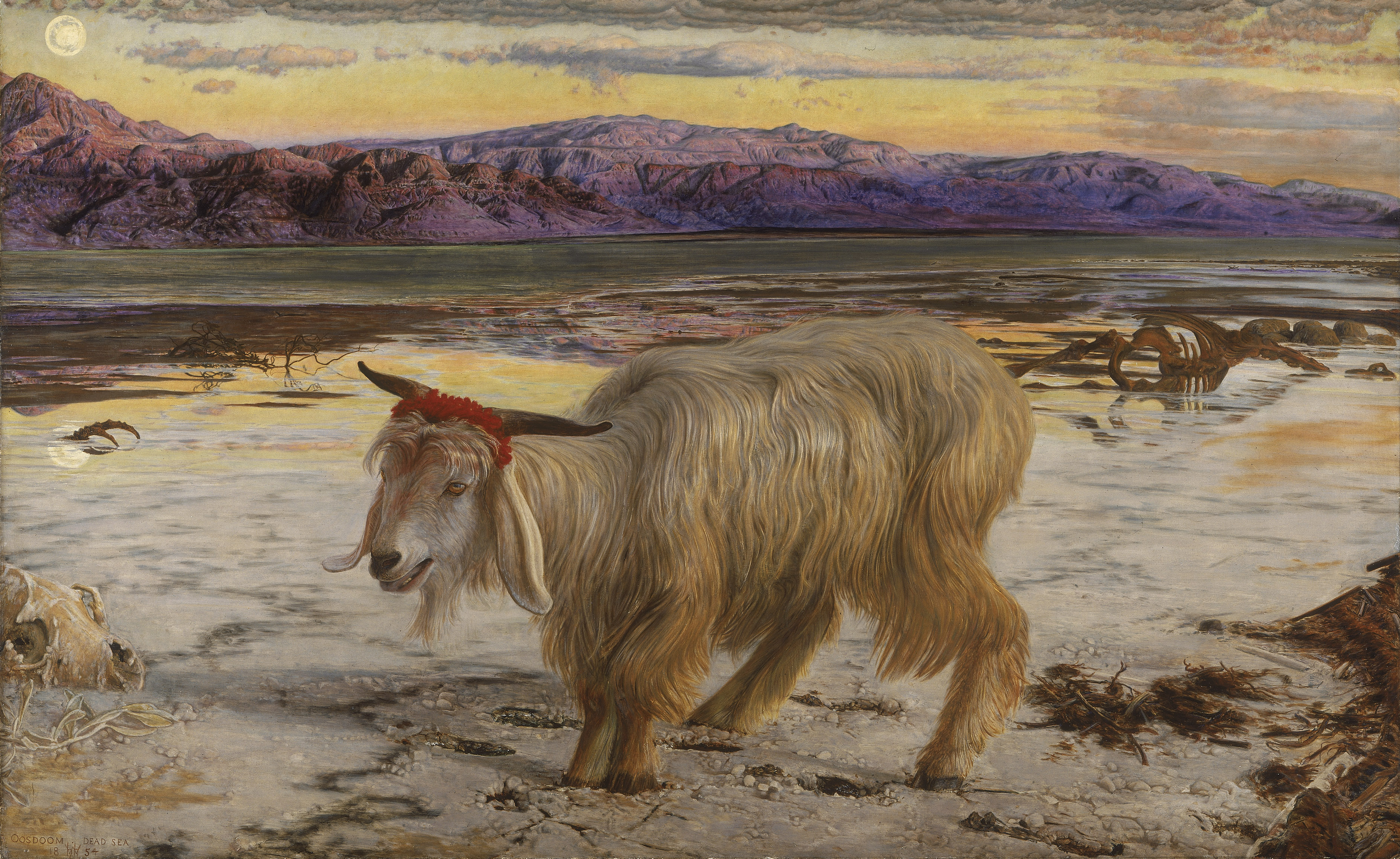
The Scapegoat by William Holman Hunt (1854-1856). Image Source: Wiki.

It is too simplistic to dismiss Heidegger's thoughts on being and time as aspects of the Nazi narrative. But it is also wrong to say that his ideas can be read separately from their Nazi context. Heidegger was in the same ballpark, and that demands a serious reappraisal of his ideas.

In building their Aryan mythology against the Jews, the Nazis ironically appropriated the Hebraic concept of scapegoating. The scapegoat was originally an early Archaic, pre-Classical improvement (dating from around the seventh century BCE) on the sacrificial rites of other ancient societies. Scapegoating, a mental gambit which is alive and well today, occurs when one projects one's sins onto a goat and sends it off into the desert to die; this leaves one free from blame and responsibility, and able to get on with life without feeling guilty for one's wrongdoings.

Wednesday, October 15, 2014

Counting Down to Hallowe'en: Howling Dogs and Flightless Moths


Image Source: Youtube.

Horror has a philosophical side. Western horror stories are usually social commentaries, not that different from morality plays of the middle ages. A regular at Scans Daily remarked: "a lot of horror ... raises the question of 'Who is the real sick man ... in this so-called society?'"

In Asia, there is a greater sense of continuity between non-being, being and death, so hungry ghost stories often involve reincarnation or karma (see related posts here and here). You can find no better blend of eastern and western traditions than the ghost stories of Lafcadio Hearn (1850-1904), an American who lived in Japan. I have previously mentioned his 1899 collection of ghost stories (which you can read online here) in this post.

Sometimes, the bridge between different human traditions is a non-human perspective. Other creatures bear witness on the other world, or afterlife, or the paranormal world beyond our senses. Youtube has many videos made by dog owners who claim that their dog can see a ghost.

Lafcadio Hearn came to the conclusion that domesticated creatures' lives are so intertwined with human lives that they, with their fundamentally different ways of being, mirror some of the things we cannot understand about ourselves and our existence. These creatures are so tied to us that they mirror these hidden truths within the human space. Our pets also perceive some of the things we cannot usually sense - including, in Hearn's view, ghosts.

The alien familiarity of silkworm moths (Bombyx mori); cultivated for over 5,000 years in China (possibly since the end of the Neolithic Age) to produce silk, the insects no longer exist in the wild. They can't fly and are completely dependent on humans in order to eat and survive. Image Source: Science Image.

If you don't want to read Hearn's stories, you can hear them below the jump. They have been prepared as an audiobook by LibriVox recordings. It is not shock or gore and can seem dry, but if you have time to listen to this video, In Ghostly Japan conveys the real meaning of horror. Hearn ponders mundane subjects, then veers off into horror, relating it to life's greatest mysteries and philosophical questions in a mind-blowing, sometimes very scary way.

Sunday, September 7, 2014

Blue Sunsets in Crimson Skies


A blue Martian sunset in a red sky, photographed by Mars Pathfinder (August 1997). Image Source: NASA via Wiki.

Are you sick of the world's turmoil? Take a fresh perspective and go off world. What does the night sky look from the surface of Mars? Are the constellations different? Does astrology change? Below, see more Martian sunsets and the view of one of the Martian moons, Phobos, from the surface of the Red Planet. The sky on Mars, like the soil or regolith, is orange. At sunset, the sky turns crimson. Sunrises and sunsets are blue. Wiki:
Around sunset and sunrise the Martian sky is pinkish-red in color, but in the vicinity of the setting sun or rising sun it is blue. This is the exact opposite of the situation on Earth. However, during the day the sky is a yellow-brown "butterscotch" color. On Mars, Rayleigh scattering is usually a very small effect. It is believed that the color of the sky is caused by the presence of 1% by volume of magnetite in the dust particles. Twilight lasts a long time after the Sun has set and before it rises, because of all the dust in Mars's atmosphere. At times, the Martian sky takes on a violet color, due to scattering of light by very small water ice particles in clouds.
On Mars, the Earth appears as the 'morning star' and 'evening star,' just the way Venus appears to us before sunrise and sunset. Our planet is the second-brightest object in the Martian night sky. From Mars, you can also see the Terran moon:
An observer on Mars would be able to see the Moon orbiting around the Earth, and this would easily be visible to the naked eye. By contrast, observers on Earth cannot see any other planet's satellites with the naked eye.
The Martian sky at noon is yellow-brown, imaged by Mars Pathfinder (June 1999). Image Source: NASA via Wiki.

Martian sunset at Gusev Crater, photographed by Spirit rover (May 2005). Image Source: NASA via Wiki.

Saturday, July 19, 2014

History in the Echo Chamber


Erasures from history are hallmarks of dictatorships. Image Source: Business Insider.

History is up for grabs. In the malleable global media, parts of history are being denied, erased or changed beyond recognition to suit new agendas. What is being changed, by whom, and where it is happening, all foreshadow coming trends in politics and daily life.

Sunday, July 6, 2014

Bitcoin: Economy of the Eternal Now


De Oude Beurs, Antwerp, Belgium (Urbex photo of the ruins of the world's first modern stock exchange, Antwerp).

In May, I chatted with Chris Ellis, aka ChrisJ of Feathercoin, about how cryptocurrencies could change global economics and society (see my earlier related post here). What follows today is not exactly an interview, but reflections on some of the things we discussed. We talked mainly about Bitcoin. But one senses that it is Ellis's work on Feathercoin - an altcoin established on 16 April 2013 and originally developed by Peter Bushnell at Brasenose College, Oxford - that brings Ellis to some of Bitcoin's biggest questions, and indeed, to some of the biggest questions surrounding all cryptos.

For Ellis, an economy is a system of how we define ourselves in relation to time. In a June 2014 interview, he noted Mike Maloney's remark that the ultimate form of money is time, the ultimate irreversible transaction.

Bitcoin is above all a technology of its blockchain, a time-stamped ledger either of economic transactions, or of interactions in Bitcoin's non-currency applications. According to Ellis, Bitcoin is really "a great big unstoppable clock." And that means that Bitcoin represents a watershed moment, the start of a change in how we understand time technologically, economically, socially and culturally.

Sunday, May 25, 2014

Buddhist Time: Being and Non-Being


Image Source: Jewcy.

The renowned Vietnamese Zen Buddhist monk and teacher Thích Nhất Hạnh has gained fame lately on the Internet. Now in his late eighties, he has been a well-known figure since the 1960s. He met Martin Luther King, Jr. on a trip to the United States in 1966; in a recent interview, he told Oprah Winfrey that when he heard of King's assassination, he lamented: "When I first heard of his assassination, I could not believe it. I thought that the American people have produced King, but are not capable of preserving him." On the basis of that collective lapse, the great African-American leader passed from our world. And we may well ask why this was so. How do societies become obsessed with death and power? What values might undo that obsession?

In the video below the jump, see a teaching from Thích Nhất Hạnh in which he questions the western emphasis on duality, on being and non-being. He questions our understanding of time based on birth and death and rather stresses life in the present moment, flowing on a long line of endless continuity. It is a completely different vision of time from tech-driven Millennial urgency. The latter gobbles up time, keeps people in a constant state of near-hysterical desperation and stress, with endless demands from mechanized standards of productivity and a corresponding devaluation of life and accomplishment.

The conviction that we have little time before we permanently expire creates ambition, economic growth and expansion, as well as the extreme stresses in western thought and culture. As a book on the same subject, Towards Non-Being (2005) suggests, this highly-strung attitude toward time pre-dates the Technological and Communications Revolutions:
Towards Non-Being presents an account of the semantics of intentional verbs such as ‘believes’, ‘fears’, ‘seeks’, and ‘imagines’. It tackles problems concerning intentional states which are often brushed under the carpet, such as their failure to be closed under deducibility. Drawing on the noneist work of the late Richard Routley (Sylvan), the book proceeds in terms of objects that may be existent or non-existent, at worlds that may either be possible or impossible. Since Russell, non-existent objects have had a bad press in Western philosophy. Th[is] book mounts a full-scale defence, and in the process, offers an account of both fictional and mathematical objects as non-existent.
The western dualistic mindset creates never-ending battles between opposing world views, between religiosity and atheism, between belief in non-existent objects and existent objects. The line between life and death is a line drawn in the sand; and that line is the origin of western politics and worldly power. The message is: You have no time; carpe diem. Casual searches on google reveal the correlation between this view of time and extreme profit, competition and aggressive expansion.


Image Source: Shutterstock.

Image Source: acentejokids.

Image Source: Deacon's Wife.

For example, the works of the English bard, William Shakespeare, focus on the problem of fleeting time before inevitable death and obliteration from this existence (see my post on this here, and a great reading from The Tempest, here). Take the speech from Macbeth, which indicates a pit of western nihilism and despair beneath this central problem:

She should have died hereafter;
There would have been a time for such a word.
Tomorrow, and tomorrow, and tomorrow,
Creeps in this petty pace from day to day,
To the last syllable of recorded time;
And all our yesterdays have lighted fools
The way to dusty death. Out, out, brief candle!
Life's but a walking shadow, a poor player
That struts and frets his hour upon the stage
And then is heard no more. It is a tale
Told by an idiot, full of sound and fury
Signifying nothing.
— Macbeth (Act 5, Scene 5, lines 17-28)

Important modern texts in this tradition include Martin Heidegger's Sein und Zeit (1927; Being and Time) and Jean-Paul Sartre's L'Être et le néant : Essai d'ontologie phénoménologique (1943; Being and Nothingness: An Essay on Phenomenological Ontology). There have been other attitudes toward time, being and consciousness in the west which were more forgiving and humane. But even the central value of western creativity, expressed directly below, still rests on an inflexible idea that time is carved into two worlds of being and non-being.

Image Source: Status Mind.

For the famous Vietnamese monk, existence and non-existence are false categories. Birth and death are a game of hide and seek. And to consider a non-being object as non-existent is "unjust." Thích speaks of a flame of non-being which manifests, then no longer manifests, according to worldly conditions, but never actually ceases to be; he gently dismisses Shakespeare's obsession with life and death:
When conditions are sufficient, I manifest. You cannot qualify me as a non-being before the manifestation and you cannot qualify me as a being after the manifestation. ... [Of a dead loved one:] Darling, I have gone nowhere. Because conditions are not sufficient, I have simply stopped my manifestation. ... There is no coming, no going. It means the notion of being and non-being cannot be applied to reality. ... To be or not to be - that is not the question. ... [There is] no birth no death. [And when the flame reappears:] I am not the same flame as the one you saw last time, but I am not a totally different flame, either.
Thích Nhất Hạnh's main remarks on this idea appear in the first half of the video below the jump. The latter half of the video is religious and ceremonial.

Wednesday, May 7, 2014

Meta-Time Lapses: Faking History for a Good Cause


The actress in Fund B92: One photo a day in the worst year of my life. Image Source: Best Ads on TV.

The blog is back from a break! I'm still facing work demands, so this blog will feature new posts on Mondays only until those demands clear. This blog has profiled the work of Noah Kalina (here and here), one of the original Millennial film-makers to take a photo of himself every day over a long period of time and turn it into a compressed flip-book video. The technique was also explored in the pre-Internet Age. Lately, the time-lapse-on-Youtube meme has become a meta-meme, where the time lapse the film-maker depicts isn't a real history, but a staged one.

In an earlier post on a time lapse video created by Ben Blennerhassett, the lines between history and metahistory began to blur. What happens to the higher integrity of reality when technological interpretations dominate how we think? Manipulated depictions of reality become subject to the conventions of fiction:
If we turn our lives into videos and self-marketing film sequences, will these works become subject to the tropes of cinematic narratives? Will these Millennial documentaries of the Self be viewed with the same expectations that we bring to watching movies?
We are on the edge of not minding that distinction between history and cinema. Will faked accounts of reality become more important or more credible than reality?

B92's staged domestic abuse still. Image Source: De Wereld Morgen.

A good example came in the faking of history for a good cause. In March 2013, a time lapse video entitled One photo a day in the worst year of my life went viral. Created in Belgrade by B92 and Saatchi & Saatchi, it depicts a woman who has been repeatedly assaulted by her boyfriend. Viewers believed the video was real and it went viral. But the video was faked; it was a guerilla marketing campaign to promote awareness of domestic violence. Fund B92's video description and credits confirm the intentions behind this believable, yet fake, meta-history:
Confronted by alarming statistics on domestic violence in Serbia we created PSA to shake public out of lethargy and put this issue into focus of society. Idea: Use YouTube’s popular format in which a person takes one photo every day, but with a twist. Result: In less than a week, video hit 3 million views and entered top 5 most popular videos on YouTube. It generated tens of thousands of comments and extensive global media coverage.
Executive Creative Director: Veljko Golubovic
Creative Director: Zarko Veljkovic
Associate Creative Director: Dragana Petkovic
Managing Director: Sonja Milovic
Account Manager: Zorica Marjanovic
Agency Producer: Ivan Zornic
Designer: Ana Cvetkovic
Planner: Tatjana Milnovic
Published: March 2013
See the video below the jump.

Friday, January 24, 2014

Evolutionary Babylon


"A rainbow-colored beast from the margins of a fifteenth-century text." Image Source: Public Domain Review via Paris Review.

The Justin Bieber mugshot is already an Internet meme (do not click here or here and don't don't don't click here (told you not to)). Fortunately, there are other things to think about, like the origins of life. Jeremy England, a 31-year-old physicist at MIT, thinks that he has identified the physics that underlies the difference between inanimate and animate matter. The thermodynamic theory, which complements Darwin's theory of evolution, is outlined in Quanta Magazine, and summarized below the jump.

The Hanging Gardens of Babylon, with the Tower of Babel in the background ("probably 19th century after the first excavations in the Assyrian capitals"). Image Source: Wiki.

Already, critics are queueing to attack England's ideas. But is this simply because his concept has appeared in many guises, to researchers working in various fields, each of which has a field-specific language and set of research precedents? Is the theory of the origin of life a modern Tower of Babel?

Tuesday, January 7, 2014

The Problem with Memory 9: Remembering to Predict the Future


Image Source and © Traer Scott Photography.

Researchers at the Donders Institute for Brain, Cognition and Behavior at Raboud University Nijmegen in the Netherlands are studying how to erase painful memories which are the main symptoms of Post-Traumatic Stress Disorder. On 22 December 2013, Time reported that the Dutch researchers found that specific and recent bad memories could be targeted and erased with shock treatments. But they have not established that entrenched negative memories, typical in PTSD sufferers, could be so treated.

Image Source and © Traer Scott Photography.

This post and this post noted similar memory-erasing research currently undertaken in California and Massachusetts. All of these concepts recall the grotesque treatment dramatized in the 2004 sci-fi film, Eternal Sunshine of the Spotless Mind. Some researchers find the notion of erasing memory to be "too invasive"; they are instead trying to decouple memory from associated negative emotions. And they acknowledge that erasing negative memories of important events is akin to erasing the primary sources of history:
Elizabeth Phelps, professor of psychology and neural science at New York University ... and other researchers have previously used far less invasive techniques to reduce the emotional charge attached to a memory— rather than eliminating the memory itself. For example, one study exposed participants to smells paired with shocks and then wafted the same scents into their noses as they slept.  The volunteers didn’t forget which scent was linked with the shock— but they no longer had a fear response to it. “If you could take away the fear associated with the memory and keep the memory, that would be more optimal,” she says.

[T]he potential uses of a technique that erases personal memories raises profound ethical questions. Our memories are deeply related to our selves and many survivors of trauma get a sense of meaning and purpose from knowing what they have conquered. If negative or challenging memories are selectively removed, what would they leave behind?

“What if we wiped out all of the memories of the Holocaust?” asks Greely, “That would be terrible.  On the other hand, the suffering caused by some memories is really powerful and I would want to prioritize letting people who want to relieve their suffering, as a general matter, relieve their suffering.”

Friday, November 15, 2013

Boomer Legacies: Waking Up from Decades of Dreamsleep


Nostalgic revivals come in cycles, and it looks like the mid-1970s to mid-1980s are returning, at least for some. Noted Baby Boomers who are currently in their sixties are talking about memoirs, sequels and anniversaries.

Sunday, September 15, 2013

A Year in the Life of a Tree


The Denver Post reports on a man who photographed a Bur Oak every day for one year and posted the photos on Facebook; he started on 24 March 2012. His experience showed that the simple act of slowing down and carefully looking at one other living thing can change one's whole perception of the world:
There is a tree that stands alone among the cornfields - about 5 miles south of Platteville, Wisconsin in the southwest corner of the state. Photographer Mark Hirsch drove by it almost every day for 19 years and never once stopped to take a picture. Then one day, he did. ...
“It was never easy and it never came naturally,” writes Hirsch. “But when I found that scene, situation or moment that made me comfortable that I had made a worthy picture for the day, it was incredibly rewarding personally. At some point, I really began to appreciate the contemplative nature of my visits to that tree.”
At first mention, a year in the life of a tree might not immediately sound interesting, visually or otherwise. Hirsch’s pictures, however, uncover a complex web of life and color surrounding the tree.
“I would describe that Tree as I would a friend,” writes Hirsch. “My initial description a year ago would have been as simple as a tree in a corn field, but now I would describe it as a tree of life in its own realm.”
“I was never very good at slowing down but I am now. I’ve learned to see things differently. And I’ve embraced an incredible appreciation for the land in and around that tree.”
By the 365th day, the project had become so renowned on Facebook that "on March 23, 2013, Hirsch took the last official pictures of the project ... [and a]lmost 300 people (and 12 dogs) showed up for a group photo under the branches of that tree [below]. Some devoted fans even drove in from Milwaukee, Chicago and northern Minnesota to be in the picture." See some of the photos below the jump, more or less in chronological order from spring 2012 to spring 2013 (they are taken from the Denver Post report or from Facebook); and the Facebook page with the full album here. Hirsch also published his photos in a book. All photos are © Mark Hirsch and are reproduced here under Fair Use for non-commercial review and discussion.

Group photo (23 March 2013), last day of the project.