TIMES, TIME, AND HALF A TIME. A HISTORY OF THE NEW MILLENNIUM.

Comments on a cultural reality between past and future.

This blog describes Metatime in the Posthuman experience, drawn from Sir Isaac Newton's secret work on the future end of times, a tract in which he described Histories of Things to Come. His hidden papers on the occult were auctioned to two private buyers in 1936 at Sotheby's, but were not available for public research until the 1990s.


Friday, July 6, 2012

He is Immortal


Today is the 50th anniversary of the death of the great American writer, William Faulkner. Above, his 1949 Nobel Prize in Literature acceptance speech, delivered in 1950 (Hat tip: Open Culture, Maria Popova of Brain Pickings). You can read a slightly different draft of the speech here. Faulkner spoke on overcoming soullessness in order that humankind could find eternity through transcendent creativity. An excerpt:
Our tragedy today is a general and universal physical fear so long sustained by now that we can even bear it. There are no longer problems of the spirit. There is only the question: When will I be blown up? Because of this, the young man or woman writing today has forgotten the problems of the human heart in conflict with itself which alone can make good writing because only that is worth writing about, worth the agony and the sweat.

He must learn them again. He must teach himself that the basest of all things is to be afraid; and, teaching himself that, forget it forever, leaving no room in his workshop for anything but the old verities and truths of the heart, the old universal truths lacking which any story is ephemeral and doomed - love and honor and pity and pride and compassion and sacrifice. Until he does so, he labors under a curse. He writes not of love but of lust, of defeats in which nobody loses anything of value, of victories without hope and, worst of all, without pity or compassion. His griefs grieve on no universal bones, leaving no scars. He writes not of the heart but of the glands.

Until he relearns these things, he will write as though he stood among and watched the end of man. I decline to accept the end of man. It is easy enough to say that man is immortal simply because he will endure: that when the last ding-dong of doom has clanged and faded from the last worthless rock hanging tideless in the last red and dying evening, that even then there will still be one more sound: that of his puny inexhaustible voice, still talking. I refuse to accept this. I believe that man will not merely endure: he will prevail. He is immortal, not because he alone among creatures has an inexhaustible voice, but because he has a soul, a spirit capable of compassion and sacrifice and endurance. The poet’s, the writer’s, duty is to write about these things. It is his privilege to help man endure by lifting his heart, by reminding him of the courage and honor and hope and pride and compassion and pity and sacrifice which have been the glory of his past.

Lovecraftian Heat Wave Film Night

Image Source: Tentaclii.

Heat waves, according to a 2008 Australian article in the journal, Environmental Health Perspectives, predispose "individuals [in temperate climates] to heat-related morbidity and mortality." The researchers continue:
Above a threshold of 26.7°C, we observed a positive association between ambient temperature and hospital admissions for mental and behavioral disorders. Compared with non–heat-wave periods, hospital admissions increased by 7.3% during heat waves. Specific illnesses for which admissions increased included organic illnesses, including symptomatic mental disorders; dementia; mood (affective) disorders; neurotic, stress related, and somatoform disorders; disorders of psychological development; and senility. Mortalities attributed to mental and behavioral disorders increased during heat waves in the 65- to 74-year age group and in persons with schizophrenia, schizotypal, and delusional disorders.
Similarly, Canada's Metro News, commenting on a severe Ontario heat wave this week that will push humidex temperatures over 40°C [104°F], notes that humidity hampers cognition and "[w]hen temperatures climb past the high 30s [90s°F], the brain can become stressed and chemically imbalanced, leading to anxiety, depression, and even aggression." According to the Canadian Mental Health Association, Canadians are more likely to commit suicide in July and August than at any other time of year. For people living in or near Colorado or other western American states, ongoing heat-wave-sparked wildfires are doubly dangerous and stressful.

This may be why some of the most dramatic and cathartic story-telling is reserved for these conditions. Film noir thrillers and pulp horror stories are often set in sweltering urban heat waves (see my earlier posts on heat waves here and here).

Maybe a little dip into the watery subconscious will help. Nothing says summer heat wave like Ph'nglui mglw'nafh Cthulhu R'lyeh wgah'nagl fhtagn. Below the jump, some B-movie adaptations of Lovecraft's works, including one about the fictitious Lovecraftian grimoire, the Necronomicon (Hat tip: Lovecraft eZine). For a post on real grimoires, see an interesting recent piece at Unsolved Mysteries in the World.

Photo of the Day: Melbourne Street Art

Image Source: Trendland.

This is an example of 1900-style street art (see more here) by Melbourne artist Stanislava Pinchuk, aka 'Miso' (thanks to -T.).

Thursday, July 5, 2012

Photos of the Day: Monopoly Street Art

All images source: This is Colossal.

This is Colossal reports that a street artist or group of street artists known as 'Bored' has begun turning the streets of Chicago into a real life Monopoly board (Hat tip: Roger Ebert).

Wednesday, July 4, 2012

Higgs Boson's Age of New Gods

Image Source: Spaceports.

Freedom. Today, one of the world's most powerful nations celebrates freedom and independence. It is no coincidence that the scientists at CERN in Switzerland chose today to announce the discovery of the Higgs boson particle, the so-called 'God particle,' in the Large Hadron Collider. The press conference (here and here) started live at 2 a.m EST.

In the United States, Fermilab's Tevatron collider was closed on 30 September 2011, after scant funding from the Obama administration. This is ironic, since the Tevatron lies outside Chicago. Although the Tevatron's discoveries contributed greatly to the understanding of particle physics, credit for finding the final part of the Standard Model goes to Europe. In the strain of competition, Tevatron's scientists announced more of their final results on 2 July 2012 (see reports here and here). They did not find the Higgs boson particle, but they got closer to it. American physicists will rejoice at this discovery in the name of their science. But in the name of their country, this is a disappointment for big American physics. It is therefore all the more ironic that CERN is announcing findings on 4 July. You can see popularly-renowned American physicist Brian Greene discuss the importance of this discovery and the post-Higgs world here (Hat tip: Spaceports).

Image Source: Wired.

For years, the Higgs particle has been a maddening hypothesis essential to proving the Standard Model. Today's experimental results placed the Higgs boson right on the line between the theoretical and the real. You can see a video of a 2011 CERN ATLAS proton collision here; ATLAS is one of two teams at CERN which have searched for independent confirmation of the Higgs particle. The other is CMS.

In the past week, the elusive particle's experimental confirmation was surrounded by blogging, rumours and leaks. BBC comments on how huge this discovery is:
A confirmation would be one of the biggest scientific discoveries of the century; the hunt for the Higgs has been compared by some physicists to the Apollo programme that reached the Moon in the 1960s.
Perhaps today's announcement is bigger than the moon landing. The Higgs particle delves into the fascinating mystery of the Big Bang. The particle emerged out of the imagination and mathematics, has entered confirmed reality, and now invites more abstractions. The discovery paves the way for another hypothesis, in effect opens the Pandora's Box of Supersymmetry (see here).

The particle accelerator at CERN. Image Source: Daily Mail.

And if the wildest promises of that Pandora's Box are true, this particle will open doors to new human pathways to understanding - a freedom and independence, if you will, from ignorance about the universe. The Standard Model might be resolved using Supersymmetry to conclude a Theory of Everything, a theory which eluded Albert Einstein.

Supersymmetry gives every last element of reality - from the tiniest sub-particle to the universe itself - a shadowy twin, a Doppelgänger. If the Higgs particle's discovery one day confirms this incredible hypothesis, it will serve as history's greatest metaphorical mirror. Supersymmetry could initiate a new era in human history, in which we can contemplate other dimensions, multiverses, and time travel as realities, not as mere speculations in science fiction.

But it just so happens that Doppelgänger and twin aspects giving way to triple worlds are extremely popular at the turn of the Millennium. In other words, scientific discoveries shape culture as much as they grow out of culture.

Monday, July 2, 2012

Göbekli Tepe: The Divine Origins of Civilization?

"Now seen as early evidence of prehistoric worship, the hilltop site was previously shunned by researchers as nothing more than a medieval cemetery." Göbekli Tepe in November 2008. Image Source: Berthold Steinhilber via The Smithsonian.

In recent years, startling archaeological discoveries have indicated that human civilization is millennia older than we have long thought it is.  Case in point: Göbekli Tepe, a Neolithic santuary perched atop a hill in southeastern Anatolia in Turkey. This sacred place, with its megaliths and strange animal carvings, is 6,000 years older than Stonehenge. That makes Göbekli Tepe 11,000 to 12,000 years old. Wiki: "The site was most likely erected by hunter-gatherers in the 10th millennium BC and has been under excavation since 1994 by German and Turkish archaeologists. Together with Nevalı Çori, it has revolutionized understanding of the Eurasian Neolithic." It is considered by scholars to be one of the most, if not the most, important archaeological site in the world.

The site in 2011. Image Source: Teomancimit via Wiki.

Göbekli Tepe comprises twenty round structures - stone circles made up of edifices weighing dozens of tonnes - which took enormous effort to build. Then, strangely, the entire complex was buried by local people 2,000 years after it was constructed, around 8,000 BCE. This is somewhat equivalent to ancient Egyptians burying the pyramids. That act adds to the questions and a dark mystery surrounding the site's purpose. Why cover up something so spiritually significant? To our mindset, it would suggest the site was cursed; some have linked it to the Garden of Eden and Cain and Abel stories in the bible. Its lead archaeologist has called Göbekli Tepe not the 'Garden of Eden,' but the 'Temple of Eden.' One theory suggests that the burial reflected a great conflict between the dying hunter-gatherer society and a rising agricultural society, indicated by evidence of mass human sacrifices in the nearby Stone Age village of Caynou. If the place was cursed, what does it mean that it is now being unearthed around the turn of the Millennium?

Only four of the site's monolithic circles have been excavated. The German archaeologist who has worked the site since the mid-1990s is Klaus Schmidt of the German Archaeological Institute (Deutsches Archäologisches Institut); he believes these structures constituted the world's oldest known, and possibly first, temple. He calls it, "the first human-built holy place." He bases this conclusion on the fact that there is no evidence that people lived at the site, even though it looked over what was once a fertile valley:
Prehistoric people would have gazed upon herds of gazelle and other wild animals; gently flowing rivers, which attracted migrating geese and ducks; fruit and nut trees; and rippling fields of wild barley and wild wheat varieties such as emmer and einkorn. "This area was like a paradise," says Schmidt, a member of the German Archaeological Institute. Indeed, Gobekli Tepe sits at the northern edge of the Fertile Crescent—an arc of mild climate and arable land from the Persian Gulf to present-day Lebanon, Israel, Jordan and Egypt—and would have attracted hunter-gatherers from Africa and the Levant. And partly because Schmidt has found no evidence that people permanently resided on the summit of Gobekli Tepe itself, he believes this was a place of worship on an unprecedented scale—humanity's first "cathedral on a hill."

Schmidt says the monuments could not have been built by ragged bands of hunter-gatherers. To carve, erect and bury rings of seven-ton stone pillars would have required hundreds of workers, all needing to be fed and housed. Hence the eventual emergence of settled communities in the area around 10,000 years ago. "This shows sociocultural changes come first, agriculture comes later," says Stanford University archaeologist Ian Hodder, who excavated Catalhoyuk, a prehistoric settlement 300 miles from Gobekli Tepe. "You can make a good case this area is the real origin of complex Neolithic societies."

What was so important to these early people that they gathered to build (and bury) the stone rings? The gulf that separates us from Gobekli Tepe's builders is almost unimaginable. ... The [standing stones are] utterly foreign, placed there by people who saw the world in a way ... [we] will never comprehend. There are no sources to explain what the symbols might mean[, according to] Schmidt ... . "We're 6,000 years before the invention of writing here," he says.
In other words, Schmidt hypothesizes that religious worship came before agriculture in the development of civilization. It was worship that impelled people to settle in order to build holy sites. And out of that settlement came domesticated animals and agriculture, the need to have captive and controlled sources of food. Thus, Stone Age peoples did not foresake hunting and gathering simply in order to settle down. They did so for a greater goal of appealing to their gods, of giving deities physical form and building a place where spirits could live, and be visited by passing hunter-gatherer bands.

The  carved beasts in this complex are not the ones associated with farming, but rather frightening creatures: lions, boars, spiders, vultures, snakes and scorpions. Perhaps it was a location where prehistoric peoples could conquer their fears. It might be a burial mound for as-yet-undiscovered warriors, or the centre for a death cult.

This interpretation means that Göbekli Tepe was a spiritual waystation, a holy pit stop on a nomadic circuit. It is as startling a vision of the deep past as it is revolutionary. It means that prehistoric human worship, the need to capture the unknown, may be the oldest of higher human impulses. That impulse may even predate spoken language, let alone written language, by several millennia.

"According to archaeologist Klaus Schmidt, 'this is the first human-built holy place.'" Göbekli Tepe in November 2008. Image Source: Berthold Steinhilber via The Smithsonian.

Because this is a civilized, non-settled Stone Age site which predates the invention of agriculture and writing (normally taken as the civilization's starting points), Göbekli Tepe is a magnet for Millennial mythology-mongers and conspiracy theorists.

Göbekli Tepe particularly lends itself to the Millennial alien astronaut concept. American journalist Linda Moulton Howe just visited the site. She marries Schmidt's stunning archaeological work to Internet-driven Millennial crypto-mystery-making. The Examiner reports that Moulton Howe thinks that structures at the site were parts of an alien machine, incredibly surrounded by vibrating pillars. Her wild theories are an example of the current symbols and metaphors which people use to make the inexplicable make sense.

Göbekli Tepe in November 2008. Image Source: Berthold Steinhilber via The Smithsonian.

"An arm, a fox and other strange carvings adorn stones at Turkey's Gobekli Tepe."
Göbekli Tepe in November 2008. Image Source: Berthold Steinhilber via The Smithsonian.

Sunday, July 1, 2012

Ancient Cities 4: Khirbet Qeiyafa

 Khirbet Qeiyafa. Image Source: Times of Israel.

Did the ancient land of Israel exist? Archaeologists have debated this question for decades. Of course, their findings have political implications in today's Middle East and their debates may well be influenced by those implications. Now, a dig at the ancient city of Khirbet Qeiyafa is providing a 3,000 year old history lesson on the past - and the present.

On 8 May 2012, archaeological finds 15 miles southwest of Jerusalem seemingly confirmed the existence of the biblical figures King David and King Solomon. The confirmation rests on excavations at Khirbet Qeiyafa (which may have been the biblical city of Sha'arayim or Neta'im), dating back to the 10th century BCE.

Most notably, reports suggest that model shrines discovered at Khirbet Qeiyafa were meant to represent Solomon's Temple, the original home of the Ark of the Covenant. Carbon dating places these relics within the time frame of biblical accounts of David's kingdom. Not only is the timing correct, but the relics potentially support the possible existence of a Jewish realm with a dedicated religion. Then there is the already-observed fact that Khirbet Qeiyafa was a walled city, indicating that it was a town within a larger polity with a centralized administration.  Live Science:
For the first time, archaeologists have uncovered shrines from the time of the early Biblical kings in the Holy Land, providing the earliest evidence of a cult, they say. ... Excavation[s] ... have revealed three large rooms used as shrines, along with artifacts, including tools, pottery and objects, such as alters associated with worship.

The three shrines were part of larger building complexes, and the artifacts included five standing stones, two basalt altars, two pottery libation vessels and two portable shrines, one made of pottery, the other of stone. The portable shrines are boxes shaped like temples.

The shrines themselves reflect an architectural style dating back as early as the time of King David (of the biblical David and Goliath story), providing the first physical evidence of a cult in the time of King David ... . Radiocarbon dating on burnt olive pits found in the ancient city of Khirbet Qeiyafa indicate it existed between 1020 B.C. and 980 B.C., before being violently destroyed. ...

[Lead archaeologist Yosef] Garfinkel suggests some of the features and styles of the structures appear analogous to those described in the Bible. For instance, one of the shrines, the clay one, is decorated with ...two pillars ... . The two pillars are suggestive, he said, of Yachin and Boaz described in the Bible as belonging to Solomon's Temple.
The Temple's two pillars - which  Garfinkel associates with the portable shrines - represented the Pillars of Creation, the Trees of Eden. Also consistent with biblical accounts, according to Garfinkel, is the lack at Khirbet Qeiyafa of cultic figurines of animals and people, and the absence of pig bones at the site, indicating a religious dietary law against the consumption of pork.

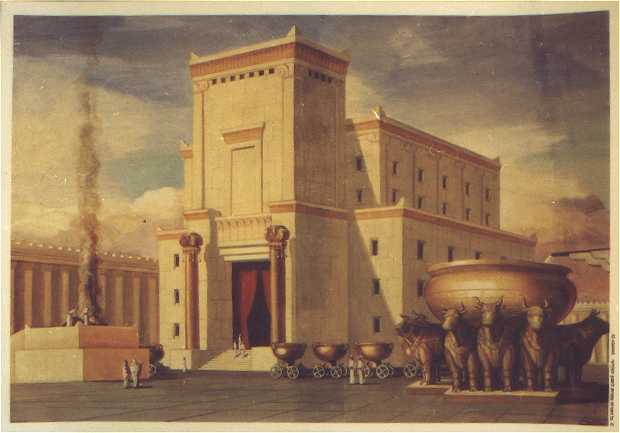
Depiction of Solomon's legendary Temple in Jerusalem. Image Source: King Solomon Legend.

Another imagining of the Temple of Solomon. Image Source: Imagebearer's Weblog.

"Yosef Garfinkel with a shrine model made of stone, found at Hirbet Qeiyafa." Image Source: Hebrew University of Jerusalem via Times of Israel.

Times of Israel describes the model shrines:
Model shrines of the type found at the site would have been used in ritual practice. One of the models, 8 inches high, is made of clay, and includes a main door and two pillars as well as decorative elements like two lions on the doorstep and three birds perched on the roof. Garfinkel suggested the pillars were suggestive of the ones known as Boaz and Yachin, which the Bible says existed in Solomon’s Temple. 
The other shrine, made of limestone and standing 14 inches high, includes stylized roof beams and a recessed doorway, which Garfinkel said could help settle disputes about how best to translate some of the Hebrew words used in the Bible to describe architectural elements of the Temple.

Leap Second

Image Source: Time.

On the night of 30 June 2012, the entire world gained one grain of sand in the hourglass - what is called a 'leap second' - one extra second in time in order to regularize sunsets. It seems negligible, but a second can change everything. See the report at Time here.