TIMES, TIME, AND HALF A TIME. A HISTORY OF THE NEW MILLENNIUM.

Comments on a cultural reality between past and future.

This blog describes Metatime in the Posthuman experience, drawn from Sir Isaac Newton's secret work on the future end of times, a tract in which he described Histories of Things to Come. His hidden papers on the occult were auctioned to two private buyers in 1936 at Sotheby's, but were not available for public research until the 1990s.


Friday, April 8, 2011

Nuclear Culture 4: Worlds within Worlds

Plutonium Abraxsis by Judson Huss. Image Source: Snippits and Snappits.

Middle Eastern and Japanese news stories are offshoots of the same problem. The past 230 years of modernization, running hand-in-hand with liberal democratization, meant that the great mass of people in developed societies gained standards of living way beyond a level they ever had. At the core of this nexus between industrial, technological and scientific advances, the rise in quality of life, and competing left and right wing political ideologies is one problem: energy.

Raising the bulk of the human population to this extent requires vast amounts of energy. Yet the sources we use bring many problems - ozone layers; global warming; strategic conflicts over oil; controversy over natural gas drilling; pollution; terrorism; despots and popular revolutions in the Middle East; and fears about nuclear safety and the weaponization of civilian nuclear materials - are we there yet? One of the most prescient science fiction novels of the 1960s was Frank Herbert's Dune. In a way, it's even more accurate than Orwell's Nineteen Eighty-Four, because it moved beyond the political world to the deeper problems of technological determinism. Herbert saw that we would biologically and genetically contort ourselves to match our primary energy source. He made it clear: we will do anything for energy. That is because with energy, we have the raw force to accomplish whatever we can imagine.


Yet we face a deeper quandary.  It comes from precisely that - from 'whatever we can imagine.' Critics dismiss the Atomic Age with three words.  Hiroshima. Nagasaki. Chernobyl. But as terrible as nuclear weapons and accidents are, they are inseparably part of the wellspring of Millennial creativity.  The discovery of radioactive elements in the 19th and 20th centuries opened the door to atomic theory and quantum physics; these doctrines fundamentally altered our vision of reality, which had previously remained essentially unchanged since the Ancient Greeks. It's a sea change in perspective that no one can escape.

Laugh of the Day


Even the Watchmen, a famously grim comics series about the countdown to a nuclear holocaust, has been spoofed to have its lighter moments. Here's a brief respite from the nuclear news (image sources: here, here, here and here).

Thursday, April 7, 2011

Nuclear Culture 3: America's Radioactive Superheroes


In the list of superhuman qualities, perhaps the most enduring are those derived from radiation.  The incredible power from our Sun has long spawned divine myths around our star.  Twentieth century science contributed a number of themes to this ancient archetype: evolution, radiation's effect on DNA, splitting the atom, nuclear power.  This is explained in a piece on nuclear accidents and the rise of the modern superhero on Boing Boing:
In the first part of the 20th century, the evolutionary scientists were expressing the idea that maybe cosmic radiation, which we've lived with on earth for our whole history, might have caused some changes to our DNA. Radiation can do that. At the same time, people were learning about evolution, which depends on random changes. I think that caught their imagination. That connection between radiation and evolution. I remember one of the earliest stories I read where they put this guy into a chamber and irradiated him, and he evolved before their eyes. Really he would have just died, but the idea remains.
Superman, Spider-Man, Captain Atom and Doctor Manhattan are all examples of Nietzsche's Übermensch; sometimes they have Messianic qualities; or they are scientists, caught in a nuclear accident; and sometimes they are Everyman figures who are suddenly raised above all others. Characters with similar origins include The Ray, Captain America, The Atom, X-Ray, the Nexus Fusionkasters and Apollo. All of them are anthropomorphized versions of qualities we attribute to the power of radiation, whether cosmic, solar, elemental or nuclear. Most of pulp fiction's characters respond to radiation by acquiring superpowers such as strength, energy manipulation and flight; but some endure a separation of body and soul by nuclear means. Some gain the ability to travel through time; and some achieve immortality. Below the jump are the most popular radiation-powered heroes in the order in which they historically appeared. In some cases, there are later versions of the same character.

Monday, April 4, 2011

Nuclear Leaks 2: Pickering, Ontario, Canada

A woman basks in the sun outside the Pickering Nuclear Plant, Ontario, Canada. Image Source: CTV News/CP/Kevin Frayer.

After the Japanese earthquake and ongoing problems with the Fukushima plant began last month, the Canadian authorities rushed to reassure citizens that Canada's nuclear sector is safe, with no reactors built on earthquake fault lines. Yet they had already launched a review of the state of atomic energy in the country before the Japanese disaster. Some older plants are being closed: Dalhousie University shut down its nuclear reactor and discreetly moved its uranium core from Halifax, Nova Scotia to an undisclosed federal facility in Ontario under cover of darkness in January, 2011.

The Canadian public remains jumpy.  Toronto newspapers report that there are calls to rethink a shift to nuclear energy.  For this post, I was going to cover the Chalk River medical isotopes plant that is north of Ottawa (Google has a timeline of incidents at that plant here), which featured Canada's only level 5 incident (the same level as Three Mile Island).  But unfortunately, there are news reports of something more pressing - a radioactive leak into Lake Ontario from the Pickering A plant - on 14 March 2011.

Sunday, April 3, 2011

Nuclear Culture 2: Radioactive Brand Names


When radium was first discovered, the element was considered to be a health booster. Due to this, radium and other radioactive materials were and have been added to many products from the late nineteenth century up to today. These elements were believed to improve vitality, cure impotence, and lately have even been labeled 'eco-friendly environmental products.' Because of the health-giving connotations initially associated with radioactivity, the terms 'X-ray,' 'radium,' 'atomic' and even 'uranium' or 'plutonium' were added to brands that had no such additives.  Here are some products that had no radioactive ingredients.  The early ones come from the high period of unstable elements, when radioactivity was used as a brand name and selling point, promising vitality and energy.  More recent products cryptically refer to these elements' originally-assumed health-giving properties (either through use on sports equipment or with promises of invigoration); new products also use radioactive elements' names to indicate very intense, glow-in-the-dark colours.  Finally, in some cases, atomic names have been used ironically by anti-nuclear activists. Regardless, the way these brand names were used tell us something about the qualities we have ascribed to radioactivity.

Saturday, April 2, 2011

Nuclear Leaks 1: Hanford


The GammaMaster: Japanese wristwatch and Geiger counter in one.  Image Source: MedGadgetCurrently sold out, the watch sells for USD $250 and was previously available out of Hong Kong.

Caption for the above photo: Leave it to the Japanese to integrate both a digital timepiece and a fully functional Geiger counter, all of it crammed into into a standard sized wristwatch. ... Feature-wise there are limits to what you can do in a wristwatch format. There's the time display in traditional dial analog format - it is a watch after all. For displaying radiation dosage, in addition to a digital display, the GammaMaster has an LCD analog display, which provides a visual indication of the current dose rate and cumulative dose. Both can be run in dosimeter mode or in survey meter mode.

Warning alarms can be set to indicate when a specified dose rate or cumulative dose is exceeded. Alarm settings are always displayed on the analog scales. Some minor negatives with the GammaMaster. For one, the radiation units of are in metric µSv/h and don't include mRems/hr, more commonly used in the U.S.

This month, I am doing a countdown to the anniversary of the Chernobyl disaster by highlighting nuclear accidents, leaks, tests and similar incidents that have occurred elsewhere in the world. If oil is the fuel of our present, nuclear power is - or seemed to be - synonymous with the future. Yet it is a future not of clean burning high-tech scientific efficiency, but one of apocalyptic consequences if mismanaged, damaged or disrupted. The operation systems of nuclear facilities are also vulnerable to computer hacker attacks (which I have blogged about here and here).

In the wake of the Japanese crisis at the Fukushima plants, the internet public is getting very jumpy. One of my friends described the slow burn that is wearing down our sense of well-being as an "apocalyptic pressure on the metaphorical inner ear." (Thanks, J.)  On Twitter, I notice that nerves are raw. On 17 March, @ozcanyuksek tweeted: "travellers from Japan have triggered the radiation detectors at Chicago's airport. Though the report does stress the levels were very low." Amid assurances that Japanese radiation fallout levels were low, @MorrisonMD remarked: "Worried about radiation from Japan coming to US? Vast majority will be dispersed, but take antioxidants & Vit C." On 23 March, Tomoko Hosaka commented: "More on Tokyo tap water. Expert: Stress people get from radioactivity is more dangerous than radioactivity itself." On 28 March, @leashless commented: "Insomnia and flashes of ill temper. I am subtly, but deeply, stressed." On 1 April, after Tokyo Electric had repeatedly made alarming comments about radiation levels, then retracted them, the company announced they were sending in a robot to find out the source of an unknown leak, which they later isolated on 2 April. By 1 April, there were alarms raised by "experts" - despite all previous claims that levels of radiation currently spreading globally from Fukushima were harmless - that the world food supply was threatened by Japanese fallout.  There is a low grade, growing background fear that reflects our helplessness and global connections back at us.

Radiation from radioactive elements - an invisible, little understood force that can kill you at high or prolonged doses - is, like petroleum, one of the millstones hanging around our collective necks from the twentieth century.  Nuclear power may not survive very far into Millennium if public opinion turns sharply against the industry.  Yet it has overcome serious incidents before, so it may continue, no matter how people feel about it.  This is the central, all-consuming problem of our times - how to create enough energy to fuel our global economy without destroying ourselves in the process.

Friday, April 1, 2011

Nuclear Culture 1: Healthy Radiation?


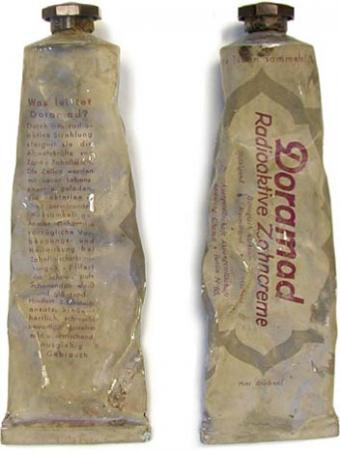
Caption for the above photograph: "Doramad was a toothpaste created in Germany in 1945. It was made by Auergesellschaft of Berlin, a company that was founded by the inventor of the gas lantern mantle, Carl Auer von Welsbach. On the back of the product’s tube it stated that ‘radioactive radiation increases the defenses of teeth and gums… cells are loaded with new life energy, the destroying effect of bacteria is hindered… it gently polishes the dental enamel and turns it white and shiny.’"

As part of nuclear-themed posts in the run-up to the Chernobyl anniversary on 26 April, this post covers radioactive elements in their heyday, right after they were first discovered.  There was a time when radiation from these elements was associated with the power of the sun - and the future.  As incredible as it may seem, radium, a highly radioactive element, was seen up to the middle of the last century as a health treatment.  Radium was discovered in 1898 by Maria Skłodowska-Curie and her husband Pierre. New World Encyclopedia: "It was once used in luminescent paints on watch dials, and in the early twentieth century it was added to products like toothpaste, hair creams, and certain foodstuffs, based on the belief that it had curative properties. These ... uses were discontinued when the adverse effects of radium were discovered." The following are pictures of actual products - from toys to suppositories - that were marketed as revitalizing, empowering or inherently fascinating because they were radioactive.

Tuesday, March 29, 2011

Prometheus Unbound: Fukushima Workers

Unbearable Lightness (2010) © by Elsilencio. Reproduced with kind permission.

The Wall Street Journal has reprinted some messages exchanged on 23 March between TEPCO workers regarding the conditions under which they are struggling to contain the problems at the Fukushima I and II nuclear plants.  They are heartbreaking reflections on drastic courage.  If you pray, remember these brave people in your prayers.  Remember them, even if you don't pray.  They are all that stands between us and disaster. They have been working incessantly since the earthquake on 11 March to stabilize the nuclear crisis. Incidentally, Fukushima (福島市) means good fortune island; let's hope that the place lives up to its name.

What follows below is quoted directly from the WSJ and all credit for translation and reporting belongs to them.  Note that the report does not fully clarify where the writers are referring to Fukushima I (the Dai-ichi plant) which is where the major problems are occurring - or to Fukushima II (the Dai-ni plant), which has been shut down.  But even then, at the Fukushima II Dai-ni plant, one worker died in a crane accident on 13 March and four others were injured, which tells you how desperate conditions are.