TIMES, TIME, AND HALF A TIME. A HISTORY OF THE NEW MILLENNIUM.

Comments on a cultural reality between past and future.

This blog describes Metatime in the Posthuman experience, drawn from Sir Isaac Newton's secret work on the future end of times, a tract in which he described Histories of Things to Come. His hidden papers on the occult were auctioned to two private buyers in 1936 at Sotheby's, but were not available for public research until the 1990s.


Tuesday, December 16, 2014

World War III of Material Consciousness


Image Source: Astroquest Astrology.

Some think history repeats itself; some think that it is a progress. Sometimes it involves transformation. Astrologers believe that we are undergoing the second last of seven fateful revolutionary celestial events, which have been jarring the world's destiny from 2012 to 2015. Specialists in this esoteric field refer to a so-called 'square' between mighty planets Pluto (underworld, reforged power, control, epiphanies and metamorphoses) and Uranus (invention, innovation, sudden change, surprises), which occurred on 15 December 2014.

Skyscript describes Pluto's symbolic energy as follows:
Sometimes considered a 'higher octave' of Mars, Pluto is similarly powerful and penetrating, but on an unconscious and psychological level. It gradually permeates the subconscious with its drives, leaving the conscious unaware until suddenly and explosively it emerges in an instinctive response that brings sweeping and often devastating change in the psyche and way of living. It can thus be a force for great personal good or ill. It evokes the principles of resurrection and determination, which when positively expressed bring resolution; when negatively expressed, coercion.

Pluto governs the conversion of apparent lost causes into successful projects, but at times the receding of objectives when their point of realisation seems imminent; cycles of death and rebirth; disregard for vested interests; extremes of good and bad (including luck); the frustration and annihilation of plans; idealistic socially motivated organisations; ideas ahead of their time; the inspiration to put an end to failing conditions; involvement in organised groups and movements desirous of social reconstruction, which may include altruistic interest groups, political parties and think tanks, professional associations and trade unions, and also gangs and underground organisations; the negation and transformation of conditions; non-recognition of the legitimacy or impositions of officially established authorities; righteous indignation on behalf of social causes; and the voluntary relinquishment of worldly interests in order to advance spiritual development, or of home, country or fortune for marriage. It manifests in writers and dramatists who seek to inculcate reformist doctrines into their literary works. It is compulsive, intense, and sometimes manipulative.
Click to enlarge. Image Source: Tarot.com.

Skyscript describes the significations of Uranus as follows:
Seen sometimes as a 'higher octave' of Mercury, Uranus enables communication without the conventional mechanism of speech and physical conduction methods. It is therefore associated with radio waves, electromagnetic radiation and electricity, and nuclear radiation. It evokes originality, which when positively expressed manifests as inventiveness; when negatively expressed, as deviance.

Uranus confers contempt for conventional conceptions of morality; distaste at being controlled and at arbitrary forms of outside authority; executive ability; flashes of intuition; perspicacious and reliable insight into others' personal motivations; interest in the principles of religion and science, and in scientific investigation of material phenomena; an inclination to part with customs; and mechanical ability that favours engineering. It is aloof; altruistic; cool; critical; crushingly assertive; conscious of personal authority and power; directed by inner impulses; eccentric; erratic; firm-opinioned; frequently fatalistic regarding personal destiny; heroic; iconoclastic; illuminating; imaginative; impersonal; impulsive; ingenious; insistent upon independence; innovative; inventive of new ideas, methods, moral codes and occupations; liberating; moved by new circumstances; off-hand; organising; peculiar; positive; persevering when faced with obstacles to surmount; power-conscious; promoting; prone to sudden changes of mind and view; prophetic; revolutionary; romantic; self-centred; self-reliant; spasmodic; spontaneous; unbendingly willful; unsentimental; variable; and violently reactive against potential privations of freedom of thought and action; but when restricted, potentially anarchistic; bohemian; eccentric; fanatical; and invective and sarcastic without provocation.

Uranus signifies everything anomalous or unconventional; and the sudden smashing and transformation of outdated established Saturnian structures and restrictions. It also signifies bereavements, blind impulses, catastrophes, changes (especially sudden changes), constructive and mechanical ability, enemies, estrangements, exiles, people in power or authority, public affairs, romances, sudden events, sorrows, suicides, tragedies, and uncertain fortunes.

The glyphs for Pluto and Uranus are noted at 90 degrees to one another in this depiction of the planetary square. Image Source: Lunar Planner.

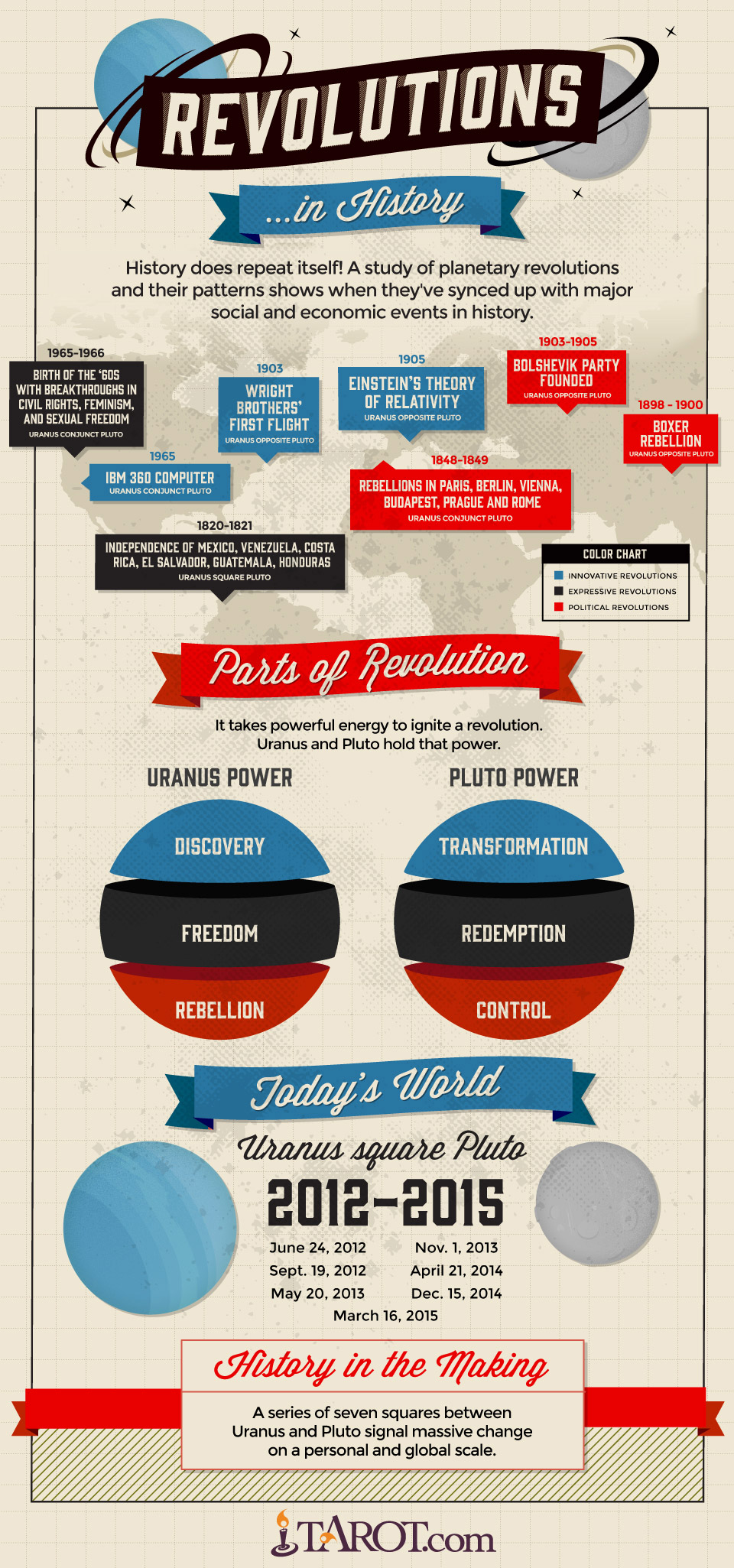
Astrologers believe that the same aspect - a conflict between power and innovation - affected other revolutions in history: Latin American independence in the 1820s; the 1848 revolutions; the Boxer Rebellion in China at the turn of the 19th-to-20th centuries; the first airplane flight of 1903; the founding of the Bolshevik Party, 1903; the Theory of Relativity of 1905; the first IBM computers of 1965; the social revolutions of the 1960s. It also appeared during the 1929 financial crash.

Image Source: Astroquest Astrology.

The astrological aspects are the same today as they were during the onset of World War II. However, the conflict now takes place in the realm of money and material consciousness, and governments are related insofar as their power hierarchies and economic systems are concerned. FemCentral considers the 2012-2015 Pluto-Uranus squares to be a World War III of finances, economic systems, our whole way of understanding money, materialism, and from that - our encrypted consciousness of the dividing line between the material and immaterial, which can involve religion:
Uranus was last in Aries from 1928-1935. This was the time of the Great Depression. Hitler. Rumblings of World War. During that period, Pluto was also square Uranus, as it is now. However, at that time, Pluto was in the sign of Cancer. It is currently in the sign opposite Cancer, which is Capricorn. ... I’m not predicting World War III. Yes, Uranus is in the same place it was in World War II, and it’s square Pluto, as it was then. But, Pluto was in emotional Cancer at that time. Now, it’s in the sign of tradition. Establishment. Money. This is what people are rebelling against. This is what will change.
From Astroquest Astrology:
I would suggest that by the time Pluto leaves Capricorn in 2022 we will have witnessed an entire change in our understanding of what it is that defines us and what it is that we hold dear and give 'value' to in life. This is the time when decadent regimes collapse and new ruthless regimes rise from the ashes. In the business world, many upheavals take place, as new business strategies replace the old economic models and business practices.

Uranus another outer planet, impersonal and inevitable in Aries will in 2012 be moving in and out of a square with Pluto, triggering many changes on a global level. ... Uranus and Pluto last squared each other in 1929 and we all know what happened in Wall St. then. Interestingly Uranus was also in Aries while Pluto was in Cancer, the sign opposite Capricorn where it is now. The Great Depression of the 30's had its biggest impact on families (Cancer) the concerns this time round are about governments defaulting and perhaps more banks collapsing (Capricorn). Interesting times!
There is a 2012 book on how the square pertains to the early teens of the 21st century: Uranus Square Pluto by Wendy Stacey. You can see the financial crash of 2008 further related to the square at Astroquest Astrology, here. Tarot.com comments on the 2012-2015 series of squares:
Some large institutions may fail, while other big corporate interests may consolidate and increase their power. We may witness political uprisings and social and religious revolutions. It could, in fact, mark an evolutionary leap for our entire species in terms of social and technological advancements.
Image Source: Universal Life Tools.

Universal Life Tools speaks similarly of this revolutionary aspect:
PLUTO in CAPRICORN is about inspiring major transformations in the hierarchical structures of governments, corporations & all those in places of power. ... ‘Pluto holds the vibration of transformation and evolution and Capricorn is about rolling your sleeves up and getting down to work… and together they influence the very foundations of governments, financial institutions, medicine, education… structures are/will break down in order to be rebuilt through evolutionary change’.

URANUS in ARIES is about rebellion against old paradigms and revolutionary change. ... ‘Uranus is the shake up planet governing revolution and evolutionary change…. exhilarating people to rebel against old fear based paradigms’.

When both PLUTO in Capricorn and URANUS in Aries square each other (sit at 90 degrees of each other on a 360 degrees astrological wheel ...) we are feeling an intense desire to rebel, revolt and not sit back and take it anymore.  We are so dissatisfied with the lies, deceit and propaganda, we just want to jump ship and start a new.   Yet at the same time, we know from a higher consciousness that running away is futile, as we need to work pro-actively to dismantle & tear-down and then rebuild, restructure and transform from the ground up.

In Addition to the Pluto/Uranus Square, on the 15/16 December 2014 Uranus is in opposition (180 degrees) to the MOON in LIBRA, and hence Pluto in Capricorn is SQUARING the MOON in LIBRA which together creates a Cardinal T Square. ... [T]he 15/16 December 2014 Cardinal T-Square will potentially create much emotional volatility and a strong impetus to break free from the perceive limiting restrictions of our social, political, hierarchical structures.  It may feel like a volcano is building inside of your as the intensity of the T-Square peaks on the 15/16 Dec. If you can hang in there and focus/build this intensity within, as we then come into the Summer/Winter Solstice on 21/22 December as the Sun moves into Capricorn,  combined with Uranus moving direct in our celestial skies, this will be the most effective time to channel these newfound inspirations from the T-Square and implement authentic steps in your life for personal and evolutionary change.
Wisdom of Astrology comments on the personal impact on individuals here, claiming that this 6th square and the December solstice will call on people to find balance in this conflict. We have to change, but what does that mean, exactly? The astrological predictions are fanciful and symbolic ways of describing the social, political and economic processes of change as well as individual experiences of those processes. We are confronted with the question: are we puppets fated by the universe, or agents of our destinies? How we transform ourselves will begin with a challenge to the financial system, and end with a personal exploration of the transition from the material and immaterial. This marks a realignment of priorities and approaches to material problems. Wisdom of Astrology argues that the end outcome of these speculations must involve an individual adoption of responsibility, a broad atomization of leadership:
This is the challenge of our times—to open to our own brilliance and re-create the world.  We have to become conscious co-creators of life—we have to consciously evolve ourselves and our society to the next stage of human awareness.  Facing what’s going on can’t make us so depressed that we give up and opt out.  That’s what patriarchy hopes we’ll do.  That’s a failure to evolve, because the next step for humanity is conscious community in the Age of Aquarius. We have to be living examples of those principles for the future good of our world.

... We have to face what’s happening in our world—face our collective choices of war and fear and of giving over power to our ‘new kings’—the corporations and banks.  If we withdraw our support from those corporate entities as much as possible, they will die out from lack of life.
To live our spiritual values means that we have to become social activists and live out our beliefs.  And so we become leaders in our own small way.  That is the Aquarian ideal, you know—everyone at the Round Table is equal, free and responsible for the collective welfare.
Image Source: FemCentral.

Friday, December 12, 2014

Look Skyward: The Geminids


Image Source: Space.com.

The nights of 12-14 December 2014 will see the height of the Geminid meteor shower, a brilliant display from an extinct comet, named for the son of the ancient Greek sun god. For a complete worldwide guide on watching these falling stars, go here.

A Geminid fireball over the Mojave Desert (2009) &copy: Wally Pacholka. Image Source: AstroPics / TWAN via Scibuff.

To see the meteors, look for the easy-to-spot constellation of Orion. The constellation of the twins, Gemini, is nearby, to the left of Orion. The meteors appear to originate from Gemini. The shower is known for its slow moving meteors and exciting fireballs. Space.com: "If you have not seen a mighty Geminid fireball arcing gracefully across an expanse of sky, then you have not seen a meteor," note astronomers David Levy and Stephen Edberg." NASA:
Geminids are pieces of debris from an object called 3200 Phaethon. Long thought to be an asteroid, Phaethon is now classified as an extinct comet. Basically it is the rocky skeleton of a comet that lost its ice after too many close encounters with the sun. Earth runs into a stream of debris from 3200 Phaethon every year in mid-December, causing meteors to fly from the constellation Gemini. ...

On Dec. 13, Cooke and a team of astronomers from Marshall Space Flight Center will host an overnight NASA web chat from 10 p.m. to 2 a.m. CST, answering questions about the Geminid meteor shower. The Geminids are expected to peak just before dawn on Dec. 14, with a predicted peak rate of 100 to 120 meteors per hour.

To join the webchat on Dec. 13, log into the chat page at: http://www.nasa.gov/connect/chat/geminids_2014.html

A few minutes before the chat, a chat window will be active at the bottom of the page.

In addition, a Ustream feed from a telescope at Marshall will be available: http://www.ustream.tv/channel/nasa-msfc
Space.com:
Even if you can't see the meteor display from your part of the world, you can watch them online. The online Slooh Community Observatory will host a live webcast of the Geminid meteor display on Saturday night beginning at 8 p.m. EST (0100 Dec. 14 GMT). You can also watch the Slooh webcast directly: http://live.slooh.com/. NASA meteor expert Bill Cooke will also host a live Geminids webchat on Saturday night from 11 p.m. to 3 a.m. EST (0400 to 0800 GMT), as well as a live webcast.

You can watch the webcasts of the Geminid shower live on Space.com, starting at 8 p.m. EST, courtesy of Slooh and NASA. The Italy-based Virtual Telescope Project will also host a Geminds webcast, beginning at 9 p.m. EST (0200 GMT).

Although the bright moon will be high in the sky by 11:30 p.m. local time Saturday (Dec. 13) (during the shower's peak), skywatchers can still catch a potentially incredible show before the moon creeps above the horizon, washing out the sky. Stargazers might be able to see an average of one or two Geminid meteors per minute Saturday before the moon rises.

By around 9 p.m., the constellation Gemini — the part of the sky where the meteors seem to emanate from — will have climbed more than one-third of the way up from the horizon. Meteor sightings should begin to really increase noticeably thereafter.
Be ready to make a wish!

See all my posts on Astronomy.

Monday, December 8, 2014

Mars Colonizers and the Secrets of the Universe


Image Source: BBC.

Space exploration will tell us the secrets of the universe. This is because space exploration is a synthetic act. It demands a united vision from, and intense cooperation among, diverse experts. It will require a Millennial convergence of many fields of research and knowledge, which have been divided and sequestered through overspecialization over the past two hundred years. No matter the focus - from cryptocurrencies to the relationship between anti-ageing and cancer - every area of human endeavour and study seems set for epiphany. We are coming from many different paths to a higher consensus of understanding which we cannot yet see.

Thursday, November 27, 2014

The Cultural Footprint of Jodorowsky's Dune


Image Source: Amazing Stories.

For every generation, there is a window of opportunity to create what Chilean director Alejandro Jodorowsky's son Brontis called, "a dreamed life." This is the Beautiful Alternative, the path not followed, the epitome of achievement not attained due to failure, impediments, lack of resources or similar circumstances. In cinema, Jodorowsky's 1970s' adaptation of Frank Herbert's Dune (1965) is considered by director Richard Stanley as "the greatest movie never made." A 2013 documentary on the subject argues that, at a critical time in the 1970s, this film marked the dividing line between what really matters artistically and real world limitations. And the fact that this particular film was not made because of monetary problems, and the unwillingness of the studios to bring such a radical vision to popular audiences, changed Hollywood and the entertainment industry forever.

Thursday, November 20, 2014

Tomb of a Sleeping Queen?


Image Source: AP via National Geographic.

From Marie Antoinette, a modern Austrian princess, we go back through time to another queen, Olympias. We go back through Austria, or Österreich (the 'Eastern Reich,' the modern remnant of the Eastern Roman Empire), and before Rome, back to Greece. In Greece, archaeological circles are buzzing about a newly-discovered burial chamber from the time of Alexander the Great (Hat tip: Graham Hancock). It is 2,300 years old and is the largest ancient tomb in northern Greece.

The burial mound stands near ancient Amphipolis, 600 kilometers (370 miles) north of Athens. The tomb inside the mound is massive, marble-walled and ornately decorated, and must house the body of a royal personage, perhaps Alexander's mother or wife.

It is unlikely to be the tomb of the famous king himself, whose grave is lost somewhere in Egypt - another mystery waiting to be solved. The site is dated after his death, in the latter quarter of the 4th century BC, approximately between 325 and 300 BCE. Alexander died in 323 BCE. A member of the Argead dynasty ('from Argos'), Wiki describes him simply: "The most notable ancient Greek King and one of the most celebrated strategists and rulers of all time. Alexander at the top of his reign was simultaneously King of Macedonia, Pharaoh of Egypt, King of Persia and King of Asia." Because of his blinding legacy, still evident today, Alexander's impact arguably surpasses that of any other leader of the ancient world, including the Persian kings, the Egyptian pharaohs, and successive Roman emperors. Unsurprisingly, that interpretation is disputed by modern Iranian scholars. Legacies aside, the tomb dates from ancient Greece's highest moment of glory and power before the flowering of a multicultural Hellenistic imperial culture, which eventually led to the emergence of the Roman Empire after the Battle of Actium in 31 BCE.

Monday, November 17, 2014

Marie Antoinette's Millennial Rococo


Image Source © Cathy Fitzgerald via etsy.

The Internet has made history ahistorical, a treasure box for post-Postmodern plunder. Globalization allows designers to create a crazy quilt of anachronistic, cross-cultural references. Even as traditions are upended, they gain new life. For example, the world has never been more republican, but royal families survive as minor celebrities. There is also a subculture devoted to some royals who have achieved historical dead movie star status.

Image Source: etsy.

Popular history of these dead stars survives in role-playing clubs and historical reenactment communities, fueled by the Internet. The craft merchant site Etsy gives a snapshot of the cult around Marie Antoinette.

Even in her lifetime, she fell prey to a modern pattern of celebrity. She entered the French court as a teen-aged magnet of attention, and set the highest standard of beauty among her contemporaries. After giving birth in front of an audience of hundreds of courtiers she complained:
"I put on my rouge and wash my hands in front of the whole world!"
There are many cryptic and apocryphal quotations associated with her, including the falsely attributed, 'Let them eat cake,' to dismiss the starving people of Paris. This was actually a quote from Rousseau, published when Marie Antoinette was only nine years old and still living in Vienna.

Her mother, the great Austrian empress Maria Theresa, purportedly consulted a seer on whether her daughter would be happy in France; and the seer supposedly replied:
"There are crosses for all shoulders."
Finally, one of the most famous quotations associated with the ill-fated French queen is:
"I have seen all, I have heard all, I have forgotten all."
She still represents ornately-adorned beauty and lavish, glittering excess. She is also popular in Gothic circles as a morbid symbol of retribution for wastefulness and exploitation, a pale face of warning. This mixed message of wealth and justice, beauty and death rings true today, and so her popularity endures.

Addendum (23 October 2015): Tea at Trianon found an English transcript of Marie Antoinette's trial, here.

Image Source: etsy.

Tuesday, November 11, 2014

Remembrance Day Irreducible


Portsmouth Naval War Memorial, Hampshire, UK. Image Source: Commonwealth War Graves Commission.

A common inscription on 20th century war memorials is taken from Ecclesiasticus 44:7:
"All these were honoured in their generations, and were the glory of their times." 
The quotation, used in this context as opposed to its original biblical chapter, recalls that war is a bloody moment of transformation, which freezes in time because of the sacrifices of its participants. It suggests that war serves, in a terrible way, a social purpose which is poorly understood, and that social purpose, or change, comes at a cost. Rituals around Remembrance Day focus on values, veterans and memories. Behind that, there is the irreducible truth of episodic and savage convulsions in history, which force transformation.

Remembrance: First World War French Officer's Time Capsule


Hubert Rochereau’s room in a house in Bélâbre, France. Images Source: Bruno Mascle/Photoshot Images via the Guardian.

The Guardian recently reported on a time capsule which preserves a French soldier's room exactly as he left it before he left for the front during the First World War. It haunts the viewer and brings back to life a European domestic world that would be forever transformed by the war. The family stipulated that the room should not be changed for 500 years:
The name of dragoons officer Hubert Rochereau is commemorated on a war memorial in Bélâbre, his native village in central France, along with those of other young men who lost their lives in the first world war.

But Rochereau also has a much more poignant and exceptional memorial: his room in a large family house in the village has been preserved with his belongings for almost 100 years since his death in Belgium.

A lace bedspread is still on the bed, adorned with photographs and Rochereau’s feathered helmet. His moth-eaten military jacket hangs limply on a hanger. His chair, tucked under his desk, faces the window in the room where he was born on 10 October 1896.

He died in an English field ambulance on 26 April 1918, a day after being wounded during fighting for control of the village of Loker, in Belgium. The village was in allied hands for much of the war but changed hands several times between 25 and 30 April, and was finally recaptured by French forces four days after Rochereau’s death.

The parents of the young officer kept his room exactly as it was the day he left for the battlefront. When they decided to move in 1935, they stipulated in the sale that Rochereau’s room should not be changed for 500 years.

Image Source: HuffPo.


Photos from HuffPo include a photo portrait of the officer. Images Source: Matthieu Bock of Europe1 via HuffPo.

Image Source: news.com.au.

Image Source: tumblr. 

Image Source: tumblr.