TIMES, TIME, AND HALF A TIME. A HISTORY OF THE NEW MILLENNIUM.

Comments on a cultural reality between past and future.

This blog describes Metatime in the Posthuman experience, drawn from Sir Isaac Newton's secret work on the future end of times, a tract in which he described Histories of Things to Come. His hidden papers on the occult were auctioned to two private buyers in 1936 at Sotheby's, but were not available for public research until the 1990s.


Showing posts sorted by relevance for query russia. Sort by date Show all posts

Thursday, July 9, 2015

Putin's Paradox


Image Source: Nine Inch News.

When there is a crisis of values, when consensus around a dominant narrative begins to dissolve, the world seeks an anti-hero. Vladimir Putin would like to be that anti-hero. This is a leader whose survival and success depend on ruthlessness, combined with a counter-factual gloss that obfuscates his darker acts (see the sobering details here, trumping the alleged Clinton body count (listed here, discredited here)). Where else could opposition leader Boris Nemtsov be shot this past February in Moscow's midnight, while business goes on as usual? That is the tip of the iceberg of the story of this man who is willing to do what others will not to steer Russia toward sole superpower status, combining with a friendly China in the race to the top, and supplanting the USA.


Putin is overtly a pragmatist and a strongman, and covertly a strategist and visionary. He uses whatever is useful from the western lexicon. For the rest of it, he speaks as the leader of the anti-western world. Putin's paradox depends on two psychological factors. First, western powers are blind to how and why opposition to the liberal democratic project works. Second, western powers depend on values of rationalized contracts, law and order, word of honour, rule of law. They have serious problems dealing with Putin's appetite for the counter-intuitive and anti-logical. In that realm, he can become a kind of Erlking, speaking the language of sane men in a primal context where such words have lost their meaning. Many of Putin's anti-logical acts make perfect emotional sense to his admirers. By any means, Putin intends to restore the international power of Russia and the dignity of the Russian people. Or so this counter-narrative alternate reality would have the people believe.

Erlking/After the Shower (2011) © Dominque Rey via SAAG. Image Source: Southern Alberta Art Gallery.

The Second World War and end of the Cold War established a now-contested consensus. These were western victories, only partly Russian. They created democratic liberal window dressing for global capitalism, combined with multicultural social welfare. Former Allies - including Russia - fought genocidal and tyrannical forces. Because the Nazi and Japanese acts to support imperial expansion were so horrific, it is inconceivable in the western mind that anyone would want to follow that path ever again. And because any alternative to this single-story consensus raises the Nazi spectre, the consensus created a bright, hard blindness about other ways of doing things. There is one way for civilized countries: the consensus. Anything else is beyond the limits. As Chimamanda Adichie explains in her TED talk linked above, a single story is dangerous and becomes oppressive, even when the story is benevolent (or thinks it is) and anti-oppressive. A single story demands other stories for balance. When a single story becomes dominant, like the western consensus narrative, then its dominance invites rebellion. And the rebellious story, even if it is tyrannical and murderous, will sound like a anti-oppression narrative.

Monday, July 28, 2014

Arctic Oil's Distant Early Warning


Image Source: Arctic Institute.

Recently, there was an upswing in French linguistic nationalism in Quebec. Commentators have drawn parallels between Quebec separatism and Scottish calls for independence. The vote on whether Scotland will stay in the UK draws near: 18 September 2014. The calls for separation, the conflict in the Ukraine and the conflict in the Middle East all have something in common: Arctic energy.

Sanctions against Russia over the Ukrainian conflict happen to block Russia's progress in Arctic oil exploitation. In the Arctic, a 2008 United States Geological Survey estimated that there are likely 90 billion barrels of oil and 44 billion barrels of natural gas. From the Russian Geographical Society:
While most offshore areas have not been surveyed for resources, the extensive continental shelves in the region are believed to hold huge reserves of oil and gas. In 2008 the U.S. Geological Survey (USGS) completed the most comprehensive assessment of potential hydrocarbon reserves to date, using computer modeling to evaluate 25 Arctic geological provinces. From this, the USGS estimates that the “undiscovered, technically recoverable” stores of petroleum include 90 billion barrels of oil, 1,670 trillion cubic feet of natural gas, and 44 billion barrels of natural-gas liquids. These figures suggest the Arctic may hold about 22 percent of the undiscovered conventional hydrocarbon reserves untapped worldwide.
Roughly 85 percent of these potential reserves are thought to occur offshore at depths of 450 meters or less. The majority of untapped natural gas probably lies within Russian territory, while most of the oil is located offshore of Alaska. The assessment indicates that more than 70 percent of the petroleum stores are concentrated in only five geological provinces: Alaska; the Amerasian Basin (underlying the Arctic Ocean); and the East Greenland Rift, East Barents, and West Greenland–East Canada basins.
That amount of energy resources is sufficient to redraw the whole picture of geopolitical power and global conflict, and gives a glimpse of the future. From Ernst and Young: A "USGS study estimated that the Arctic could hold about 13% of the world’s undiscovered oil reserves and as much as 30% of the world’s undiscovered natural gas reserves." Russia claims around 50 per cent of potential Arctic oil and gas resources. The USA claims approximately 20 per cent; Norway 12 per cent; Greenland 11 per cent; and Canada claims roughly 5 per cent of these resources. Other estimates place Canada's share at a much higher 20 per cent. There are disputed Arctic areas which determine these countries' relative wealth and power in the region. Metro:
“It’s the opening chapter of what’s going to amount to be a very long story, and people are playing nice and working together — for now,” says Robert Huebert, a University of Calgary professor and expert in circumpolar relations and defence policy.
Non-Arctic powers also stake claims in polar regions: "As the Arctic ice melts, the area is predicted to become a center of strategic competition and economic activity. Last year [in 2013], China signed a free trade agreement with Iceland and sent an icebreaker to the region despite having no viable claims in the Arctic."

To put this into the Middle Eastern perspective: OPEC states that the Middle East, Africa and South America have an estimated 1.2 trillion barrels of proven oil reserves. The Economist predicts that demand for oil in some developed countries will fall, due to technological and sustainable energy innovations.

But in developing countries, consumption of oil is rapidly increasing, as is the population. A 2013 BP study projected energy needs up to 2030:
  • Population and income growth are the key drivers behind growing demand for energy. By 2030 world population is projected to reach 8.3 billion, which means an additional 1.3 billion people will need energy; and world income in 2030 is expected to be roughly double the 2011 level in real terms.
  • World primary energy consumption is projected to grow by 1.6% p.a. from 2011 to 2030, adding 36% to global consumption by 2030. The growth rate declines, from 2.5% p.a. for 2000-10, to 2.1% p.a. for 2010-20, and 1.3% p.a. from 2020 to 2030.
  • Low and medium income economies outside the OECD account for over 90% of population growth to 2030. Due to their rapid industrialisation, urbanisation and motorisation, they also contribute 70% of the global GDP growth and over 90% of the global energy demand growth.
By 2035, global demand is expected to reach 101 million barrels of oil per day.

In 2011, The Economist estimated the world's total proven oil reserves (reserves that can be extracted with current technology) of around 1.38 trillion barrels would run out over the next 100 years. Most analysts foresee a decline of output and corresponding importance of the Middle East, with a turning point around 2030. Real Clear World: "There may be as many as 7.9 trillion barrels of potentially recoverable oil [i.e. unproven reserves] left in the world from all sources, according to the IEA, with more than 90 percent of it outside the Middle East."

Click to enlarge map. Image Source: Global Research.

Saturday, July 20, 2013

Time and Politics 8: Alexey Navalny's Zombie Apocalypse


Alexey Navalny. Image Source.

Could a blogger become the Russian President? All eyes are on Alexey Navalny, the 37-year-old Moscow lawyer and activist. He uses blogging to tackle Russian corruption and shows immense political promise. Over the past three years, the consensus in the western press is that he is the Russian opposition figure to watch. In April of this year, he declared his intention to run for President. He registered to run for mayor of Moscow on the 17 July 2013.


Navalny's political hopes may increase or decrease as the Putin establishment has begun to crack down on him. Navalny was charged last summer on trumped-up charges. On 18 July 2013, he was sentenced to five years in jail for embezzlement, which could potentially break his political influence. He has just been temporarily released on the 19 July while appealing his sentence and has resumed his municipal campaigning.

A Matrix-like photo of Putin and supporters. Navalny said: "This is the real mafia family." Image Source: Navalny's blog, 16 July 2013.

On 19 July 2013, Navalny likened harassment from authorities to being chased by zombies: "I want to note that I would really like it if all my possible arrests and jailings had only this visual and musical accompaniment." This is the intro to the 2009 American film, Zombieland.

Sunday, November 1, 2015

Time and Politics 15: Educated Readers and Pimlico Flats


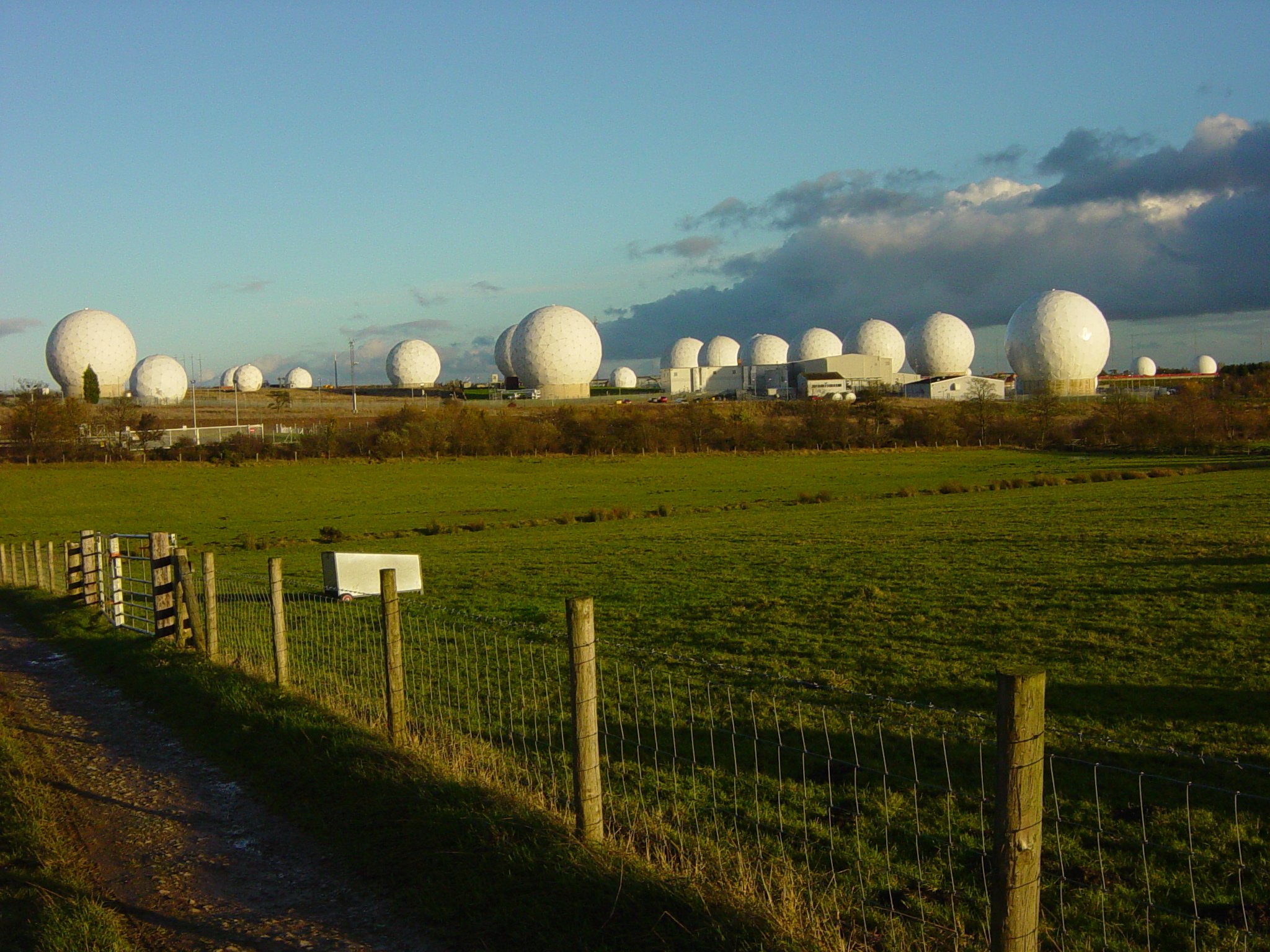
Williams worked for Echelon, or the Five Eyes, an intelligence accord between the UK, USA, Canada, Australia and New Zealand. The radomes in this photo at RAF Menwith Hill in North Yorkshire are alleged to be part of the ECHELON system. Image Source: Wiki.

Here is a follow-up to a previous post: there are hair-raising rumours online about the 2010 death of GCHQ computer expert and cryptographer Gareth Williams. In that earlier post, I quoted a passage from C. S. Lewis's That Hideous Strength, on how truth comes out in the tabloids:
"Why you fool, it's the educated reader who can be gulled. All our difficulty comes with the others. When did you meet a workman who believes the papers? He takes it for granted that they're all propaganda and skips the leading articles. He buys his paper for the football results and the little paragraphs about girls falling out of windows and corpses found in Mayfair flats. He is our problem. We have to recondition him. But the educated public, the people who read the highbrow weeklies, don't need reconditioning. They're all right already. They'll believe anything."
Williams's body was not discovered in Mayfair, but in a not-so-safe safe house in Pimlico, another district of the City of Westminster.

A supposed Met computer model reconstruction of the scene when Williams's body was found. Note how different this video-game-like scene is from the video of Williams's flat below the jump. Image Source: Breitbart.

Two rumours about Williams's death appeared in late summer 2015. In one story, he was named as the hacker in the Clinton diary hack. In another, a former Russian intelligence agent, now hiding in London (while chatting indiscreetly with the national press), claimed to have investigated the matter for personal reasons.

Sunday, July 19, 2015

Unhacking the Reality of Russia's Troll Farms


Image Source: ritabrezkolin.

Recent posts on this blog have pointed to debates about how to verify memory, truth and reality. These are pressing questions. Mistaken arguments based on online information lead to outrageous conspiracy theories. These theories masquerade as products of verified data-gathering. Many people online are travelling further and further from truth, rationality and reality, while thinking they are doing exactly the opposite.  Can we map the philosophical distinctions and debates made between subjective perception and objective reality onto the distinctions between virtual reality and meatspace? How do we determine reality, based on evidence and experience from online communication and relationships? How do we write news and real-time history, and confirm events in reality, when all information, sources and historical authorities are suspect?

Image Source: Buzzfeed.

Later posts will seek to answer these questions. Today's post explores how dangerous continued confusion on these questions can be, starting with Russian leader Vladimir Putin's quest to rewrite post-Cold War history. One of the primary tools used in this regard is the establishment of so-called 'troll farms,' groups of social media actors employed by the Russian state to spread anti-American real- and faux-news that appears to come from domestic American man-on-the-street sources. This is an example of Stalinist disinformation techniques and the Russian state-media apparatus, targeting a rival national audience rather than its own.

Of course, in the Communications Revolution, everyone in governments, corporations, hackerspace and social media circles is gathering and playing with information. Today's focus on the Russian case does not deny the existence of trolls and hackers working for other powers and businesses. The point is to understand the dangers of Millennial propaganda - which is always cloaked in the pretense of its targets' commonly-held virtues - with this example. Trolls and troll farms can alter public opinion; worse: they can change their targets' perceptions of reality. They can change memory. They can change history. A great informational power struggle is taking place. The winners will define reality. On those foundations, anything can be built.

Vigilance in this regard means not just finding the evidence online which confirms the message with which you agree politically, or hearing the message you want to hear. It means hearing the message you do not want to hear, and considering it to be plausible. Unfortunately, healthy skepticism is now a breeding ground for anti-reality trolls, so caution is required on that front too. Algorithms on search engines now tailor our results based on earlier search histories, narrowing our worlds into smaller and smaller solipsistic bubbles, exposing us only to those with whom we easily agree. Rationalists believe that logically-aligned data provide solid conclusions to support their arguments. They do not, because all data are malleable. Hackers and whistleblowers supposedly topple evil authoritarian power structures by blowing them away with the cold, hard truth. Well, even if they do, does that mean that these actors are automatically 'good'? To what service do they put their revelations? And as with the links listed below about Russia troll farm whistleblowers, how can we be sure they are telling the truth?


The recent Pluto flyby revealed how instantaneous media have confused people about the real accomplishments of Big Science and space exploration. Some thought the flyby was faked, echoing the moon landing conspiracy theory and indicating a lack of confidence in information authorities and in photographs and videos as evidence. Some complained that there was no live feed from Pluto, showing zero understanding the immense distances involved and the related scientific challenges. The vast supply of online information on these subjects has provided no online education. Instead, it has provided a false sense of confidence about being 'right' in quasi-rationalized, self-righteous and communal ways.

Image Source: CStar.

Saturday, April 23, 2016

The Algorithms of Power


Marilena Preda-Sânc, Globe (Glob, world globe, nails, 35 x 35 x 35 cm, 1999; via the Bucharest Biennale). Image Source: Pavilion.

The footage below of the ruined Syrian city of Homs below was circulated by RussiaWorks on Youtube on 2 February 2016. Business Insider cites the Center for Documentation of Violations in Syria, which states that 13,301 people have died in the city since 2011. Business Insider also reports critically on the Russian video source:
"The video has not been independently verified but is similar to previous RussiaWorks productions, such as a video from January shot in the Damascus suburb of Darayya.

Speaking to Business Insider in October [2015] Boris [Z]ilberman, a Russia expert at the Foundation for the Defense of Democracies, said: 'RussiaWorks is part of a slick campaign by the Kremlin to sell the war at home and project Russia as a military power.'

'The videos are put together by a number of Russian war correspondents/production folks that are tied to the Kremlin and probably have a lot of time on their hands — and some good drones — to make highly edited videos.'"
The Russians, with Iranian-backed Shia troops, are supporting Syrian government forces against Syrian opposition fighters and ISIS. On 20 April 2016, American analysts discussed these military movements into Aleppo, with Sunni civilians fleeing Aleppo ahead of the Russian, Syrian government's and Shia troops' advance:
"Russian aircraft, helicopters and troops have also been moving toward Aleppo over the past several weeks, they say. At the same time, hundreds of Iranian-backed Shia militia fighters are converging on the area to bolster existing regime forces.

'The Syrian regime seems to be driving towards the eventual isolation of opposition forces in and around Aleppo,' a U.S. intelligence official said on condition of anonymity.

The official said at least in the area north of Aleppo, Russian actions appeared to be in support of the Syrian regime, aimed at cutting off the supply lines for moderate opposition forces.

'We also see indications of fighting southwest of Aleppo between Syrian forces with Russian backing and opposition elements,' the official added.

Russian officials have long said their actions in Syria have been aimed at terror groups such as Islamic State and al-Qaida-linked Jabhat al-Nusra, and U.S. officials admit Russia has picked up the pace of airstrikes on terror targets.

But analysts caution the type of Russian equipment being sent to Aleppo suggests not just a different enemy in the short term but also a broader strategic endgame.

'Russia has begun to alter the shape of its own deployment,' Institute for the Study of War analyst Genevieve Casagrande said during a panel discussion Wednesday [20 April 2016]."

Video Source: RussiaWorks via Independent via Facebook. Also circulated on Youtube by RT.


Some argue that the Americans, particularly the CIA, the British, sometimes the French, and the Israelis are behind a masterful New World Order bid to turn the whole Middle East into a batch of western puppet states, with countries falling domino by domino, after a social-media-driven succession of Arab Springs gone wrong. That gives the Americans and supposed Illuminati too much credit. Syrian leader Bashar al-Assad is very much 'like father, like son'; the Syrian civil war resembles the 1982 Hama massacre, in which Hafez al-Assad crushed a Sunni uprising by the Muslim Brotherhood which had been brewing since 1976. The failed American bid to topple Assad by joining the Saudis to fund Syrian opposition forces - and some argue, ISIS, despite American battles with the group - has led to a disastrous foreign policy mess, which brings the drone-slinging Americans to what The Guardian called, "plan B."

Déjà vu: similarities between Shia-led crackdowns on majority Sunni uprisings in Syria. Image Source: Georgetown University via Ben Davies.

Plan B involves cooling the American alliance with Saudi Arabia and tentatively supporting Iran, leaving one to wonder where the Saudis will pivot, perhaps toward Russia. The picture: ISIS in Europe; Russia and Iran in Syria; the Saudis alienated by the Americans to temper Iran's nuclear ambitions. All eyes turn to Jordan, now sharing anti-ISIS intelligence with the Israelis and Egypt, terrified of a nuclear Iran. If Iran has nuclear weapons, some argue that other Middle Eastern countries should have them too, or none at all. Beyond the usual astronomical expenditure on weapons in the Middle East, what would a nuclear arms race there look like and where would it lead? There is already a conventional arms race. In 2015, USD $1.7 trillion was spent collectively by all powers on weapons of mass, medium and minor destruction; you can see a worldwide comparative chart here. Of that amount, Saudi Arabia spent USD $87.2 billion in 2015; in 2013, the country spent USD $67 billion, and USD $56 billion in 2012, which gives an idea of the kingdom's escalating anxieties.

Monday, December 12, 2016

WikiLeaks' Advent Calendar


Every day in December has opened a new door like an Advent calendar, and the surprises behind each door are orchestrated by Julian Assange. Some of his followers think he is dead, despite recent statements about his Swedish rape case. His supporters, who are reading WikiLeaks materials, believe they have uncovered child sex trafficking rings in the American establishment. Their comments on these documents are dismissed as lies, hoaxes, and suppressed as hate speech by the mainstream media and governments.

The LA Times first warned against pro-Republican fake news sites on 14 August 2014. Image Source: Politics USA via Rob Goldstein.

Perhaps more intriguing than the Pizzagate allegations is the claim that Assange was threatened in mid-October 2016 and this threat tripped part of his dead man's switch. On 23 November 2016, there was a report at The Lie Politic that a 'taster' was released on WikiLeaks to protect his life. That taster is here. I will show some of the images and links from the taster below the jump. By the third week of November, The Lie Politic claimed, the material had been available for a month and it was not discussed in the alt-press or the mainstream press. The former are wrapped up in Pizzagate. The latter are busy dismissing everything the alt-news are reporting as fake news.

Image Source: The Lie Politic.

Friday, February 15, 2013

The Sky is Falling

Meteors over the Urals. Image Source: Gazeta.ru.

Reports today state that asteroid 2012 DA14 will nearly graze the earth and will be visible everywhere except North and South America:
Space rock 2012 DA14 is only 50 metres across. It will pass the Earth on Friday evening (UK time) just 17,100 miles above our heads. There is no danger of a collision. Nevertheless, this is closer to the Earth than many artificial satellites. It will pass from the southern to northern hemisphere and set the record for the closest pass of any known asteroid since systematic surveys of the sky began in the mid-1990s.

The celestial mining corp Deep Space Industries claims that the asteroid is worth USD $195 billion, but they won't be going after it:
The company has no plans to go after 2012 DA14; the asteroid's orbit is highly tilted relative to Earth, making it too difficult to chase down. But the space rock's close flyby serves to illustrate the wealth of asteroid resources just waiting to be extracted and used, Deep Space officials said. [Deep Space Industries' Asteroid-Mining Vision in Photos]

"While this week's visitor isn't going the right way for us to harvest it, there will be others that are, and we want to be ready when they arrive," Deep Space chairman Rick Tumlinson said in a statement Tuesday (Feb. 12).

Deep Space Industries wants to use asteroid resources to help humanity expand its footprint out into the solar system. The company plans to convert space rock water into rocket fuel, which would be used to top up the tanks of off-Earth satellites and spaceships cheaply and efficiently.
Asteroid mining: Chasing the almighty dollar. Image Source: Deep Space Industries via Space.com.

In addition, an alarming (apparently unrelated) meteoroid falling over the Ural Mountains rocked the town of Chelyabinsk in Russia over the past 24 hours. The meteor blew out windows merely by the sheer force of passing across the sky (see more videos here). Guardian:
Infrasound data collected by a network designed to watch for nuclear weapons testing suggests that today's blast [in Russia] released hundreds of kilotonnes of energy. That would make it far more powerful than the nuclear weapon tested by North Korea just days ago and the largest rock crashing on the planet since a meteor broke up over Siberia's Tunguska river in 1908. "It was a very, very powerful event," says Margaret Campbell-Brown, an astronomer at the University of Western Ontario in London, Canada, who has studied data from two infrasound stations near the impact site. Her calculations show that the meteoroid was approximately 15 metres across when it entered the atmosphere, and put its mass at around 40 tonnes. "That would make it the biggest object recorded to hit the Earth since Tunguska," she says.
The Guardian reports that more than 1,000 people were injured, mainly by flying glass. Conspiracy theories are never far behind, as usual:
Vladimir Zhirinovsky, long-term leader of Russia's far right parliamentary bloc, claimed the meteor was not a cosmic event but something more sinister, my colleague Mark Rice-Oxley reports. Zhirinovsky said: "It is not meteors falling, it's the Americans testing a new weapon. [Secretary of state John] Kerry warned [foreign minister Sergei] Lavrov on Monday ... that there would be such a provocation and that it might affect Russia."
Video Source: RT.

Friday, December 31, 2010

Happy New Year: Around the World, Around the Clock

2011 arrives in Auckland, New Zealand. Image Source: Daily Mail.

This blog post will update through the day as the clock strikes midnight through the world's time zones.  The first major city to celebrate New Year's of 2011 in the world is Auckland, New Zealand (see video below the jump).

Wednesday, August 8, 2018

Millennial Extremes 14: Next Gen Tech and the Bering Strait Connection


Image Source: InterBering.

The blog is back after a break! Today's post is about a mega-project which illustrates how early generations of imperialists have passed to torch to Millennial globalists.

If the Channel Tunnel ignited the hopes of a European generation when it opened in 1994, the Bering Strait Tunnel is an engineering scheme which could similarly transform geopolitics and revolutionize transportation. The dedicated site, InterBering, expects "Tourists will be able to cross between the U.S. and Russia in just 15-20 minutes." The most colourful aspects of the plan include proposed five star hotels along the route:
"Where the tunnels pass under America's Krusenstern Island (Small Diomede), a railway station can be built allowing passengers elevator access to the island. A world-class hotel would provide them with a mid-Strait vista of the confluence of the Pacific and Arctic Oceans. A stay at this iconic hotel, along with a journey on the magnetic levitation train serving it, will become a tourist attraction in its own right. A similar facility can be created on Russia's neighboring Ratmanov Island (Big Diomede)."
Bering Strait Tunnel proposal. Image Source: InterBering.

Thursday, January 24, 2019

World War III Projections 3: Venezuela, The First Caribbean Domino?


Today, Venezuela's government is being forced to change through a strange internal and external consensus. While the anti-Maduro parts of the Venezuelan population are justifiably happy, there is a larger dimension of these events to consider.

Image Source: Growthlines.

The alt-media conspiracist outlet, Abel Danger, predicted earlier this month that Venezuela would be the first domino to fall in a new American- and British-led initiative, which will decimate Latin America and the Caribbean Basin in a long-term series of large wars. This supposed effort follows the same model as was used to devastate the Middle East over the past several decades. From 8 January 2019, The Terrible Forthcoming Destruction of the Caribbean Basin:
"President Trump has announced the withdrawal of US combat troops from the 'Greater Middle East', but the Pentagon is still pursuing the implementation of the Rumsfeld-Cebrowski plan. This time the aim is to destroy the States of the 'Caribbean Basin'. This is nothing like the overthrow of pro-Soviet regimes, as in the 1970’s, but the destruction of all regional state structures, without consideration for friends or political enemies. ...

In a series of previous articles, we presented the SouthCom plan to provoke wars between the Latin-American nations in order to destroy the structures of all the States in the 'Caribbean Basin'.

Preparations for wars of this magnitude, intended to follow on from the conflicts in the 'Greater Middle East' according to the Rumsfeld-Cebrowski strategy, requires a decade.

After the period of economic destabilisation and that of military preparation, the actual operation should begin in the years to come by an attack on Venezuela by Brazil (supported by [Israel]), Colombia (an ally of the United States) and Guyana (in other words, the United Kingdom). It will be followed by others, beginning with Cuba and Nicaragua (the 'troïka of tyranny' according to John Bolton).

However, the original plan may be modified, particularly because of the return of the imperial ambitions of the United Kingdom which may influence the Pentagon."
The same article was reposted at Information Clearing House. It originally appeared on the Voltaire Network Website and was penned there by Thierry Meyssan. Meyssan is a left-wing French journalist and 9/11 truther who has investigated far-right movements. He has also worked for Russia Today and Odnako (Однако) and is apparently now based in Damascus, Syria. To me, it looks like he's a spy.

10 December 2018: Russia provided two nuclear-capable 'Blackjack' aka 'White Swan' bombers to Maduro's régime. Image Source: Federico Parra / AFP / Getty Images via The Guardian.

Meyssan is convinced that the European Union project will be dropped, or perhaps left to the Germans to sort out. The European powers will return to their old plans of imperial colonization abroad in competition with, and sometimes in cooperation with, the United States. Venezuela is the first domino to fall. On 15 January 2019, he wrote:
"[O]ne of the consequences of the successive ends of the bipolar and unipolar world is the re-establishment of colonial projects. One after the other, the French, Turkish and English have publicly declared the return of their colonial ambitions. We still need to know what form they will adopt in the 21st century."
While from a dubious source, if it is correct, it is terrible news for everybody. This larger context may explain Trump's plan to build a wall along the southern border of the United States. The wall construction may anticipate a widespread southern conflict and block the flow of soldiers and refugees. The Russians have provided nuclear-capable bombers and a Kalashnikov manufacturing plant to the Maduro administration. The latter has led to a spread of guns all over the Caribbean. Freelance journalist Colin Freeman has begun covering this story.

Note also that the 8 January report suggests that the Caribbean and Latin American conflict is believed to have been laid out over the past decade, prior to Donald Trump's election. This would mean that the planning for the conflict occurred under the Obama administration. If this is even partly true, it means that the 2016 American election, Brexit, the debate over the wall in the United States, the fierce political fights between liberals and conservatives, the Democrats' moves to impeach Trump, and the US government shutdown have been a big puppet show. Perhaps the puppet show kept eyes off the actual theatre of operations while pieces were moved into place.

Other small outlets made similar reports in the first half of January. As the Trade Union and Worker News in Africa put it, with yet another article by Meyssan, Goodbye Middle East, Hello Latin America. Whatever the evolution of the Venezuelan régime, nothing can justify what is being prepared against its population.

Friday, July 19, 2013

Smallpox Afterlife


Shapona, the West African God of Smallpox (1969). Image Source: CDC (ID #15226).

Caption for the above photograph: "This is a statue of Shapona, the West African God of Smallpox. It is part of the CDC’s Global Health Odyssey (GHO) collection of artifacts. A uniquely carved wooden figure, it is adorned with layers of meaningful objects such as a monkey skull, cowrie shells, and nails. Donated in 1995 by Ilze and Rafe Henderson, it was created by a traditional healer who made approximately 50 Shaponas as commemorative objects for the CDC, WHO, and other public health experts attending a 1969 conference on smallpox eradication."

Officially, smallpox was eradicated in 1979. One of the most feared of illnesses, it still exists in disease research centres in the United States and Russia. The disease was eradicated through a global mass vaccination campaign in the 1960s and 1970s. To see photos of the disease symptoms, and of the gruesome occasional reactions to the vaccinations, go to the Centers for Disease Control site (here). The images are not for the faint-hearted.

The last people who naturally contracted two variations of smallpox both survived and are still alive. One was Rahima Banu Begum, who had the last known case of naturally occurring Variola major smallpox in 1975, on Bhola Island in the Bangladesh district of Barisal. In a 2009 interview, she stated that she is still treated poorly by villagers and family members because she once had the disease. The other is Ali Maow Maalin, a Somalian cook who contracted the last case of naturally occurring Variola minor smallpox in 1977. Interviewed most recently in 2006, he now works for the World Health Organization to promote vaccination campaigns.

Smallpox and humans have a long history. The virus emerged around 10,000 BCE. Wiki notes some of the virus's modern history: the disease devastated Native American populations with the arrival of European colonists in the 16th century; with no previous exposure, they died at the rate of 80 to 90 per cent. Sometimes, Europeans infamously spread smallpox to Native Americans on purpose, although historians debate the degree to which this occurred. Smallpox killed about 400,000 Europeans annually at the end of the 18th century. It killed between 300 million and 500 million people in the 20th century.

Vaccination against the disease also had a long history. Intentional exposure of healthy people to another's smallpox scabs was practiced as far back as 1,000 BCE in India; this exposure might cause death, but usually brought on a mild form of the disease, which one might survive, thereafter becoming immune. The smallpox vaccine was the world's very first vaccine to be developed, by Edward Jenner in 1796, through his use of the milder cowpox virus. Similar treatments had preceded Jenner's work as early as the 1770s. The term 'vaccine' comes from the Latin vacca for cow.

The development of a stable vaccine in the 1960s led to the World Health Organization's innoculation campaign between 1967 and 1977. After a fatal 1978 accident at a UK repository, only two repositories of the disease remained: the Centers for Disease Control in Atlanta, Georgia and the State Research Center of Virology and Biotechnology (VECTOR) in Koltsovo, Russia.

Since then, smallpox lurks in hideous sleeping afterlife, always promising to reemerge as the ultimate bio-threat. When one considers that smallpox was humanity's constant companion for some twelve millennia and has only been at bay for a mere 33 years, it is easy to see why it is still a cause for worry. Most disturbing, perhaps, is the possibility that weaponized artificial smallpox could be created as bioengineering gathers pace. But another thread appears through all the fears of pandemics, the politics, the foreign policy and secrecy: the smallpox vaccine offers a potential cure for some cancers. 

Below the jump, see some points about smallpox which have come to light since 1990.

Saturday, May 6, 2017

Emmanuel Macron's New Campaign Trail


Click to enlarge. Image Source: 4chan via Twitter.

Hackers have opened the e-mail account or accounts of the favoured French electoral candidate, Emmanuel Macron, and dumped 9 gigabytes of the contents online, current up to 24 April 2017. BBC:
"The campaign said that genuine files were mixed up with fake ones in order to confuse people. ...

About nine gigabytes of data were posted online by an anonymous user.

The details are unclear so far, but Mr Macron's En Marche movement said internal campaign documents, including emails and financial data, had been taken in an 'act of massive, co-ordinated hacking'.

'The leaked files were obtained several weeks ago by hacking personal and professional email accounts of several officials of the movement,' it said in a statement.

The campaign said the documents showed only legitimate campaign activities.

France's election authorities have warned media outlets against reporting on the contents of the leaked documents because of the restrictions now in place. ...

That too remains unclear. The Macron camp has not blamed any specific party but said the hack clearly aimed to damage it and undermine French democracy[.]

It compared it to the leak of Democratic Party emails in last year's US presidential election that was blamed on Russian hackers.

Wikileaks, which published those emails, posted a link to the Macron documents on Twitter but implied it was not responsible."
The NYT, which is firmly anti-Le Pen, reported that Le Pen's campaign also faced regular (unsuccessful) hacks during the campaign. Some people on Twitter think the hack is Russian; some think the hackers were American. Some think the hack is fake. Liberals think it is anti-democratic and Russian or neo-Nazi-sourced.

Wednesday, August 20, 2014

Beware the Ides of August


James Foley, US journalist, before execution, in a video released by IS on 19 August 2014. Image Source: Buzzfeed.

I have a friend, R., who is a retired British army colonel. He once said to me: "March is not the problem! Beware the Ides of August, when everyone goes away on holiday. That's when the real trouble happens, when no one is at the helm." After that, I paid more attention to what happens in the second half of August.

News stories ebb and flow as the MSM turn their attention from one item to the next. They create the false impression that one issue disappears while another suddenly intensifies. Ebola flares up alongside the crisis in the Ukraine. Those stories subside, combined with a ceasefire in Gaza, which draws attention to Ferguson, Missouri. This morning, Ferguson quietened, following news of the beheading of American journalist James Foley by the Islamic State (IS/ISIL/ISIS).

The MSM initially covered the Foley story with numbing euphemisms such as 'risks journalists follow in conflict zones.' The Guardian was more concerned, citing 'outrage' and a need to identify James Foley's British executioner, who was obviously chosen to spread even more fear in the west. The euphemisms are a sign of fear. But this was the organization that even frightened Al Qaeda - until its Yemen affiliate decided formally to join forces with IS on 19 August (see report here).

MSM journalists' rationale for downplaying IS is that not reporting on IS deprives the group of media sway; the MSM outlets refuse to be commandeered into becoming IS mouthpieces. However, the flip side of this decision is that the mass of people - unless they search online - do not know what is going on at all!

MSM coverage misleads further, because all these news stories are ongoing and interrelate. Twitter surged to cover Ferguson's police brutality, witnessing the rise of America's police state. Michael Brown's shooting in Missouri also confirmed Obama's individual significance. His presidency marks a turning point in the history of race in America. The only problem is that troubles in Ferguson just happen to coincide with the total failure of Obama's foreign policy.

The media seamlessly divert attention from foreign to domestic affairs without acknowledging what that diversion means. In a similar way, Clinton's 1998 impeachment during the Monica Lewinsky scandal obscured his foreign policy failures in Africa in the 1990s. One could argue that those failures helped pave the way to 9/11.

There is a reason why Putin now flexes his muscles in the Ukraine, whereas in 2002, Russia's relations with NATO were cordial. In 2010, the Moscow Times commented on why Russia will never join NATO. It boiled down to Russia's refusal to mingle domestic democratic accountability with foreign policy:
NATO requires that its members have civilian and democratic control over their armed forces. This is a fundamental princip[le] that allows for military integration and inter-operability among members. Although NATO countries have different political systems — some are presidential republics, others are parliamentary — they all have transparent defense budgets and public and legislative oversight over their countries’ military affairs. This includes independent investigations into military failures and abuses, parliamentary control over how funds are allocating — or not allocated — for weapons programs and constitutional checks and balances on a leader’s ability to send troops to fight in foreign military operations. In Russia, however, civil control over the military is anathema to the basic principles of Prime Minister Vladimir Putin’s vertical power structure, which has effectively folded all three branches of power into one huge executive branch. Any autocratic power, by definition, rejects public accountability in all spheres of government — and this is particularly true for its armed forces.
America's domestic accountability for her foreign policy is one reason why ISIS has overrun Syria and Iraq. IS took Mosul and are battling to recapture the Mosul dam - a critically important site left vulnerable in a desert country. That the Mosul dam and the Haditha dam are in jeopardy is a catastrophic failure in terms of American military and political strategy in Iraq. American airstrikes allowed Iraqi government forces to regain of control (barely) of the Mosul dam. The execution of James Foley was an IS media counterstroke for that IS defeat.

Obama's passivity in this gathering storm confuses even his critics who expect him to do nothing. The trouble lies in the extended domestic sensibility America brings to its foreign politics. While Obama is emblematic of everything the Americans struggle with when they look inward, he has also epitomizes everything they struggle with when they look outward. How can this superpower, founded in revolutionary anti-imperialism, accept its mantle as an imperial global superpower? Many Americans reject any imperial legacy as uncivilized, autocratic and cruel. The president of the republic cannot become caesar. Progressive Americans demand at the very least that American foreign policy function as an arm of domestic values. Meanwhile, America's critics regard the US as a hypocritical power because it often acts well beyond that domestic democratic remit; and critics see the USA spouting democratic cant while secretly, tactically promoting vicious dictatorships.

How can Obama respond to the Islamic State? As a domestically-minded superpower, America is trapped between the Devil and the Deep Blue Sea. Whether they are hawks or doves, Americans can't win. No mindset of small town democracy, with its civic and legal orthodoxies, will defeat the people who executed James Foley and who have tortured people across Syria and Iraq. The US cannot meet IS actions  with hand-wringing, moral pleas and media blackouts. But if America moves ruthlessly to crush these brutal opponents, the USA becomes an agent of chaos, a torturer, a democracy that betrayed its best values. Others would argue that it is the USA itself that pulls the strings behind the curtains of conflict. It is one of the oldest problems in the book. Power corrupts. The American position changes depending on perspective. But whatever perspective on the USA you may take, one thing has happened that no one expected: America has found a way through.

Thursday, May 12, 2016

The Tornado


A tornado in Colorado, USA (7 May 2016). Image Source: Tori O'Shea.

This blog is skeptical of conspiracy theories because they are not consistent with the way reality is created. Conspiracy theories about current events - for example, regarding the disastrous situation in Syria - are examples of modern urban folklore, which impose exactly the same superstitious, deterministic logic onto the world that an established religion would. Many of today's orthodoxies are nominally secular, but they are no less based in blind faith. Actors on the international scene do try to impose strategic control on the world's hot spots; the media come to these hot spots with spin, preconceived ideas and even false flag agendas. However, the notion that anyone - governments, politicians, banks, shadowy cabals, unseen actors, evil establishments - controls the reality that ensues from fluid conditions is incorrect.

Tuesday, March 1, 2016

Anniversaries: Venera 3 Landing on Venus


Venera 3 did not gather information due to a malfunction, but it still made history when it crashed into the planet's surface on this day in 1966. Image Source: NASA.

Today is the 50th anniversary of Venera 3's crash landing on Venus on 1 March 1966. Venera 3 was the first human-made object to make an impact on another planet's surface. The site Russian Space Web gives a great chronology and details of the development of Russian rockets and space programmes from their earliest days.

Location of the Soviet Venus landers (1961-1984). Image Source: Wiki.

See my earlier post on Russian space art, here. The 2004 BBC television series, Voyage to the Planets, depicted what a manned mission to Venus would look like (previously mentioned in this post). On 17 November 2015, Ars Technica reported that the Russians and Americans are going to cooperate to explore Venus with landers in the 2020s:
After more than a year on ice due to Russia’s aggression in Ukraine, NASA and Russia’s Space Research Institute has resumed discussions about a joint exploration mission to Venus, which could include a lander. NASA hasn’t flown a mission dedicated to Venus since its Magellan probe, from 1990 to 1994, which mapped 98 percent of the planet at a resolution of 100 meters or better.

So far NASA has only committed to talking with Russia about its Venera-D mission, which could launch in the 2020s. The space agency has agreed to perform a year-long feasibility study and several meetings during the next year. After that time NASA and Russia’s Space Research Institute, or IKI, will decide whether to continue its partnership, according to a report in Spaceflight Now.
For more information on the planned Venera-D mission, see here, here, here, here and here.