TIMES, TIME, AND HALF A TIME. A HISTORY OF THE NEW MILLENNIUM.

Comments on a cultural reality between past and future.

This blog describes Metatime in the Posthuman experience, drawn from Sir Isaac Newton's secret work on the future end of times, a tract in which he described Histories of Things to Come. His hidden papers on the occult were auctioned to two private buyers in 1936 at Sotheby's, but were not available for public research until the 1990s.


Tuesday, February 21, 2012

Happy Tibetan New Year!

2012 will cross cultures: A Czech Tibetan Buddhist New Year's card. Image Source: Brozkeff's Mandala.

Also known as Losar, the Tibetan Buddhist New Year festival is celebrated for 15 days, starting on the first day with drinking a kind of beer called chhaang. The holiday is celebrated in Tibet, Nepal and India and has pre-Buddhist origins. These origins reflect yet another the ancient connection between astronomy, astrology, and the way we measure time. Wiki: "The festival is said to have begun when an old woman named Belma introduced the measurement of time based on the phases of the moon. ... Later when the rudiments of astrology, based on the five elements, were introduced in Tibet, this farmer's festival became what we now call the Losar or New Year's festival." This is the year of the Male Water Dragon and the year is 2139 by the Tibetan count.

Monday, February 20, 2012

Photo of the Day: The Long Road Home

Image Source: The Atlantic.

In the 2010 movie, Repeaters, the characters get trapped in a time loop.  One of the film's commenters on the IMDB suggested that their predicament was a metaphor for post-traumatic stress, and the purgatorial relationship with time that it inflicts upon its sufferers, wherein they relive experiences over and over (see the trailer here).  The photo above is perhaps a related example of the so-called thousand-yard stare.  It is a photograph of an American Marine in Afghanistan from January 2012, but it made me immediately think of the experiences of the British military in the same region, recounted in Kipling's Plain Tales from the Hills, stories which were originally published in the Civil and Military Gazette.  This photograph could have been taken yesterday, or 120 years ago. From The Atlantic: "Men of 1st Battalion, 6th Marine Regiment, during an operation near the end of their third deployment in three years in Afghanistan. They were securing route 611, which runs Kajaki Sofla, an area that had long been a safe haven for insurgent sub-commanders and for arms and drug trafficking. (Cpl. James Clark/USMC)" Other photos from Afghanistan are here.

Sunday, February 19, 2012

Calling all Chronomancers


 Image Source: TV Tropes.

Millennial Aporia - the collapse and evolution of values - may reflect an antagonistic attitude toward time, an attitude we must resolve. In a blog post earlier this month, Tara Mohr quoted the late Irish priest and poet, John O’Donahue, who said: “One of the biggest problems of modern life is that time has become the enemy.” Mohr argued that there is something extremely disturbing about our war with time.  To exist in conflict with time, she says, is to be in conflict with ourselves.  Since time shapes human consciousness, Mohr believes we should revise our current view of the passage of time.

Saturday, February 18, 2012

The Very Human Anatomy of the Internet

Tissue Series Quilled Paper anatomical artwork (2011-2012) © Lisa Nilsson. Image Source: Colossal Art & Design.

Machines Like Us reports that the seemingly-infinite potential of the Internet will be limited by the capacities of our brains.  In short: "the total amount of information cannot grow faster than our ability to digest or handle it."  That's probably really good news:
Scientists have found that the capacity of the human brain to process and record information—and not economic constraints—may constitute the dominant limiting factor for the overall growth of globally stored information. These findings have just been published in an article in E[uropean] P[hysical] J[ournal] ... by Claudius Gros and colleagues from the Institute for Theoretical Physics at Goethe University Frankfurt in Germany.
Ref: 1. Gros C., Kaczor G., Marković D., (2012) Neuropsychological constraints to human data production on a global scale, European Physical Journal B (EPJ B) 85: 28, DOI 10.1140/epjb/e2011-20581-3.

Friday, February 17, 2012

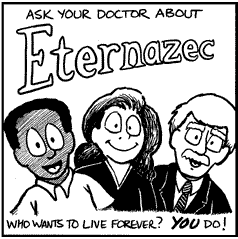
Fountain of Youth 13: The Psychological Distress of Immortality

What Else Is There? (2012) © by oO-Rein-Oo at Deviant Art. Reproduced with kind perimission.

On January 30, novelist Jonathan Franzen expressed his worries to the Guardian that ebooks would corrode values and diminish an appreciation for paper books (thanks to -J.).  "All the real things are dying off," he sighed.  This provoked plenty of sharp criticism in the comments, for example: "Jonathan Franzen warns that people shouldn't travel by train as the greater than horse carriage speed may suffocate passengers through an involuntary inhalation of ether."

But Franzen made one thought-provoking comment that, if extrapolated, could explain why we age:
"One of the consolations of dying is that [you think], 'Well, that won't have to be my problem'," he said. "Seriously, the world is changing so quickly that if you had any more than 80 years of change I don't see how you could stand it psychologically."
This got me thinking about the primary cause of ageing.  What if the primary reason we age is not physical, as futurists such as Kurzweil would have us believe?  What if we age because our brains are hard-wired to exist for no more than 100 years at the absolute limit?  What if our brains cannot handle the psychological test of ageing, combined with historic change in our environment?  What if it's our brains that begin short-circuiting the body, forcing it to collapse and ultimately fail?  What if ageing is a measure of how we are mentally able to adapt to change, or not adapt to it?  Conversely, does that mean that the true elixir of life is a case of mind over matter?

Thursday, February 16, 2012

Retro-Futurism 21: Twitter Not New at All -(STOP)-

The latest electronic gadget, straight from the 1890s to your desk: the Tworse Key, which digitally translates your telegraph-style Morse Code messages into regular Tweets. Image Source: Economist.

In their heyday, my parents and their friends were the last generation to travel by ship and communicate mainly by telegrams. Their collections of old private letters have wads of telegrams in them. We now see the seemingly obsolete brevity of telegraphy as romantic, and recall its peak as a form of global communication during the 1890s to the 1960s. There's even an Aussie company called Telegram Stop that lets you send old-styled faux telegrams to your friends; they say: "Our telegrams are made to look and feel like a classic telegram from the original days when telegrams were one of the only forms of national and international communications, we’ve taken great care to ensure the experience to the recipient is one that garners surprise and a sense of warmth." They've caught on like wild fire, and are especially popular in lieu of e-cards.

At the Turn of a Different Century

The War of Wealth, a Broadway play by Charles Turner Dazey that dramatized a run on a bank during the depression of the 1890s (the play opened 10 February 1895). (Library of Congress; Image © Strobridge Lith. Co., c1895) Image Source: Wiki.

Exponential technological change. Recession spreading from the west to Asia. Unemployment. Middle Eastern uprisings. Occupy. Internet clampdowns.  Budding cyber conflicts and a new class system.  Global marketing and collapsing local cultures. Nuclear tensions. People are being tested. Hardship turns private lives upside down, but walks hand-in-hand with opportunity.  The test is a moral and spiritual one above all, a test of resolve and a test of the heart. In a state of flux, some answers are superficial but look substantial, while others look risky but actually are profound and enduring.  Conspiracy theories multiply, as do reports of sasquatches, ghosts and UFOs.  The question is not whether these things exist or not, because they are fringe constants, the stuff of superstitions, mysteries, myths and legends.  If we were to find scientific proof of all three tomorrow, they would quickly be replaced by other things.  They haven't changed.  We have.  What changes is popular credulity.  There is a rush to believe in the unbelievable, possibly because that gives a wider range of reference points and hence an illusion of stability to generally accepted reality.  It becomes increasingly difficult to read the signs correctly and find stability anywhere.

On January 28, The Art of Manliness quoted a manual entitled Courage by the French pastor, Charles Wagner (1852-1918).  Wagner's historic source from 1894 rings true today.  The mid-1890s were a time of cultural, political and technological flux, and of economic depression after the Panic of 1893Wiki"Until the Great Depression of 1929, the Panic of '93 was the worst economic depression the United States had ever experienced."  A credit crunch and financial panic hit Britain and there was a steep drop in trade in Europe.  It lasted ten years, and the decade and a half that followed after 1900 was still shaky economically, leading straight into world war.  At the same time, the 1890s decade saw the Klondike Gold Rush, the invention of the earliest standardized automobiles, of cinema (the first commercial film, , was shown in 1894), telephone exchanges, and airplanesJust that list of innovations tells us how much we are still living in the era of 1890s.  As of 24 January 2012, there were thirty people left alive in the world who were born in this decade, so it has not quite left living memory and has, in a sense, now returned.

Wednesday, February 15, 2012

Laugh of the Day: Hyundai Canada Sasquatch Ad

Image Source: Hyundai via Bigfoot Lunch Club.

The Bigfoot Lunch Club posted a link to Hyundai Canada's new Bigfoot ad campaign. See below the jump for the first funny ad, and go here for the main site which has a whole gallery of actor Douglas Tait as the Sasquatch. This Youtube channel features the on-set bloopers with Tait in costume.