TIMES, TIME, AND HALF A TIME. A HISTORY OF THE NEW MILLENNIUM.

Comments on a cultural reality between past and future.

This blog describes Metatime in the Posthuman experience, drawn from Sir Isaac Newton's secret work on the future end of times, a tract in which he described Histories of Things to Come. His hidden papers on the occult were auctioned to two private buyers in 1936 at Sotheby's, but were not available for public research until the 1990s.


Monday, August 11, 2014

Farewell to Robin Williams, a Long Goodbye and Peace


To Robin Williams, who made us laugh and inspired a generation with one scene (here) in Dead Poets Society (1989), I am so sad that he is gone.

I have mentioned that carpe diem scene, sentiment and stars many times on this blog: here, here, here, here and here. That speech is one of the reasons this blog exists. You only have so much time in your life; if you have something to say, you had better say it. I have thought about Dead Poets Society for years. With that role, Williams showed his insight, depth and versatility as an actor. He went on to play other characters who grappled with social alienation (The Fisher King, Good Will Hunting, One Hour Photo).

Dead Poets Society asked a question about how the individual can find validation in a world of conflicting values, while struggling with conformity and non-conformity, the pressurized demands for achievement, the futile sense that time is always running out, and a final, redemptive creativity: "Only in their dreams can men be truly free. 'Twas always thus, and always thus will be."

Laugh of the Day: Techwife


(Click to enlarge.) Image Source: Twitter.

Look Skyward: The Perseids Return


A Perseid over Glastonbury Tor (2010) © M. Kempsey. Image Source: Telegraph.

Caption for the above photograph: Somerset: Meteor at Midnight, Glastonbury Tor by Mike Kempsey (DT6 Photographic) (UK). A meteor captured streaking across the sky by Glastonbury Tor in Somerset on 12 August 2010 at the peak of the annual Perseid meteor shower. The Perseids is one of the most prolific showers, often with around 80 meteors an hour during its peak. Nevertheless, meteors are hard to catch on camera: the photographer has used a continuous shooting mode so that the camera was photographing non-stop in order to catch this fleeting image. Photo: Mike Kempsey (DT6 Photographic).

The Perseids, the star attraction among annual meteor showers because of their long viewing time in late summer, have returned. These falling stars have been observed around the constellation Perseus for at least 2,000 years, since 36 CE, or earlier in Eastern sources. They are visible from late July to late August. They are visible mainly in the Northern Hemisphere in the east/northeastern sky. This year, a Google doodle commemorated this brightest moment of the amateur star-gazing calendar.

Google gives background on the 2014 Perseids Google doodle here.

You can see a worldwide map on where to look for them according to your location, here. For tips on watching them, go here.

The meteors will peak on Wednesday, 13 August, from 1 a.m. to dawn. A bright moon will interfere with the peak of the Perseid meteor shower, so the best views may be earlier in the week.  Spacedex:
In 2014, The Full Moon on August 10th and the Waning Gibbous Moon occurring on August 12th will have a negative impact on the visibility of the Perseids. Due to the bright moonlight, the fainter meteors may not be visible. It is advisable to observe the meteor shower during the predawn hours on the mornings of August 11, 12, and the 13th. With up to 60-100 meteors per hour predicted, observers may catch several bright meteors streaking along in the night sky.
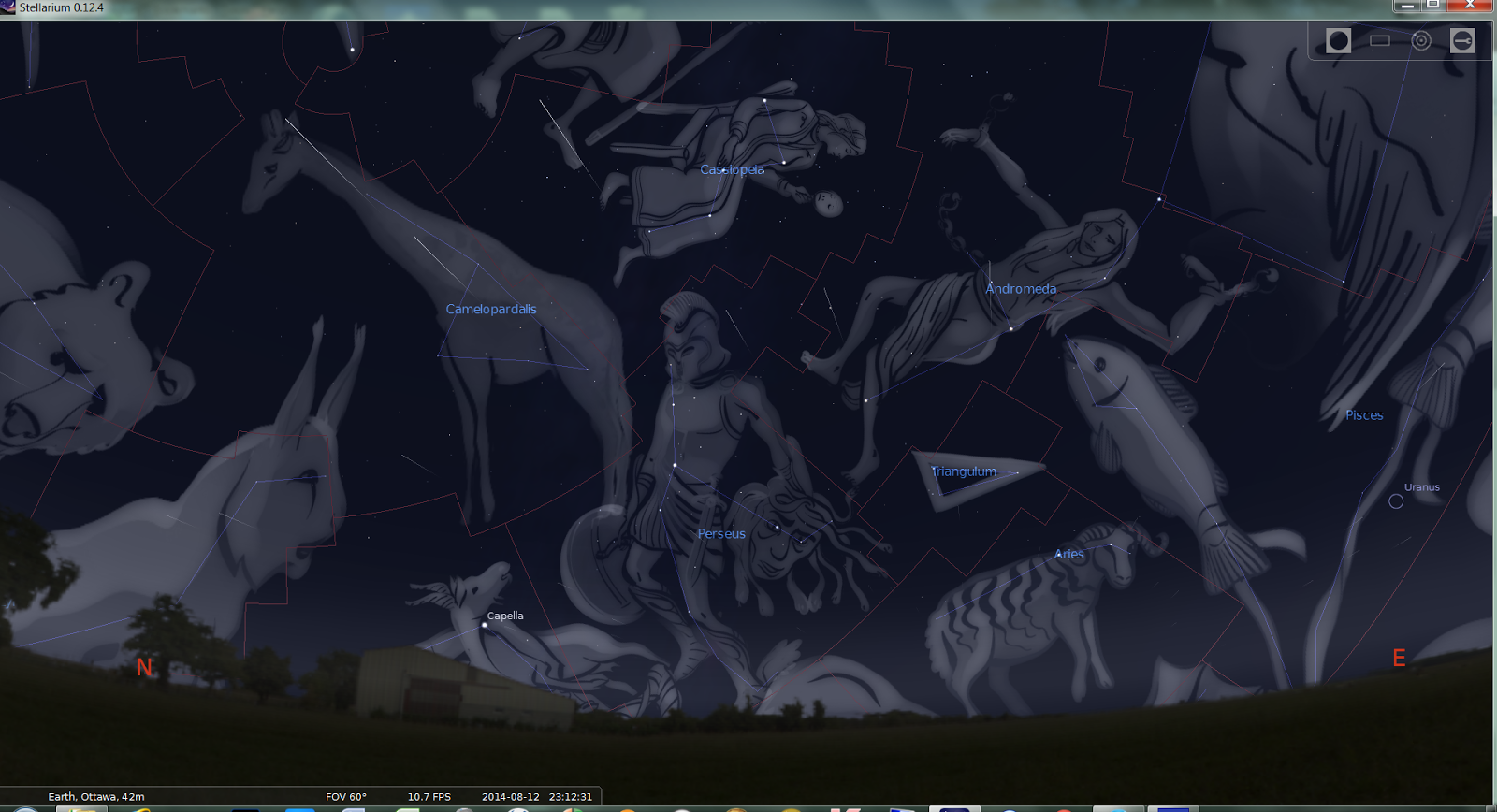
Stellarium star-gazing freeware shows the Perseids falling according to time and location of the place on earth and spot in the sky; you can download it, set the view to your location, and cycle through times of day/night until you find an optimal viewing window when the moon does not obstruct the view, yet it is still dark.

Watching them is worth the trouble: seeing one meteor, let alone a storm of them, reminds one of ancient star-gazing traditions, and gives a sense of the unity between the earth and the heavens. Although they are just burning space rocks, they have a miraculous effect on the psyche.

Read my earlier post on the myths around falling stars, here. Ancient tradition said that you could wish on these meteors because they represented a moment when the firmament opened and the gods looked down onto our world, knocking some stars down as they did so. Although they are normally deaf to human entreaties, because they are listening at that moment, they will hear your requests.

Look east/northeast to find the constellation Perseus. Image Source: NASA.

Click to enlarge: the northeast area of the night sky to watch the Perseids near their peak for Ottawa, Canada, 12 August 2014. Image Source: Stellarium (a free downloadable software that lets you look at the constellations in your area).

Sunday, August 10, 2014

Anniversaries: Hiroshima in Colour


This week (August 6 and 9) marks the 69th anniversaries of the US atomic bombings of Hiroshima and Nagasaki. There were two terrible legacies from the Second World War, never fully understood, which became mainstream post-war and were insidiously repurposed into false positives. The first legacy involved discoveries made around social control, derived from Nazi propaganda and the Holocaust. The other legacy was nuclear.

The latter paved the way for the Cold War, atomic weaponry and the 'green' nuclear energy industry. Nuclear tests, such as 1954's Castle Bravo (above), punctuated a line of technological developments which eventually led to the rise of the Internet. At that point, the two legacies came full circle and reunited: the Atomic Age gave birth to the Digital Age.

Image Source: PBS via ENE Energy News.

These underground continuities are rarely recognized, but they are all around us; they include the most recent Fukushima headline - that 11,000 metric tonnes of subterranean trench water containing uranium and plutonium are leaking into the Pacific. Finally, on 6 August 2014, PBS reported that the China Syndrome is indeed occurring, and the radioactive core is exposed to ground water. In 2011, commentators estimated that the molten core - which is basically radioactive lava - could melt through the concrete floor of the plant within hours. The report claims that the core - in Reactor #3? - has melted two feet into the ten-foot concrete floor (or further? and in which of the three reactors?), although how this reassuring fact has been confirmed is a mystery:
3:30 – Miles O’Brien, PBS: Three of [Fukushima Daiich's] cores are now melted down, still steaming hot, their steel containment structures breached. Engineers believe some of the nuclear fuel has melted right through the steel containment vessels on to a concrete basement floor, where it is exposed to groundwater. [...] Each and every day, about 100,000 gallons of fresh groundwater seeps into the basements of the plant, where it becomes contaminated with a witch’s brew of radionuclide. [...] No one disputes the plant is steadily leaking radiation-tainted water into the sea. ...

14:05 — Masuda: Unfortunately, the fuel itself is exposed.
14:10 - O’Brien: Melted through?
14:15 — Masuda: Melted through the pressure vessel, and coming down to this room and it goes down to the floor.
If you think PBS ran this story on the anniversary of the Hiroshima bombing by coincidence, you are not paying attention. The Japanese hope to invent robots which can remove the radioactive melted cores at the Daiichi plant by 2020. In the meantime, expect continuous pollution of the atmosphere and the Pacific Ocean.

Friday, August 8, 2014

Photos of the Day: Roman Shoes


Woman's shoes, Roman, 2nd-3rd century CE. Image Source: pinterest.

Today, from the pinterest page, Roman clothing, we have pictures of Roman shoes.

What Roman Londoners wore. Image Source: Museum of London Archaeology via pinterest.

"These Roman shoes were found between 1979 and 1982 during archaeological excavations at Bar Hill fort on the Antonine Wall (In Scotland). The Antonine Wall was built between 139-140 CE." Image Source: pinterest.

Monday, August 4, 2014

World War I's Sunlit Picture of Hell


From Siegfried Sassoon's diary: The Soul of an Officer (1916). Image Source: Sassoon Estate/Cambridge Digital Library, via European Pressphoto Agency and NYT.

Today marks the 100th anniversary of the beginning of conflict in World War I. Commemorations are taking place in Mons. To observe this anniversary, the Digital Library at Cambridge University has placed Siegfried Sassoon's war journals online. One of the most famous poets of the war, Sassoon (1886-1967) was an officer who was decorated for bravery on the Western Front; his actions included the single-handed capture of an entire trench from 60 German soldiers.

He kept diaries in the trenches, later famous for their poetry, drawings and reflections. They show his contemplation of the soul of the war. NYT: "My inner life," he wrote, "is far more real than the hideous realism of this land, the war zone." He witnessed the most terrible battle of all, the Somme, where over one million combatants died. He described the Somme as a "sunlit picture of hell."

You can read his journals - over 4,100 pages - here. One poem, Memory, shows the stark line drawn between the pre-1914 world, and the bloody loss and shattering disillusionment that followed.

Memory

When I was young my heart and head were light,
And I was gay and feckless as a colt
Out in the fields, with morning in the may,
Wind on the grass, wings in the orchard bloom.
O thrilling sweet, my joy, when life was free
And all the paths led on from hawthorn-time
Across the carolling meadows into June.

But now my heart is heavy-laden. I sit
Burning my dreams away beside the fire:
For death has made me wise and bitter and strong;
And I am rich in all that I have lost.
O starshine on the fields of long-ago,
Bring me the darkness and the nightingale;
Dim wealds of vanished summer, peace of home,
And silence; and the faces of my friends

Saturday, August 2, 2014

Entropy and Immortality: An Interview with Miguel Coelho


Dr. Coelho at the Murray Lab, Harvard University. Image Source.

Today, Histories of Things to Come is very pleased to interview biochemist Dr. Miguel Costa Coelho, a Postdoctoral researcher at Harvard University, who has done ground-breaking research in the field of ageing. He is based at the Lab of Professor Andrew W. Murray and the FAS Center for Systems Biology at Harvard; and he is also affiliated with the Human Frontier Science Program.

Coelho's doctoral research at the Max Planck Institute in Germany traced the way a type of yeast actually gets younger as it ages. He found that when a stressed mother cell divided, it passed on all cellular junk associated with accumulated damage (the process we know as ageing) to one daughter cell, which died shortly thereafter. This left the other daughter cell pristine. Normally, both daughter cells would inherit cellular junk, allowing damage to accumulate in both over time. Coelho likened the outcome in this study to "the eternally young and beautiful Dorian Gray, and his corrupt and damaged portrait in the attic" (public access here; the full article is here).

There we have it, published 17 June 2014: under certain conditions, these yeast cells can grow toward immortality via compartmentalization, segregation and consequent elimination of progressive cellular damage as they divide over time. This finding was widely reported in the international press.

Monday, July 28, 2014

Arctic Oil's Distant Early Warning


Image Source: Arctic Institute.

Recently, there was an upswing in French linguistic nationalism in Quebec. Commentators have drawn parallels between Quebec separatism and Scottish calls for independence. The vote on whether Scotland will stay in the UK draws near: 18 September 2014. The calls for separation, the conflict in the Ukraine and the conflict in the Middle East all have something in common: Arctic energy.

Sanctions against Russia over the Ukrainian conflict happen to block Russia's progress in Arctic oil exploitation. In the Arctic, a 2008 United States Geological Survey estimated that there are likely 90 billion barrels of oil and 44 billion barrels of natural gas. From the Russian Geographical Society:
While most offshore areas have not been surveyed for resources, the extensive continental shelves in the region are believed to hold huge reserves of oil and gas. In 2008 the U.S. Geological Survey (USGS) completed the most comprehensive assessment of potential hydrocarbon reserves to date, using computer modeling to evaluate 25 Arctic geological provinces. From this, the USGS estimates that the “undiscovered, technically recoverable” stores of petroleum include 90 billion barrels of oil, 1,670 trillion cubic feet of natural gas, and 44 billion barrels of natural-gas liquids. These figures suggest the Arctic may hold about 22 percent of the undiscovered conventional hydrocarbon reserves untapped worldwide.
Roughly 85 percent of these potential reserves are thought to occur offshore at depths of 450 meters or less. The majority of untapped natural gas probably lies within Russian territory, while most of the oil is located offshore of Alaska. The assessment indicates that more than 70 percent of the petroleum stores are concentrated in only five geological provinces: Alaska; the Amerasian Basin (underlying the Arctic Ocean); and the East Greenland Rift, East Barents, and West Greenland–East Canada basins.
That amount of energy resources is sufficient to redraw the whole picture of geopolitical power and global conflict, and gives a glimpse of the future. From Ernst and Young: A "USGS study estimated that the Arctic could hold about 13% of the world’s undiscovered oil reserves and as much as 30% of the world’s undiscovered natural gas reserves." Russia claims around 50 per cent of potential Arctic oil and gas resources. The USA claims approximately 20 per cent; Norway 12 per cent; Greenland 11 per cent; and Canada claims roughly 5 per cent of these resources. Other estimates place Canada's share at a much higher 20 per cent. There are disputed Arctic areas which determine these countries' relative wealth and power in the region. Metro:
“It’s the opening chapter of what’s going to amount to be a very long story, and people are playing nice and working together — for now,” says Robert Huebert, a University of Calgary professor and expert in circumpolar relations and defence policy.
Non-Arctic powers also stake claims in polar regions: "As the Arctic ice melts, the area is predicted to become a center of strategic competition and economic activity. Last year [in 2013], China signed a free trade agreement with Iceland and sent an icebreaker to the region despite having no viable claims in the Arctic."

To put this into the Middle Eastern perspective: OPEC states that the Middle East, Africa and South America have an estimated 1.2 trillion barrels of proven oil reserves. The Economist predicts that demand for oil in some developed countries will fall, due to technological and sustainable energy innovations.

But in developing countries, consumption of oil is rapidly increasing, as is the population. A 2013 BP study projected energy needs up to 2030:
  • Population and income growth are the key drivers behind growing demand for energy. By 2030 world population is projected to reach 8.3 billion, which means an additional 1.3 billion people will need energy; and world income in 2030 is expected to be roughly double the 2011 level in real terms.
  • World primary energy consumption is projected to grow by 1.6% p.a. from 2011 to 2030, adding 36% to global consumption by 2030. The growth rate declines, from 2.5% p.a. for 2000-10, to 2.1% p.a. for 2010-20, and 1.3% p.a. from 2020 to 2030.
  • Low and medium income economies outside the OECD account for over 90% of population growth to 2030. Due to their rapid industrialisation, urbanisation and motorisation, they also contribute 70% of the global GDP growth and over 90% of the global energy demand growth.
By 2035, global demand is expected to reach 101 million barrels of oil per day.

In 2011, The Economist estimated the world's total proven oil reserves (reserves that can be extracted with current technology) of around 1.38 trillion barrels would run out over the next 100 years. Most analysts foresee a decline of output and corresponding importance of the Middle East, with a turning point around 2030. Real Clear World: "There may be as many as 7.9 trillion barrels of potentially recoverable oil [i.e. unproven reserves] left in the world from all sources, according to the IEA, with more than 90 percent of it outside the Middle East."

Click to enlarge map. Image Source: Global Research.