TIMES, TIME, AND HALF A TIME. A HISTORY OF THE NEW MILLENNIUM.

Comments on a cultural reality between past and future.

This blog describes Metatime in the Posthuman experience, drawn from Sir Isaac Newton's secret work on the future end of times, a tract in which he described Histories of Things to Come. His hidden papers on the occult were auctioned to two private buyers in 1936 at Sotheby's, but were not available for public research until the 1990s.


Monday, September 29, 2014

Counting Down to Hallowe'en: Tarot Cards and the Art of Divination


The High Priestess of the Tarot Illuminati deck (2013). Image Source: The Tarot Review.

Welcome to this year's Hallowe'en Countdown! Be sure to check other blogs participating in this October-long blogathon, here. This year, countdown posts will appear every Monday, Wednesday and Friday until the frightful holiday.

Today's post looks at how the tarot deck started with Renaissance social commentary and became a modern occult game which tells your future. During the Renaissance, tarot became less a card game about late medieval life and more a divinatory tool with alchemical symbols. Posing a question to cards is known as cartomancy, a partly rational, partly irrational exploration of the subconscious in relation to objectively- and subjectively-experienced time:
The divinatory meanings of the cards commonly used today are derived mostly from cartomancer Jean-Baptiste Alliette ([1738-1791] also known as Etteilla) and Mlle Marie-Anne Adelaide Lenormand (1776-1843). The belief in the divinatory meaning of the cards is closely associated with a belief in their occult, divine, and mystical properties: a belief constructed in the 18th century by prominent Protestant clerics and freemasons.
With this merger of social, historic and mystical ideas, tarot card games became associated with how an individual life can mesh with the world's larger destiny.

An example of how pre-Masonic alchemical knowledge from the Renaissance was embedded in the earliest tarot decks; this moment of illumination on the left is from the Rosary of the Philosophers (1550), but actually derives from earlier sources and was reproduced in the Sola Busca tarot in 1491 (the Three of Wands, or Clubs, on the right). Image Source: Sola Busca Tarot 1998. 

Illuminatio: the alchemical winged sun (an Egyptian symbol, later represented as variants of the Christian cross, see below) from the Rosary of the Philosophers (1550). "Some of the woodcut images have precedents in earlier (15th century) German alchemical literature, especially in the Buch der heiligen Dreifaltigkeit ([The Book of the Holy Trinity] ca. 1410)." Image Source: Wiki.

"The winged sun is a symbol associated with divinity, royalty and power in the Ancient Near East." 'Winged Sun of Thebes' (from Egyptian Mythology and Egyptian Christianity by Samuel Sharpe, 1863). Image Source: Wiki.

Rosicrucian Christian play on the same symbol. Image Source: pinterest.

Comments on the 1912 Cagliostro deck reveal the nuances between famous tarot decks and their different origins and influences: "The deck is based upon the works of Papus (Gérard Anaclet-Vincent Encausse) who was a proponent of the works of Lévi. Qabalistic attributions are also based on Lévi, and the majors are numbered in the continental style. The keywords follow Etteilla. So how to read it? Like a[n occult] Wirth deck." This is the Hermit trump card, one of the major arcana, from the Cagliostro deck. Notice how the wicked are defeated when knowledge is inverted. Image Source: pinterest.

As far as we know, playing cards were likely invented in China in the 9th century; but they are not artifacts which would long survive and probably have an earlier history. Playing cards arrived in Europe, probably from India, in the 14th century. For cards from other regions of the world, such as Indian ganjifa cards, go here, here and here.

When it comes to tarot decks, you can look at the classics or neo-classics: there is the oldest known surviving whole deck, the alchemical Renaissance Sola Busca (circa 1491); reprinted by Wolfgang Mayer in an impressive limited edition in 1998); the Visconti-Sforza (15th century); the Scapini (15th century); the Minchiate (16th century - a larger deck which includes slightly different trumps, the signs of the zodiac, the four elements and four virtues); the Marseilles (16th century); the occult Etteilla (1791); the Classic (1835); the Soprafino (1835); the Rider-Waite (1910); the Cagliostro (1912); the Knapp (1929); the Thoth (1943); or the faux-antique Deck of the Bastard (2013), which reproduces many elements from earlier versions in a deck amateurs can actually use. Or you can look at the latest decks, which I do below the jump.

Tuesday, September 23, 2014

Quote of the Day: Alan Moore on Editors


Image Source: Wired.

The quote of the day comes from Alan Moore, via Rob Brezsny's advice to Aquarians for the week of 25 September 2014:
Alan Moore is the British author who wrote the graphic novels Watchmen and V for Vendetta. He is now nearing completion of Jerusalem, a novel he has been working on for six years. It will be more than a million words long, almost double the size of Tolstoy's War and Peace, and 200,000 words bigger than the Bible. "Any editor worth their salt would tell me to cut two-thirds of this book," Moore told the New Statesman, "but that’s not going to happen." Referring to the author of Moby Dick, Moore adds, "I doubt that Herman Melville had an editor. If he had, that editor would have told him to get rid of all that boring stuff about whaling: 'Cut to the chase, Herman.'" Let's make Moore and Melville your role models in the coming week, Aquarius. You have permission to sprawl, ramble, and expand. Do NOT cut to the chase.
The Guardian reported that Moore finished Jerusalem a week and a half ago. The book explores a tiny area of Northampton, where Moore grew up, through stories of his family's past. The bearded sage will undoubtedly reach universal transcendence with this work: it spans many different radical writing styles, genres and ideas. Jerusalem is now with the copy-editors.

Moore has repeatedly argued that gods, as the products of our imaginations, are real entities, produced by the magic of artistic creativity. He became a ceremonial magician on his fortieth birthday as "a logical end step to my career as a writer." That didn't happen. Wiki:
"I believe that magic is art, and that art, whether that be music, writing, sculpture, or any other form, is literally magic. Art is, like magic, the science of manipulating symbols, words or images, to achieve changes in consciousness ... Indeed to cast a spell is simply to spell, to manipulate words, to change people's consciousness, and this is why I believe that an artist or writer is the closest thing in the contemporary world to a shaman."
See my earlier post on Moore's June 2013 interview with The Believer, on the subject of gods, art and magic, here.

The Art of the Retcon 3: Time and Heroism in the Multiverse


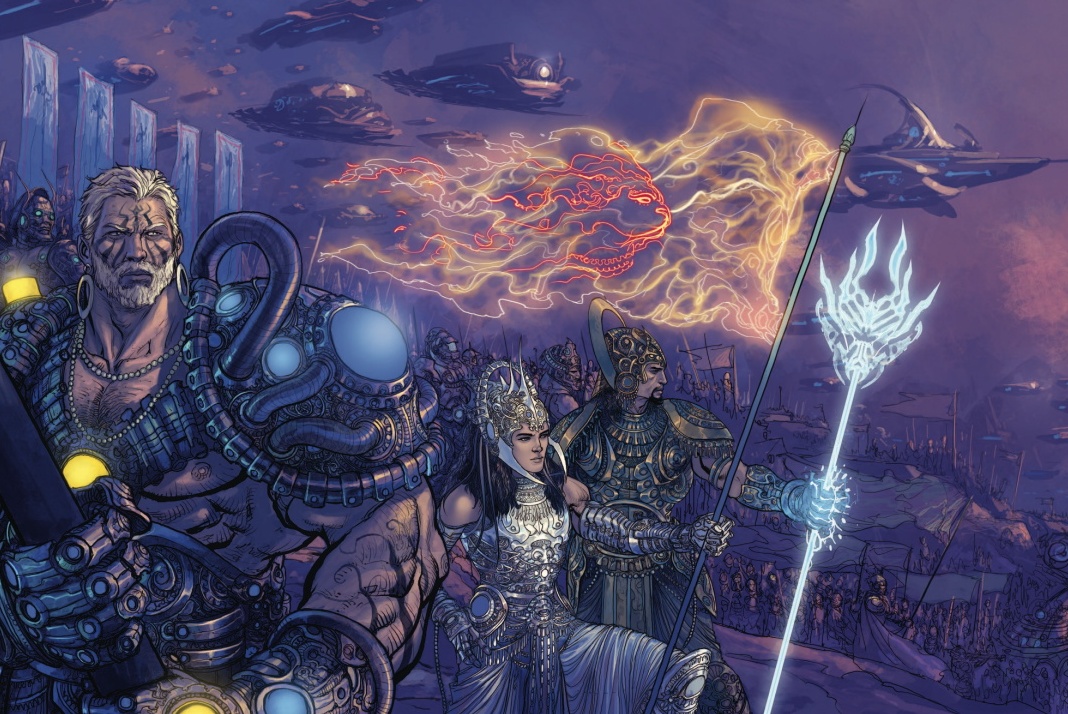
Morrison's 18 Days retells the great Mahabharata in an animated CGI drama on Youtube (you can watch it here). 18 days is the length of the battle in the Mahabharata. Image Source: Broken Frontier.

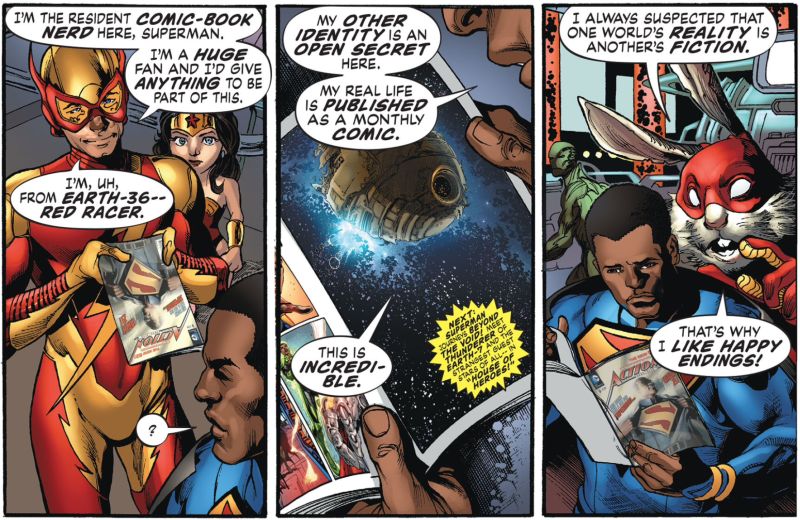
The wavering fictional reality of DC Comics resembles theories from today's quantum physicists.  A comic book fantasy of multiple Earths and multi-dimensional universes aligns with contemporary scientific ideas of a fractured multiverse and mysterious dark matter.  It makes one wonder: if our physicists are right and the multiverse is real, what sort of creatures are we because of it, and how do we feel its effects?

Multiversity #1 (October 2014). "Every comic you ever read is real." – Grant Morrison. Behind the Panels review: "Morrison directly challenges the reader. 'Whose voice is speaking in your head anyway? Yours?' The same narration urges us to stop reading. That’s when things get beautifully weird."

Are we pawns of a larger order we will never perceive? Scottish writer Grant Morrison would say: yes. He is delivering his long-promised crossover, Multiversity, right now via DC Comics, and a glance at the multiversal map below shows that he is combining years of esoteric interests - mind expansion through drug dreams, a fascination with ancient Indian epics and religions, and a belief (expressed in 2012's Supergods) that modern superheroes are manifestations of ancient gods. More importantly, in Multiversity, the heroes exist along a metafictional continuity with our reality and time. They are part of humankind's long quest to define the line between creation and destruction, from which everything else follows in this world, and other worlds too.

DC's map of the Multiversity (August-September 2014; click to enlarge). Image Source: DC Entertainment.

From 2009 to 2013, Morrison worked with Dynamite Entertainment and Liquid Comics to produce 18 Days, a retelling of the Mahabharata, in which a classic Indian battle sees the age of gods give way to the age of men. Two of the founders of Liquid Comics are author Deepak Chopra and his son, Gotham Chopra. Deepak Chopra famously discussed these ideas with Morrison at several comics conventions; the Chopras also published a book about it, The Seven Spiritual Laws of Superheroes (2011). CBR reported on one such discussion in 2006 in San Diego:
Superheroes, in Chopra's view, are not external beings. "These are archetypal beings that stoke the fire of life and passion in our own souls. These are potentials that exist within us, and by creating these superheroes through our own collective imagination, we are in a way serving our deepest longings, our deepest aspirations, and our deepest desires to escape the world of the mundane and the ordinary and do things that are magical."
Morrison draws from Indian traditions to marry that consciousness to the cosmos of existence. Thoughts become physical substances in other dimensions. The great epic of the multiverse involves the genesis of values in that consciousness through dharma and karma, action and negative action, creation and destruction, good and evil. In our reality, mythical heroes are legendary archetypes. But Morrison insists that these paragons embody physical forms in other times and places.


18 Days concept art by Mukesh Singh. Images Sources: Decode Hindu Mythology, Comic Vine, Concept Art, Dynamite Comics, Planet Damage, Mukesh Singh.

Monday, September 15, 2014

Syria's Conflict and Ancient Plunder


One of at least 18 Odyssey mosaics reported stolen from northeastern Syria in early 2013. This is a detail of Odysseus tied to his mast, resisting the sirens. Despite reports, conflicting information originally places this mosaic in Tunisia, not Syria. Image Source: Past Horizons.

Since 2011, reports have circulated that Syria's classical heritage is being ruined or plundered by the conflict in that country. When war began, there were some 78 formal archaeological digs in the country. Then the conflict between the population and the government, followed by the Islamic State, led to an obliteration of Syria's precious past. Islamic State militants, like the Taliban, abhor graven images, although they are still willing to sell the stolen artifacts which they don't destroy. They are not alone on that black market.


Full mosaic: Odysseus and the Sirens at the Bardo Museum in Tunis, Tunisia (2nd century AD). Image Source: Wiki.

On 2 September 2014, the New York Times reported that the Islamic State has set up a nasty sideline selling Syrian archaeological artifacts:
We have recently returned from southern Turkey, where we were training Syrian activists and museum staff preservationists to document and protect their country’s cultural heritage. That heritage includes remains from the ancient Mesopotamian, Assyrian, Hellenistic, Roman, Byzantine and Islamic periods, along with some of the earliest examples of writing and some of the best examples of Hellenistic, Roman and Christian mosaics.
In extensive conversations with those working and living in areas currently under ISIS control, we learned that ISIS is indeed involved in the illicit antiquities trade, but in a way that is more complex and insidious than we expected. ...
ISIS permits local inhabitants to dig at these sites in exchange for a percentage of the monetary value of any finds.
The group’s rationale for this levy is the Islamic khums tax, according to which Muslims are required to pay the state treasury a percentage of the value of any goods or treasure recovered from the ground. ISIS claims to be the legitimate recipient of such proceeds.
The amount levied for the khums varies by region and the type of object recovered. In ISIS-controlled areas at the periphery of Aleppo Province in Syria, the khums is 20 percent. In the Raqqa region, the levy can reach up to 50 percent or even higher if the finds are from the Islamic period (beginning in the early-to-mid-seventh century) or made of precious metals like gold.
The scale of looting varies considerably under this system, and much is left to the discretion of local ISIS leaders. For a few areas, such as the ancient sites along the Euphrates River, ISIS leaders have encouraged digging by semiprofessional field crews. These teams are often from Iraq and are applying and profiting from their experience looting ancient sites there. They operate with a “license” from ISIS, and an ISIS representative is assigned to oversee their work to ensure the proper use of heavy machinery and to verify accurate payment of the khums.
In addition to the looting, ISIS seems to be encouraging the clandestine export of archaeological finds, which is primarily centered on the border crossing from Syria into Turkey near Tel Abyad, an ISIS stronghold. There is reason to suspect that ISIS has approved and encourages the transborder antiquities trade.
To control history, especially to squander or erase it, is to control the future. There are some 10,000 archaeological sites scattered across the country. All are now vulnerable.

Sunday, September 14, 2014

Photo of the Day: Bergs of a Comet


Images Source: ESA via BBC.

Tomorrow, the European Space Agency is planning to announce how and where its spacecraft, Rosetta, will land on the comet 67P/C-G. This Jupiter class comet, discovered in 1969 by Klim Churyumov and Svetlana Gerasimenko, is a 10-billion-tonne mass of ice and dust, which is currently about 400 million km from earth. Here are some photos of Rosetta has already taken of the comet's surface.


Sunday, September 7, 2014

Blue Sunsets in Crimson Skies


A blue Martian sunset in a red sky, photographed by Mars Pathfinder (August 1997). Image Source: NASA via Wiki.

Are you sick of the world's turmoil? Take a fresh perspective and go off world. What does the night sky look from the surface of Mars? Are the constellations different? Does astrology change? Below, see more Martian sunsets and the view of one of the Martian moons, Phobos, from the surface of the Red Planet. The sky on Mars, like the soil or regolith, is orange. At sunset, the sky turns crimson. Sunrises and sunsets are blue. Wiki:
Around sunset and sunrise the Martian sky is pinkish-red in color, but in the vicinity of the setting sun or rising sun it is blue. This is the exact opposite of the situation on Earth. However, during the day the sky is a yellow-brown "butterscotch" color. On Mars, Rayleigh scattering is usually a very small effect. It is believed that the color of the sky is caused by the presence of 1% by volume of magnetite in the dust particles. Twilight lasts a long time after the Sun has set and before it rises, because of all the dust in Mars's atmosphere. At times, the Martian sky takes on a violet color, due to scattering of light by very small water ice particles in clouds.
On Mars, the Earth appears as the 'morning star' and 'evening star,' just the way Venus appears to us before sunrise and sunset. Our planet is the second-brightest object in the Martian night sky. From Mars, you can also see the Terran moon:
An observer on Mars would be able to see the Moon orbiting around the Earth, and this would easily be visible to the naked eye. By contrast, observers on Earth cannot see any other planet's satellites with the naked eye.
The Martian sky at noon is yellow-brown, imaged by Mars Pathfinder (June 1999). Image Source: NASA via Wiki.

Martian sunset at Gusev Crater, photographed by Spirit rover (May 2005). Image Source: NASA via Wiki.

Photo of the Day: Tethys


Image Source: NASA.

Today, from NASA, a photo from 22 July 2005: "Seen from ice moon Tethys, rings and shadows would play across fantastic views of the Saturnian system. Haven't dropped in on Tethys lately? Then this gorgeous ringscape from the Cassini spacecraft will have to do for now. Caught in sunlight just below and left of picture center, Tethys itself is about 1,000 kilometers in diameter and orbits not quite five saturn-radii from the center of the gas giant planet. At that distance (around 300,000 kilometers) it is well outside Saturn's main bright rings, but Tethys is still one of five major moons that find themselves within the boundaries of the faint and tenuous outer E ring. Discovered in the 1980s, two very small moons Telesto and Calypso are locked in stable locations along Tethys' orbit. Telesto precedes and Calypso follows Tethys as the trio circles Saturn." (Hat tip: Starship Asterisk.)

Sunday, August 31, 2014

Time and Politics 12: College Days Before the War


Click to enlarge: application form to Elon College (1913). Image Source: Elon University via Chronicle for Higher Education.

For today, as classes start at universities across North America this week, see a college application from 1913 to Elon University, North Carolina, USA. It is only four pages long! The source is a report from the Chronicle of Higher Education. Those were the days when liberal arts were both progressive and considered a solid background for doing just about anything (including, unfortunately, dying in World War I). Post-2008-recession, critics consider the liberal arts to be politicized breeding grounds of the hopelessly underemployed, unemployed and unemployable. Today's defenders of the liberal arts insist that the arts and humanities teach their students critical thinking. Part of that critical thinking can extend to considering how progressive the new Millennium really is.

A friend, J., observed that at Elon University, "They didn't mention that, until 1963, only white people need apply!" He suggested that the progressive view now recognizes that the western-centric view of history - which this application embodies with its emphasis on classics - has given way to a broader, enlightened world history.

I agreed that this is the current prevailing view, although I feel it contains an anachronism. We now assume automatically that the western-centric vision is causally bound to racism, inequality, slavery, oppression, patriarchy. The notion that today's discipline of world history is more advanced than the previously western-centric, classics-focused liberal arts curriculum includes its own hubris-laden, anachronistic assumption about contemporary progress.

In 1913, people could not travel or communicate the way we can now. So why would we automatically expect people from that time to have the same broad global vision we do? Yes, it was an oppressive, unequal, patriarchal system. But at the time, wasn't the classics curriculum the founding source of liberal arts education? Wasn't that curriculum considered the epitome of progress in 1913?

One hundred years from now, what will people say about late 20th century and early 21st century liberal views of inclusion? Probably they will say that it was woefully benighted and reflective of its own time and place. We could equally say that today's world history discipline derives from perspectives informed by economic and political globalization, not the expansion of tolerance - even though it looks that way. Isn't it true that in today's globalized world, whose official creed is advanced progressive, tech-driven liberalism, there are more slaves now than at any time in history? And beyond that conventional definition of slavery, isn't technology not-so-quietly enslaving the entire plugged-in population? Bondage happens. That brutal reality - namely, that inequality, loss of freedom, vicious hatred, and violence are integral to the shiny, ultra-advanced globalized Millennium - breaks through heady tech dreams in unpleasant surprises and shocks.