TIMES, TIME, AND HALF A TIME. A HISTORY OF THE NEW MILLENNIUM.

Comments on a cultural reality between past and future.

This blog describes Metatime in the Posthuman experience, drawn from Sir Isaac Newton's secret work on the future end of times, a tract in which he described Histories of Things to Come. His hidden papers on the occult were auctioned to two private buyers in 1936 at Sotheby's, but were not available for public research until the 1990s.


Tuesday, November 11, 2014

Remembrance Day Irreducible


Portsmouth Naval War Memorial, Hampshire, UK. Image Source: Commonwealth War Graves Commission.

A common inscription on 20th century war memorials is taken from Ecclesiasticus 44:7:
"All these were honoured in their generations, and were the glory of their times." 
The quotation, used in this context as opposed to its original biblical chapter, recalls that war is a bloody moment of transformation, which freezes in time because of the sacrifices of its participants. It suggests that war serves, in a terrible way, a social purpose which is poorly understood, and that social purpose, or change, comes at a cost. Rituals around Remembrance Day focus on values, veterans and memories. Behind that, there is the irreducible truth of episodic and savage convulsions in history, which force transformation.

Remembrance: First World War French Officer's Time Capsule


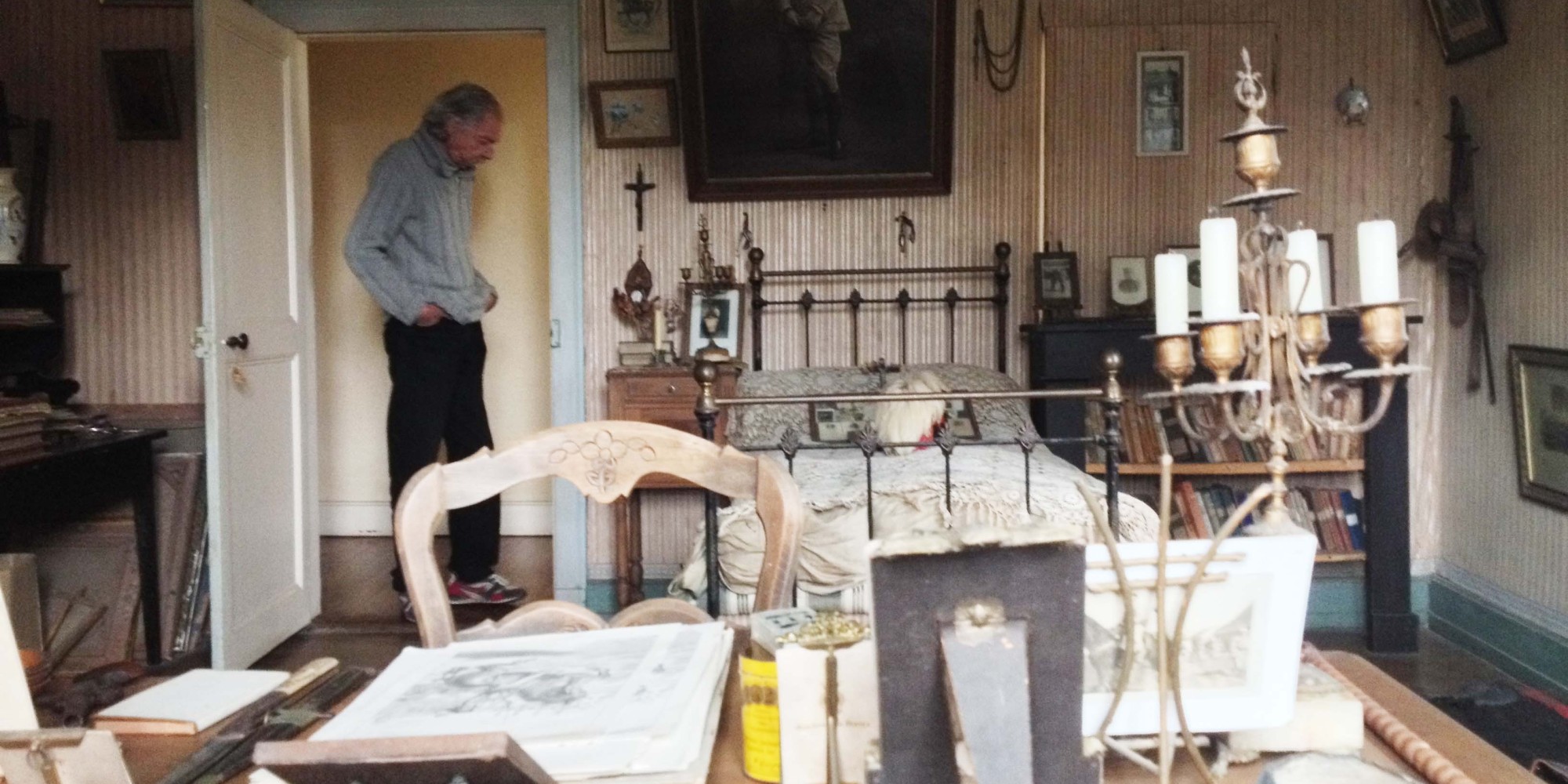
Hubert Rochereau’s room in a house in Bélâbre, France. Images Source: Bruno Mascle/Photoshot Images via the Guardian.

The Guardian recently reported on a time capsule which preserves a French soldier's room exactly as he left it before he left for the front during the First World War. It haunts the viewer and brings back to life a European domestic world that would be forever transformed by the war. The family stipulated that the room should not be changed for 500 years:
The name of dragoons officer Hubert Rochereau is commemorated on a war memorial in Bélâbre, his native village in central France, along with those of other young men who lost their lives in the first world war.

But Rochereau also has a much more poignant and exceptional memorial: his room in a large family house in the village has been preserved with his belongings for almost 100 years since his death in Belgium.

A lace bedspread is still on the bed, adorned with photographs and Rochereau’s feathered helmet. His moth-eaten military jacket hangs limply on a hanger. His chair, tucked under his desk, faces the window in the room where he was born on 10 October 1896.

He died in an English field ambulance on 26 April 1918, a day after being wounded during fighting for control of the village of Loker, in Belgium. The village was in allied hands for much of the war but changed hands several times between 25 and 30 April, and was finally recaptured by French forces four days after Rochereau’s death.

The parents of the young officer kept his room exactly as it was the day he left for the battlefront. When they decided to move in 1935, they stipulated in the sale that Rochereau’s room should not be changed for 500 years.

Image Source: HuffPo.


Photos from HuffPo include a photo portrait of the officer. Images Source: Matthieu Bock of Europe1 via HuffPo.

Image Source: news.com.au.

Image Source: tumblr. 

Image Source: tumblr. 

World War I, Day by Day


Monks watch the bombardment of Liège by a Zeppelin Airship. "Deutscher Luftflotten Verein" in the Battle of Liège (6 August 1914). Image Source: WWI Propaganda Cards.

To remember the centenary of the beginning of the First World War in 1914, the BBC has a general Website (here) and posted several podcast series (here; thanks to -C.). Among them, 1914: Day by Day (here) is narrated by historian Margaret MacMillan and gives a day-by-day account of the opening of the war in 1914, based on archival documents. By presenting this history in short recordings, one gains an understanding of how a great war could unfold on a daily basis and how contemporaries reacted. Imagine their shock and growing fear, their realization that this war was different from all the ones before it, when the Bank of England was forced to close on 31 July 1914, or when German Zeppelins bombed the Belgian city of Liège, the first air attack on a European city, on 6 August 1914.

Zeppelin attack on Liège 9 August 1914 (Albert Ebner Kunstanstalt München). Image Source: WWI Propaganda Cards.

The bombardment of Liège (Gustav Liersch Berlin Kr. 45 Art by: Hans Rud. Schulze). Image Source: WWI Propaganda Cards.

Wednesday, November 5, 2014

A Charm of Early Faith and Everlasting Life


Image Source: ReJesus.

Mysterious Universe reports on the discovery this September of a sacred charm, which demonstrates the earliest known use of magic in the Christian religion. (Hat tip: Graham Hancock). The spell is written in Greek on a 1,500 year old papyrus and dates between 574 CE and 660 CE. It was uncovered by researcher Roberta Mazza among other papyrii in the archives of the Library at the John Rylands Research Institute in Manchester, UK. Mazza assumed that folds in the papyrus indicate that the charm was likely worn inside a locket for protection. She remarked:
"The almost illegible text says that it was  released in the village of Tertembuthis (modern el-Ashmunein [in Egypt]) and is a receipt for the payment of grain tax which was certified by the tax collector from the village. Therefore we may reasonably guess that the person who re-used the back for writing the amulet was from that same village or the region nearby, although we cannot exclude other hypotheses. ... The amulet maker would have cut a piece of the receipt, written the charm on the other side and then he would have folded the papyrus to be kept in a locket or pendant. It is for this reason the tax receipt on the exterior was damaged and faded away."
Earliest known Christian magical spell refers to the bread at the Last Supper as manna from heaven. Image Source: Capital OTC.

The amulet links the Jewish Old Testament idea of manna, or food from heaven created at twilight on the sixth day of Creation, to the sacred bread eaten at the Last Supper, as described in the New Testament. This connection suggests that manna was the bread at the Last Supper, and it granted everlasting life to those who consumed it because it came from a celestial and sacred source. Manna is a curious symbol which bridges the physical and the metaphysical. As a charm, the papyrus embodies and coveys to its bearer some of that transitional power:
Whether or not it is overtly acknowledged as such, modern Christianity certainly maintains many of the primary components that could allow us to make such comparisons; namely that of prayer, and belief in its healing power as wrought by a merciful creator of all existence. And although it is aged by some 1500 years, the papyrus charm newly rediscovered at John Rylands Research Institute in the UK signifies the earliest known instance of such superstitions being observed in conjunction with a physical token of some kind.
The charm's text combines words from Psalm 78:23-24, Matthew 26:28-30 and other Biblical passages and reads:

“Fear you all who rule over the earth.
Know you nations and peoples that Christ is our God.
For he spoke and they came to being, he commanded and they were created; he put everything under our feet and delivered us from the wish of our enemies.
Our God prepared a sacred table in the desert for the people and gave manna of the new covenant to eat, the Lord’s immortal body and the blood of Christ poured for us in remission of sins.”


Monday, November 3, 2014

Small Worlds


Rotifer showing the mouth interior and heart shaped corona (40x) by Rogelio Moreno (2014). 1st Place.

Here are some of the winners from Nikon’s annual Small World microscope photography contest. (Hat tip and Images Source: Wired.)

Rhombohedral cleavage in calcite crystal (10x) by Alessandro Da Mommio (2014). 2nd Place.

Sunday, November 2, 2014

Feast of the Faithful Departed


Image Source: Salt and Light.

Today is All Souls' Day, when Catholics and other Christians celebrate the souls of the faithful departed. Salt and Life blog summarizes the meaning of this feast:
All Souls are our family and relatives, our neighbors and friends, our ancestors, that “cloud of witnesses” who accepted the godly realism of their lives, shared it with others already on earth, and continue to do so now before the throne of the Lamb in heaven. For this reason, they are truly blessed, and give us a reason to hope, to believe, to struggle and to live. The feast of All Souls and the month of November is a source of consolation for each of us.
All Souls follows the carnival of the dead in October, when unsettled and unforgiven spirits are freed to bewitch and unnerve, to drag away unsuspecting people and seduce them with the pleasures of the world and ensnare them in purgatorial diversions. What follows Hallowe'en's excesses is the celebration of All Saints on 1st November. And then on the 2nd of November, All Souls, a renewal of perspective, a pulling together, a recollection of what really matters.

The Christian feasts incorporated pre-Christian holidays, creating a yearly calendar that is a moral and psychological journey, bound up with the cycles of nature. Just as it is normal to go through periods of self-doubt, to lose one's way, it is natural, having found a new path, to experience a sense of renewed direction and purpose.

While this psychological journey is represented in other religions, the central challenge of the Christian tradition has always incorporated a tension between the individual and the collective. The historically Christian societies seek to resolve this central paradox: how can one battle to achieve the greater good in individualistic societies, which abhor an all-dominant collective? Which comes first: the individual or the community?

If Hallowe'en is a voyage into the excesses of the self, then All Souls is a reminder that there is a departed, silent collective, whose journey was somehow victorious. These souls still bear witness on the living. Even from a non-Christian or secular perspective, the symbolic message of such a journey is epic and compelling. Will the ghosts of 107 billion people bring counsel to those who are living stewards of reality?

Friday, October 31, 2014

Happy Hallowe'en 2014!


Henry Fuseli (1741-1825), Fairy Mab (c. 1815-1820). Folger Shakespeare Library, Washington. "Mab is the chief fairy in folklore and literature. Fuseli's source for this subject was John Milton's poem L'Allegro (around 1630). The painter claimed that he was attempting to express 'female Nature'. Fuseli emphasises the themes of sensual indulgence and sexuality, with a fairy slumped into a bowl of junket (sweetened cream) and another little spirit holding a spoon and bowl, symbolising male and female genitals."-Tate. Image Source: Madame Pickwick (Hat tip: -C.).

Happy Hallowe'en! This marks the end of the Countdown to Hallowe'en blogathon. I was too busy blogging to check all the other participants, but be sure you do so (here). I did have a chance to look at Plaid Stallions, Dark Mind of a Feminist, The Ghost Town, The Grim Gallery, Limer Wrecks, Russian Nerd, Radiator Heaven, and Wonderful, Beautiful, and Strange Finds, and I was not disappointed!

On the Internet, reddit is Creepy Central; you can look at these subreddits for Hallowe'en chills, but you may regret it.
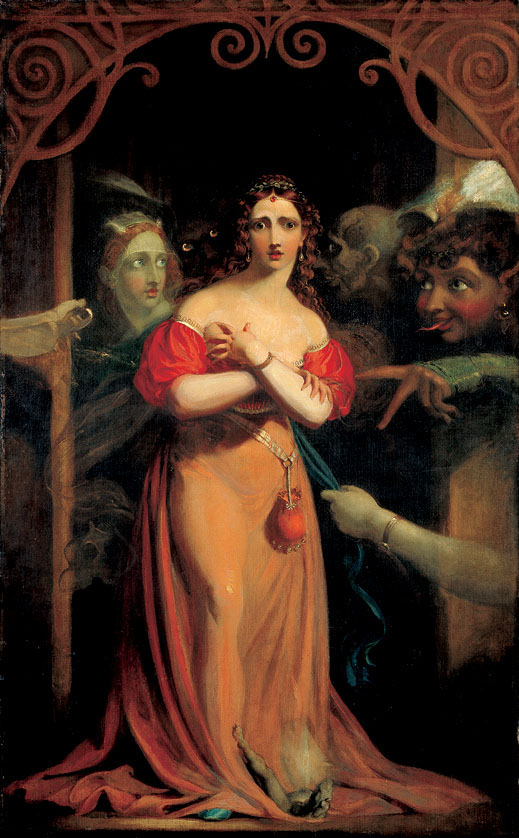
Theodore Von Holst (1810-1844), Bertalda, Assailed by Spirits (Bertalda von Kuhleborns Geistern erschreckt) c.1830. Von Holst was Fuseli's student. This painting is taken from the novella Undine (1811) by Friedrich de la Motte Fouqué. Image Source: Wiki.

Below the jump, see more creepy sights, read spooky stories and listen to ambient suspense and ambient horror music. All copyrights belong with creators and are reproduced under Fair Use for non-commercial appreciation and discussion only.

Thursday, October 30, 2014

Counting Down to Hallowe'en: The Death Rites of the Toraja


Tau tau - Toranjan effigies of the dead - on a balcony in Indonesia. 'Tau tau' means 'like a person' or 'little person.' Image Source: Wiki.

The most elaborate funeral rituals in the world occur among the Toraja people of South Sulawesi, Indonesia. The locals have partly converted to Christianity, and partly to Islam. The remainder adhere to a system of polytheistic animism known as Aluk ('the Way' or 'the Law' - a religion of laws and habits); in this tradition, death is central to the culture. Because death rituals were and are so important to this culture, they persist among converts to other religions who have otherwise abandoned Aluk, at least insofar as life-oriented rituals are concerned. Thus, one might have a hybrid religious life: a Christian wedding but a traditional, animist funeral.

Among the Toraja, dying is an epic journey with several stages, starting with an in-between state where the living make the dead walk through all the places they frequented in life. These are complicated funerals which can last for years, because the higher the status of the deceased individual, the more expensive and involved the funeral, including sacrifices of many buffaloes and pigs and the involvement of the entire community in some ceremonies. Family economies revolve around the stages of death, rather than the stages of life. Ancient Origins:
During their lives, the Tarajans work extremely hard to accumulate wealth. But unlike other societies, the Tarajans do not save their money to give themselves a good life, rather they save for a good send off in death. In fact, it is the extravagance of the funeral, not the wedding, which marks a family’s status.
At the second stage after death, the physical presence of the dead person splits in two between the corpse and a doll version of the corpse, called the tau tau; the act of carving is divided into several stages, punctuated by sacrificial offerings:
The tau-tau is fashioned before the second phase of a major mortuary ritual for the dead commences. During the manufacture of the doll, the woodcarver sleeps near (or even under) the house where the deceased lies on view. Actual work on the effigy also takes place in the vicinity of his house, possibly even on the floor of the rice barn opposite the tongkonan. When the image is completed it is placed beside the dead. Just like the deceased, the tau-tau receives food to eat (an offering, indeed, for giving food to the tau-tau is a ritual process). All this occurs before and during the second phase of the ritual, in other words for quite same time, as the time lapse between the first and the second phase of the ritual can be considerable.
Expenses include everything from the required carving and dressing of the tau tau effigy to buying the corpse new clothes and cleaning the body at least every three years, in a ritual called Ma’nene.

Further cruel sacrificial blood-letting (and subsequent meat distribution according to social status to both the corpse and living villagers) which follows is matched by the eerie fact that the body is not buried until the family raises funds to cover vast funeral expenses. Therefore, one may confront a corpse hanging around the house and town until his or her relatives can afford to inter the body:
When a Torajan dies, family members of the deceased are required to hold a series of funeral ceremonies, known as Rambu Soloq, over many days. During this time, the deceased is not buried but is embalmed and stored in a traditional house under the same roof with his or her family. Until the funeral ceremonies are completed, the person is not considered to be truly dead but merely suffering an illness. The dead relative is referred to simple as “a person who is sick” or “the one who is asleep”. Remarkably, this could even last several years after death, depending on how long it takes the family to raise money.
These practices have fueled a counter-surge of funeral tourism among foreigners, fascinated by this grim religious fixation on the liminal stage between life and death.