TIMES, TIME, AND HALF A TIME. A HISTORY OF THE NEW MILLENNIUM.

Comments on a cultural reality between past and future.

This blog describes Metatime in the Posthuman experience, drawn from Sir Isaac Newton's secret work on the future end of times, a tract in which he described Histories of Things to Come. His hidden papers on the occult were auctioned to two private buyers in 1936 at Sotheby's, but were not available for public research until the 1990s.


Friday, April 24, 2015

Time and Politics 14: Who Now Remembers the Annihilation of the Armenians?


Image Source: BBC.

Wer redet heute noch von der Vernichtung der Armenier? Who now still speaks of the annhilation of the Armenians? These were Hitler's words to the German military forces on 22 August 1939. In this speech, he ordered them to invade Poland and exterminate the Polish people. He insisted that the Poles were expendable, not just at that moment in an act of war, but that they could be completely wiped from the pages of history. The monstrous idea behind Hitler's imperial vision - he who writes history controls politics, society and the future - applied deadly lessons from World War I; it was recognized by other world leaders and thinkers at the time. In one sentence, the German leader summarized his clear, conscious awareness that history could be altered, and it was on that basis that one could do anything to anyone to achieve near-infinite aims.

Today is the 100th anniversary of the start of the Armenian genocide. Source: imgkid.

Tuesday, April 21, 2015

Saturation Point


Image Source: Business2Community.

Singularity experts regard ageing as a complex set of biological mechanisms which can be decoded, rebooted with stem cells, rejigged genetically, medicated, contained, redirected and even reversed. This is a literal-minded over-rationalization. Gurus like Ray Kurzweil set a date for the onset of the Singularity (the year 2045!), the way wild-eyed prophets used to arrive out of the desert to predict the end of the world. The end of the world was often a year that was almost, but not quite, over the horizon.

Perhaps ageing can be conquered by downloading human consciousness into a computer, or eased by engaging with the arts and material culture. However you choose to attack the problem, once you are out of the goldilocks zone of ages 18 to 35 - the period when the world weighs your juvenile potential and considers you to be naturally synchronized with material dynamics - the ageing process asks you one simple question about psychological agility: how much change can you take? Can you bear the emotional burden of the Singularity? What is your saturation point?

In Kim Stanley Robinson's Mars trilogy, the scientific unlocking of ageing biology and related diseases is fairly easily accomplished. The real challenge comes when the ultra-aged face prolonged mental distress as their brains are expected to survive beyond a normal human lifespan. After the Singularity, Robinson predicted, the eternally young will go mad. Only the most resilient will learn how to survive, and the results will not be pretty.

Saturday, April 18, 2015

More Human than Human


Ed (2014) © Chris Jones. Video Source: Youtube.

For today, see a sample of computer generated imagery from September 2014. Soon, we won't be able to tell real people from virtual humans online. From the creator, Chris Jones:
Work in progress, hand-made with Lightwave, Sculptris and Krita, composited with Davinci Resolve Lite. Music by me. ... Due to popular demand I'm attempting to extend the soundtrack, but it's not coming easily... so it could take a while. No scans, motion capture or photos were used (except for reference). First half rendered in ~800 hours on a 2008 vintage quad core. Additional rendering by GarageFarm.


Wednesday, April 15, 2015

Little Pockets of Eternity


The Photography Workshop is the Website of Mumbai-based photographer Kedar Kulkarni. You can see his personal gallery here, and particularly his beautiful photos of small town India here. Kulkarni also runs workshops for other photographers and posts their works. For today, see images from the site taken by Dinkar Patil. In November 2014, Patil captured the animate, the inanimate and the people along the Narmada River, all interacting in the breathtaking regional environment and eternal light of India. This was Patil's Roadtrip Series 5:
The walking part of the journey began in Vadodara, Gujurat, India and ended in Jabalpur, Madhya Pradesh, India. A total walking distance of 800 kms that was completed in 32 days, with rest stops, with an average of 30 kms, walked per day for a total per day, walking time of between 7-8 hours.
Patil does something curious here. Stone gods clustered in corners come alive, while the landscape's living inhabitants begin to look fixed and permanent. It is a fascinating swap.


Patil's style is un-photoshopped, anti-glossy, uncontrived. It could be Kulkarni's influence, who lists his great inspirations in the history of photography here. Patil's photos take the viewer back to a time when we still believed in a reality, served by the camera. From the dawn of photography, photos documented interactions between an artist, a tool, and the environment. At that time, we kept track of things, rather than things keeping track of us. We were the actors and agents, not our tools. By contrast, in today's graphics, the camera dominates the photographic story. We are no longer watchers, we are watched. Cameras and other tools for seeing (and spying) oppress us in an endless House of Mirrors with meta-visions and meta-narratives. Thankfully, that is not the case here: in Patil's work, some little pockets of eternity slip through his lens.

Monday, April 13, 2015

Photo of the Day: Suntory Whisky 3D on the Rocks


See more of Suntory's 3D-printed ice cubes here, and my earlier post on Blade Runner custom scotch glasses, here. A 3-D printing Redditor corrects this story: "Not 3d printed -- idiot reporter thinks anything computer controlled must be a 3d printer... It was milled with a very awesome mill."

Sunday, April 12, 2015

Forever: Maybe Not the Word You Want?


Johnny Depp's original 'Winona Forever' tattoo. Image Source: johnnydepp.org.

In the past couple of days, the word forever kept coming up. Finally, it all converged in a 'plate of shrimp' moment. The first mention came up in this analysis at The White Review of Johnny Depp and Winona Ryder. The article, Famous Tombs: Love in the 90s, described Depp's and Ryder's relationship as the American youth romance of the decade. Author Masha Tupitsyn then probed a more interesting question. She almost cracked what, exactly, happened to the Depp-Ryder romance, not in terms of what it meant privately to the two actors, because we can't know that, but what it represented to the rest of us.

Image Source: Buzzfeed.

Tupitsyn hints that it never went anywhere, but Johnny and Winona did. She believes that Depp sublimated it in alcohol and drugs, replacing love for a woman with addictions so distracting that it became impossible to get back to the original source. Meanwhile, Ryder moved forward, but part of her is still trapped in that past time. It wasn't just her love for Depp. She embodied a decade for Generation Jones and Gen X rebels, symbolized by the curious fact that she is naturally a blonde, but for decades has dyed her hair Gothic black:
Like John Cusack, another black haired/pale skinned 80s/90s idol, as well as a youth actor whose great, and perhaps only gift, was to enact a different kind of youth (a counter-youth and counter-masculinity) in his youth, Winona Ryder was never timeless, she was of the time. Most especially that brief time in her life, her teenage years and early twenties. Perhaps this is why Jake Gyllenhaal’s light hair was dyed jet-black for the retroactive DONNIE DARKO, and Christian Slater’s jet-black for HEATHERS. Something about dark hair showing up in the late 80s and early 90s as a form of retribution for an aesthetically fascistic and representationally narrow decade. These are people who were not kissed by the sun, who were not California Dreamin’, or, as the German writer Heinrich Laube puts it, ‘These pale youths are uncanny, concocting God knows what mischief.’ If, as the teenage radio pirate DJ, ‘Hard Harry’ puts it in PUMP UP THE VOLUME (1990), the 80s were a totally ‘exhausted decade, where there’s nothing to look forward to and no one to look up to’, Winona Ryder rose up from the bleached-blonde ashes of the 1980s.
Depp and Ryder started in gothic and horror genres. Their early work, like that of contemporaries Keanu Reeves, Parker Posey and River Phoenix, appeared in dark indie films or popular movies with unsettling vibes. Depp made his feature film debut in Nightmare on Elm Street (1984), in which he played a nice but useless boyfriend. These roles reflected a time, when, for a brief period, surreal depictions of the collective unconscious entered the American mainstream in almost unedited forms. It was remarkable. David Lynch, an American director surreal enough to be respected by Europeans, became popular, as his Twin Peaks exposed the underside of the American Dream.

Wednesday, April 8, 2015

Perspectives and Milestones


Paul Stankard's handblown glass pieces look impossible to create. In Beauty Beyond Nature, he discusses the craft. Image Source: Paul Stankard via boing boing.

This blog has just passed 2 million hits! Welcome to the 1359th post and the end of the blog's fifth year. Thank you to everyone who has stopped here. Your time is precious and comments are always appreciated. Thank you to every interviewee who has been kind enough to discuss your work. And thank you to other bloggers I have met along the way, who have shown me the value of real-time publishing. These bloggers are all amazing people, intelligent and gifted mavericks (you know who you are), who know what to read on a desert island, and how to walk the line.

This blog was partly inspired by a site called The Strip, and partly by the late Mac Tonnies, whose blog (now in paperback on Amazon here) was published from 2003 until his untimely death in 2009. Tonnies' Posthuman Blues remains a landmark. Sometimes I revisit his blog, and I am still amazed by his ideas and vision, his uncanny ability to pin down the Zeitgeist, to channel the new Millennium's collective unconscious, to decrypt and encrypt a cultural environment of changing symbols, to describe the future.

Blogs remain relevant because some are still independent. Media independence? Political neutrality? What's that? Although media outlets co-opt blogs to make them branded social media products, some blogs remain artistic life statements and authentic testimonies. Readers follow a blogger on a personal journey as he or she tries to make sense of the exploding world of communications. So, Histories of Things to Come is based on a true story.

Tuesday, April 7, 2015

Planet Walkers


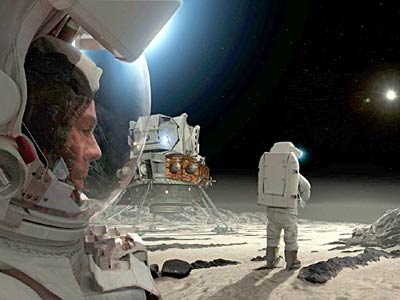
Press imagery for the BBC series, Voyage to the Planets (2004). Image Source: BBC.

For today, here are two fictional Youtube videos on what it would be like for astronauts to walk on the surfaces of Venus and Pluto. The clips are modified, taken from the 2004 BBC TV series, Space Odyssey: Voyage To The Planets. This award-winning, fake-umentary series speculated on what a manned exploration of the solar system would be like:
Five astronauts pilot the nuclear thermal rocket powered Pegasus spacecraft on a tour of the solar system. Their mission is a collaboration of the NASA, CSA, ESA and РКА space agencies and takes the crew to Venus, Mars, a close flyby of the Sun, Jupiter’s moon[s] Io and Europa, Saturn, Pluto, and the fictional Comet Yano-Moore. Most of the planetary destinations the crew reaches are followed by a manned landing there. Prior to the mission large tanks of hydrogen were deposited in stable orbits around the planets to allow the crew to refuel to have sufficient delta-v for the multi-year mission.

The crew encounter many hardships and disappointments along the way. A Venus EVA that almost ends in disaster when the lander Orpheus encounters launch delays, the near-loss of the shield during the aerobrake in Jupiter's upper atmosphere and the loss of samples from Jupiter's moon Io all test the crew's resolve. The most devastating blow comes when the ship's medical officer dies of solar radiation-induced lymphoma in Saturn orbit, forcing the crew to decide whether to continue the mission to Pluto, or abort and return to Earth. In the original British release, the crew decides to press on to Pluto, making history. The American version, broadcast on The Science Channel, was trimmed for length, the crew deciding to turn back at this stage rather than continue. The programme is narrated by David Suchet.
I don't know how long the links will last, but the series is up in parts on Youtube and another link is on Vimeo:

Voyage to the Planets still (2004). Image Source: BBC via The Space Review.

Voyage to the Planets (2004) concept art by Daren Horley. Image Source: The Rogue Verbumancer.

The Youtuber who posted the Venusian clip argues:
Theoretically , we can build VENUS SPACE SUIT. "Chief Navy Diver Daniel Jackson (US Navy) holds the depth record using an ADS. On August 1, 2006 he was submerged at 2,000 feet (610 m) deep off the coast of La Jolla, California." Venusian pressure is an equivalent to a 1-km-deep water ocean. Pressure isn't even the biggest problem , the biggest problem is temperature and acid in atmosphere. But if we landed on the highest mountain Maxwell Montes, conditions would be much more better: pressure - equivalent to a approx. 325 m(!) in ocean , temp. 650 F (+343 C). We can create suits made of titanium [melting point is more than 1,650 °C or 3,000 °F] and use basalt-based fiber technology with a thermal range of -260 C to +982 C (1800 F) and melt point of 1450 C . The biggest problem is to create corrosion resistant coating and effective cooling system. 

Atmospheric diving suit (2006), a potential precursor for a Venusian spacesuit.
Image Source: U.S. Navy photo / Mass Communication Specialist Seaman Chelsea Kennedy via Wiki.