TIMES, TIME, AND HALF A TIME. A HISTORY OF THE NEW MILLENNIUM.
Comments on a cultural reality between past and future.
This blog describes Metatime in the Posthuman experience, drawn from Sir Isaac Newton's secret work on the future end of times, a tract in which he described Histories of Things to Come. His hidden papers on the occult were auctioned to two private buyers in 1936 at Sotheby's, but were not available for public research until the 1990s.
"A penumbra is defined as incomplete or partial shadow. In astronomy, it refers to the shadow cast on the earth by the moon in a partial eclipse. Brooklyn-based artist Randall Stoltzfus translates these natural phenomena in his current body
of work. ... 'My paintings take light as subject, and by necessity shadow is what I need to describe that light,' says Stoltzfus. These painted fields of circular marks also echo the rings of light found in the shadow patterns beneath trees during a solar eclipse - a visual metaphor that Stoltzfus maintains as an artistic touchstone. ... Sight and perception are intrinsic to Stoltzfus’ thoughtful process. 'Our perception is ... always partial, and always collective in a way we sometimes find difficult to acknowledge,” says Stoltzfus. 'We see individual things, less often aware of the broader condition of light and shadow that make this possible. The sources that power our sight dwarf what we actually comprehend.'"
"'I paint the circles by hand. That might seem like an odd thing to do in the information age, but I’m doing it this way on purpose,' says Stoltzfus. 'I’m hoping that you’ll notice how each circle is different. And noticing this, your seeing will begin to slow.' Building continuous circular patterns with layers of oil, adding carefully selected pigments, gold leaf, and other media, his textured works produce abstract horizons and subtle forms that are equally alluring and otherworldly. Stoltzfus' works often make reference to biblical allegories, an influence of his Mennonite upbringing."
Fukushima Reactor #3 (10 February 2016). Image Source: Reuters.
11 March 2016 is the fifth anniversary of the Tōhoku 9.0 earthquake and tsunami and subsequent level 7 nuclear disaster at Fukushima Daiichi power plant. I have discussed these events here, here, and here. Over 220,0000 people have been displaced; officially, almost 16,000 people died, with over 2,500 missing. It is a catastrophe which tests political and moral attitudes, values and perceptions. It depends how you interpret the information, because Fukushima sits right where the line of confident science and powerful technology breaks down, because everyone agrees that cleaning up the mess is beyond our current knowledge and capabilities. Unfortunately in Japan, there is also a conflation between showing a correct patriotic attitude and acknowledging a technological and environmental breakdown that affects us all.
RT (23 September 2015): The Fukushima disaster was preventable, and came about due to poor planning and engineering failures. Video Source: Youtube.
Despite Fukushima, there is an increased global commitment to nuclear electric power, due to increasing demands for electricity to run the Internet and to drive global development. In researching one related post for this blog, I found that several contracts were concluded in 2012 to build new nuclear plants around the world. The money is made now in short term business deals. When things go wrong with this technology, we pay the price for thousands of years. One could argue that the plant personnel were blameless, because the accident was caused by the horrific earthquake and tsunami. But the Japanese government showed distinct lack of foresight 45 years ago, when its officials decided to build rows of nuclear reactors, on unstable ground, by the sea, right on a giant earthquake fault. After Fukushima, only Germany instituted an Energiewendeand stepped back from nuclear power, and their Chancellor is a physicist.
On 18 April 2015, Tokyo Electric (TEPCO) sent a robot into Reactor #1 to investigate, but the machine broke down due to radiation. Image Source: TEPCOvia Fukushima Diary.
20 March 2015: Reactor #1 muon photography of the Reactor Pressure Vessel, with corium missing. Image Source: TEPCO via Extreme Tech.
"According to the new estimate, all the melted fuel penetrated the pressure vessel, fell onto the bottom of the containment vessel and melted about 68 cm into the concrete."
On 20 October 2015, TEPCO sent a robot into Reactor #3 to find out what had happened to the Primary Containment Vessel. The robot - a 3D-printed one with a smartphone attached, no less - gave limited results, here; its photos are below. On 17 December 2015, TEPCO finally admitted that from 14 to 16 March 2011, radioactive steam from Reactor #3 and MOX fuel leaked into the environment after a melt-through of the Primary Containment Vessel. They also confirmed that they observed "black smoke" rising from Reactor #3 from 21 to 23 March 2011.
16 October 2015: "Investigation Results inside Unit 3 Spent Fuel Pool using a Waterproof Camera in Fukushima Daiichi Nuclear Power Station." Image Source: TEPCO.
20 October 2015: "Investigation Results of the Inside of Unit 3 Primary Containment Vessel (PCV) at the Fukushima Daiichi Nuclear Power Station." Image Source: TEPCO.
22 October 2015: "Investigation Results of the Inside of Unit 3 Primary Containment Vessel (PCV) at the Fukushima Daiichi Nuclear Power Station." Image Source: TEPCO.
Greenpeace via RT(10 February 2016): "Fukushima causes mutations & DNA damage with 'no end in sight.'" TEPCO workers outside Fukushima Reactors #3 and #4. Image Source: RT.
Mikhail Gorbachev, when discussing Chernobyl, described the possibility of a China Syndrome and contamination of the Black Sea as something that had to be prevented at all costs. At Chernobyl, it was prevented because the Soviet government brought in Siberian miners on a suicide mission to build a huge concrete barrier underneath the plant, to block the corium's path. At Fukushima, China Syndromes were not prevented. On 26 October 2015, The Japan Times reported that 400 tonnes of radioactive water were being dumped into the Pacific Ocean every day.
4 March 2016: "Workers get changed into their protective clothing inside the anti-seismic building before working on the radiation decontamination process." Image Source: Gizmodo.
22 April 2013: "Dead Mice Found in the Outdoor Transformer Box for Unit 2 Spent Fuel Pool Alternative Cooling System at Fukushima Daiichi Nuclear Power Station." Image Source: TEPCO.
Citizen-Scientist International Symposium on Radiation Protection November 2014 closing remarks. Posted on Youtube on 23 October 2015; at time stamp 36:15 hear comments from Keith Baverstock, former World Health Organization regional adviser for radiation and public health: "I am really appalled by how the international system has failed. ... Quite frankly, we don't get anything through the media. ... There is no general understanding of the situation ... here in Europe because the media are not putting this view forward. In fact, I think many people would be very surprised that it was still a matter for discussion. And they would be even more surprised to learn that it was still an ongoing accident and that it hasn't terminated yet. And they would be even more surprised that nobody has any good ideas on how to stop it." He argued that the IAEA faces a conflict of interest when investigating nuclear disasters and that Japan is breaking international laws by dumping radioactive material into the ocean. Video Source: Youtube.
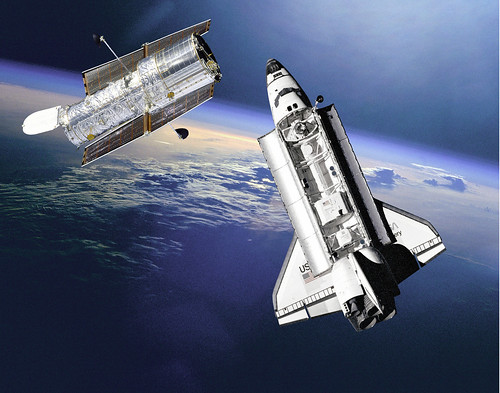
In 1990, the Discovery crew installed and later maintained the Hubble Space Telescope, which hugely expanded our view of the stars. Image Source: flickr.
The 2012 total solar eclipse as seen from Queensland, Australia. Image Source: EPA via Daily Mail.
On March 8 and 9 there is a total solar eclipse. It begins on 8 March 2016 at 11:19 p.m. UTC. It reaches its maximum point on 9 March at 1:59 a.m. UTC. The full eclipse will end in its range of visibility on 9 March at 3:38 a.m. UTC. The totality will be visible in Sumatra, Borneo, Sulawesi and the partiality in locations across the Pacific.
Visible area of solar eclipse, 8-9 March 2016. Image Source: Time and Date.
Years ago, I concluded that changing one's name artificially is a hex sign. Someone has built a fake reality for themselves around a fake identity, an alter ego. Of course, that depends on the circumstances; and now, alter egos and icon names are everywhere on the Internet. The original question concerned what is fake and what is real when it comes to building reputation through a public persona. In those pre-Internet days, a fake name propelled a figure forward to become more real and credible than the original person, for all the wrong reasons.
In 1974, Orson Welles made a documentary - his last completed major work - about disinformation and the agency it gives to fake people. His film, F for Fake, concerns a notorious Hungarian art forger, Elmyr de Hory (1906-1976), who sold hundreds of fake copies of paintings by master artists, authenticated by art experts, to top galleries and museums. The film also focuses on the forger's biographer, Clifford Irving. Irving made his name by writing a fake biography of Howard Hughes, which was completely fabricated and for which Irving spent nearly two years in prison.
Welles encountered these characters in Ibiza, Spain. As he tried to get to the bottom of this story, the director confirmed how impossible it was to unravel liars' lies. Over time, their fabrications gained credibility and authority, based on reputations, cultivated layer by layer, over decades in exclusive social settings. In another short from the same period, set inside a fake private gentlemen's club in London, he poked fun at class and wealth as sources of enduring historical and social authority. He thought it comical that those who acquire higher levels of class and wealth gain historical weight, no matter what their true value. And in F for Fake, he found that when liars move in these temporally-weighted circles, first to lie, then to 'come clean' and tell the 'truth' (even if they never really do), they gain even more false authenticity.
De Hory's art forgeries reflected that, because art masterpieces are part of wealthy settings. Great art is considered to be durable, a lasting testament; it has more temporal weight than wealth. Artworks are luxury items which allow collectors to augment their wealth and class status, to build identity through assertions of taste. With art ownership, collectors associate the constructed longevity of their identities with the longevity of the artwork. Today's art world has responded to this market by seeking new 'great master' prodigies, who must produce more 'great works' for a nouveau 'ageless canon.' New billionaires buy new 'masterwork' art pieces, and the billionaires and the art artificially inflate each other's perceived lasting value. In Welles's terms, they are all fakes. One painter in his film shrugged: "The fakes are as good as the real ones, and there is a market and there's a demand [for them]." Welles set out to resolve how money, fame, power and time were wrongly connected in people's minds.
F for Fake provoked introspection, since Welles was reminded of his own fake 1938 War of the Worldsradio drama performance about a Martian invasion, which people believed was real. F for Fake was further reminiscent of the film which made Welles's name at age 26, Citizen Kane, a fictional history of the character Charles Foster Kane, newspaper-magnate-turned-presidential-candidate. Kane was modeled on the real media tycoon, William Randolph Hearst. The last section of F for Fake includes some autobiographical asides, after which Welles deliberately transformed the documentary into a faux-documentary, starring his girlfriend at the time, Oja Kodar. He confessed in the last few minutes of the film that he had created a 'film forgery.' "Art," he said, "is a lie that makes us realize the truth." You can watch F for Fake here, while the link lasts.
To quote a reviewer: "So if you're keeping track, F for Fake is a fake documentary, about a fake artist, being described by a fake writer, and framed by a self-described fake super genius person." It is a difficult, scattered film, now dated, and was poorly received by critics. Others defend it, especially because the film hinged on a single scene of crystal clear truth. American media psychologist James Herndon deemed one clip (below) from F for Fake to be "the profoundest moment in all of cinema." In it, Welles suggested that every expression of genius, identity, or creativity is limited and fleeting. The director approached Chartres cathedral in France as the silent testimony of anonymous artists, whose greatness will transcend the mortal condition only for a few centuries or millennia. Any attempt at creativity, no matter how beautiful, masterful, or fraudulent, constitutes a futile effort to overcome death.
Top, from Citizen Kane, fictional Kane, running for president. The real man on whom Kane was based never ran for president, but was elected to the House of Representatives and made unsuccessful bids to become Mayor of New York City (1905 and 1909), Governor of New York (1906), and Lieutenant Governor of New York (1910). Hearst had to settle for manipulating politics through his newspapers. Images Source: Everything You Hate.
Welles as Kane in Xanadu, the fictional depiction of Hearst's San Simeon castle. Image Source: The Latest.
The real Hearst Castle in San Simeon, California, USA, built 1919 to 1947, is a monument to a megalomaniac ego seeking permanence; it is stocked with exotic animals, priceless art objects, and imported historical buildings. It is a national and California historical landmark. Image Source: Wiki.
The Gothic study and library in Hearst Castle. Image Source: Inside Inside.
The outdoor swimming pool at Hearst Castle features an actual ancient Roman temple which Hearst bought in Europe and imported to California. Image Source: Wiki.
As a comment on the futile quest for immortality, F for Fake was anti-master, anti-author, anti-expert, anti-wealth, anti-fabrication, but pro-authenticity. This film, Welles's last, is filled with the wreckage of Citizen Kane, with Chartres standing in as the universal artist's palace, confronting the billionaire's estate Xanadu, based on the real Hearst estate San Simeon. This time, Welles played Charles Foster Kane again, only 'for real.' Now, Welles was the supposedly rich man, riding on his reputation, clinging to his baubles and pretty young girls, knowing it was all bullshit; he distrusted hangers-on and friends who had also arrived at the top by dubious means. In his heart, he was haunted by the possibility that not a single thing he had done was worth anything. He wondered if his own work, already a rip-off, would be ripped off; maybe people would only know and recognize derivative Wellesian products, made by other people. With nothing left but his battered art, Welles sought sanctuary in the palace of Chartres. Where Chartres was a house of triumph, San Simeon was a monument to fraud.
Chartres clip from F for Fake (1974). Video Source: Youtube.
Welles was sure of one thing. When it comes to lasting greatness, the ego must die and all its pathetic trappings must go. The ego, aware that it will die and that wealth, fame, and reasonable accomplishments are insufficient builders of immortality, makes one last ditch, explosive effort to leave its permanent mark. Welles wanted to find something irreducible and moral beneath that. Surrounded by frauds and liars, the only integrity he could imagine was a confessional, of stating the truth that he was a fraud too. But coming clean with the truth was also an act of trickery, and so Welles was left with another layer of subterfuge. He concluded that, of all the areas in life in which one built credibility and reputation, only a creative endeavour - no matter how embattled - might come close to liberating humans from this disastrous loop of projected myth, believable lies, and hierarchies of liars.
Although art immersed the artist in falsehoods with its fake depictions of reality, when artists produced something like Chartres cathedral, the result was a fleeting reflection of eternity. This became true only when the art object was stripped of any pretension toward ego, reputation, projected value, collectable wealth, authority, control, or greatness. And for those who tried to buy, or falsely create, fake ageless identities associated with that final truth, F for Fake asserted that no matter how wealthy you are, you cannot buy time, and you cannot buy your place in history.
These waterworks photographs come from one of Istanbul's most famous tourist attractions, the Basilica Cistern, built on the orders of Byzantine Emperor Justinian I in 532 CE. Constructed at the height of the Eastern Roman Empire, the cistern stored drinking water beneath the palace and lay largely undisturbed for over a thousand years. Known as Yerebatan Sarayi, or the 'Sunken Palace' in Turkish, it is also located on the same site as an ancient basilica. Slate:
The two giant Gorgon-head pillar bases at the far end of the cistern are an intriguing mystery. It is suspected that they may have been pulled out of an older pagan temple, where motifs of the famous Gorgon Medusa were used as a protective emblem. It is possible that the placement of these two faces—upside-down and sideways, at the base of pillars—may have been a deliberate display of the power of the new Christian Empire. Or it’s possible that the stones were just the right size.
In the 1980s, authorities added lights, renovated and cleaned the cistern, and added fish to keep the waters clear.
The upside down head of Medusa. Image Source: Mustafa Ozer/AFP/Getty Images via The Guardian.
A Bersin study of the modern learner and employee (26 November 2014). Image Source: Todd Tauber/Dani Johnson via Bersin/Deloitte.
The above infographic comes from Bersin, a human resources analysis site for Deloitte. It explains how technology has transformed the cognition and behaviour of today's employees. It confirms that technology has fragmented time and attention spans, and overwhelmed and distracted people. Technology is also eroding traditional roles and the structure of workplace authority.
Josh Bersin founded the Deloitte-affiliated research group, and gives his 2016 prediction on human talent here. You can download the 2016 report here. Bersin concludes that this year, the worlds of management, human resources, employee evaluation and productivity are in upheaval due to technology; his solution is to make those humans conform more exactly to the technology, rather than investigate the cognitive disconnection evident in that process:
Everywhere I go, from India to China to London, New York and Silicon Valley, I hear people tell me they are totally reinventing the process of performance management. As I describe in the report, the big change here is not doing away with ratings or changing the way we assess people, but rather a completely new way to think about management itself, and the role managers play. This is a profound change in thinking, forcing us to rethink our culture, rewards, the role of managers, and how we direct and align people in the organization. Companies today are turning into “networks of teams” so many of the traditional management practices we developed over the last 20 years are open to debate. ...
We recently had the opportunity to host GE as they described their new approach to performance management. GE, which is rebranding itself as the "leading digital industrial enterprise," has decided that simplicity, focus, and development is core to their new performance management process. The company has radically simplified its process, is experimenting with mobile apps, and is rewriting the book on how to drive a high-performance meritocracy. ...
What started as a small idea (the concept of the “always on engagement survey”) has now become mainstream, as companies in all industries realize that they must compete and operate based on culture. If you don’t know what your culture is and you’re not watching it on a daily basis, you can’t possibly curate and improve it. So the world of pulse surveys, always-on feedback tools, anonymous suggestion systems, and corporate “Like Buttons” is upon us. One of our clients now has a red/yellow/green button people press at the end of their shift, telling management how well their day went every day.We in HR have to take this one on and build systems and frameworks to harness all this feedback so executives can make informed decisions on a regular basis. ...
We are doing a lot of research on this topic right now, and my conclusion is that the current models we use are broken. Books like Leadership BS ... and The End of Leadership ... tell a story: we simply are not building leadership fast enough, early enough, or with enough of an open mind. As I describe in the report, it’s time to accelerate people into leadership earlier in their careers, put a greater focus on mentoring (leveraging the boomers who aren’t retiring yet), and create new models and reward systems for talent mobility. ...
I haven't seen this much disruption in corporate learning since I started as an analyst back in the early 2000s. Employees are now in charge, video learning is everywhere, and hundreds of new learning tools and platforms are entering the market. The L[earning] & D[evelopment] profession and function has fallen behind, and after three years of double-digit growth, it’s time for L&D to focus on digital transformation, learning experience design, and open peer to peer learning like never before. The report gives more detail, but let me simply say that in today’s economy, where income inequality remains a top political issue, “The Learning curve is the Earning Curve” – so your employees and job candidates expect you to turn corporate learning into a magnificent part of your overall employee experience. Lots to do here.
The red-yellow-green button system mentioned above reveals how this 'innovative overhaul' ironically leads to human resources and managerial professionals technologically monitoring and assessing employees within shorter and shorter timeframes. Where it used to be once per year, then once per quarter, now it is once per day - or less - once per hour, once per half hour. The red-yellow-green progress button is an app developed by Microsoft, see here; it is also available from other companies, and progress button systems are now ubiquitous. And so the conceptualization and mechanization of human productivity continues, as a reflection of a computer program. In 2012, PM Timescriticized the red-yellow-green button system and suggested there should be a two button system, with the buttons labeled yellow and orange; the yellow-orange system was meant to come closer to a reality of a permanent, low-grade crisis of always falling behind. Looking at the 2014 chart above, that is actually closer to the Millennial reality, but only if productivity is to be measured by the very tools which are undermining and transforming it:
My options are now:
Yellow: The project does not have any known issues but there is still high risk that something could go wrong (as demonstrated by the cone of uncertainty). As with any project in flight, we are managing it cautiously and we are doing our best to deliver successfully.
Orange: An issue has surfaced and the project goals are in jeopardy. We are triaging the issue(s) and at this time we believe we can still be successful
Red: An issue has surfaced and we do not believe 100% project success can be obtained due to the discovery. More than likely we will either miss the desired date, or exceed budget, or not be able to deliver the desired scope by the target date.
In short, human productivity is hampered by, and evolving in unknown ways, due to mechanization and technological over-exposure. So the solution is more mechanization and more technological over-exposure? One could assess workers like human beings, operating in a human environment with human capabilities, not as extensions of a software program's progress assessment capabilities; employees should not be considered as though they were so many pre-built agents in a Multiple Agent Simulation System in Virtual Environment (MASSIVE) CGI crowd scene. It is the unreflective exploitation and application of technology, piled on technological assessment and evaluation, within already flooded technological environments, which together are the problems here, not the irreducible fact that human beings naturally find creative ways to evade these overwhelming circumstances.
MASSIVE simulated human actor for cinematic scenes are listed here. They range between USD$3000 and USD$5000 each; but they are also available on 30-day rental contracts. MASSIVE's motto is 'simulating life.' Above, AI-driven character animation in The Dark Knight(2008). Image Source: MASSIVE.
Venera 3 did not gather information due to a malfunction, but it still made history when it crashed into the planet's surface on this day in 1966. Image Source: NASA.
Today is the 50th anniversary of Venera 3's crash landing on Venus on 1 March 1966. Venera 3 was the first human-made object to make an impact on another planet's surface. The site Russian Space Webgives a great chronology and details of the development of Russian rockets and space programmes from their earliest days.
See my earlier post on Russian space art, here. The 2004 BBC television series, Voyage to the Planets, depicted what a manned mission to Venus would look like (previously mentioned in this post). On 17 November 2015, Ars Technica reported that the Russians and Americans are going to cooperate to explore Venus with landers in the 2020s:
After more than a year on ice due to Russia’s aggression in Ukraine, NASA and Russia’s Space Research Institute has resumed discussions about a joint exploration mission to Venus, which could include a lander. NASA hasn’t flown a mission dedicated to Venus since its Magellan probe, from 1990 to 1994, which mapped 98 percent of the planet at a resolution of 100 meters or better.
So far NASA has only committed to talking with Russia about its Venera-D mission, which could launch in the 2020s. The space agency has agreed to perform a year-long feasibility study and several meetings during the next year. After that time NASA and Russia’s Space Research Institute, or IKI, will decide whether to continue its partnership, according to a report in Spaceflight Now.
For more information on the planned Venera-D mission, see here, here, here, here and here.
Happy Lunar New Year! Come on over to Patreon and Substack , where I am sharing selections from my new novel in progress, Vampire Daddy. ...
CROWDFUND HIGHLIGHTS
Followers
Translate
Tip Jar
Tips always welcome! Please support the blogger.
CRYPTO TIPS
BTC:bc1qn64kr0wr2ste54v300hufqk39ymtmws5rnf0r2
ETH:0x33E14ef754CAdc113A409211fbd6Ea42544aA4A1
For all my crypto wallets, crypto exchange and trade referral links, go here.
Readers Say
"Turns out this was insanely prescient. " (27 Feb. 2025)
"I was [s]truck by the thought that another dominant illusion that bewitches the poor, the r[i]ch, the powerful and the weak equally is that tomorrow will look like yesterday... It is happening again... In so many ways we continue to hold onto past pains, to refu[s]e to look at and truly feel what has happened, to not notice that we act from a place of fear in the face of some distant echo. Nothing will ever be the same." (7 May 2020)
"A haircut is as emblematic of fascism as the Hakenkreuz? That's absolutely ridiculous, good God!" (5 October 2019)
"This was a truly amazing and inspired blog post. I do hope you are able to publish a book that further delves into these cyber resistance and cultural movements. I'd buy it today." (26 December 2017)
"I've shared many of your blogs on my facebook page over the past few years -- I think your blog's one of the best on the internet." (19 October 2017)
"I like your blog. Interesting content. Deep thoughts, well formed and presented." (21 June 2017)
"This blog is a goldmine and a beacon. Deep, clear, multiperspectivist and enlightened. Congratulations." (23 June 2015)
"I'm definitely a lurker. You have the greatest blog on the internet. ... You are a lighthouse." (26 August 2013)


 Posts
Posts