TIMES, TIME, AND HALF A TIME. A HISTORY OF THE NEW MILLENNIUM.

Comments on a cultural reality between past and future.

This blog describes Metatime in the Posthuman experience, drawn from Sir Isaac Newton's secret work on the future end of times, a tract in which he described Histories of Things to Come. His hidden papers on the occult were auctioned to two private buyers in 1936 at Sotheby's, but were not available for public research until the 1990s.


Friday, October 11, 2013

All Hallows' Eve Countdown: Hollywood: Bones in the Foundations


Article about the haunting of 'Falcon Lair,' the last home of Rudolph Valentino (1895-1926) (click on page to enlarge). Motion Picture Magazine (November 1928, Vol. XXXVI, No. 4). Image Source: Media History Digital Library.

Hollywood, city of lights, art and artifice, takes its toll on the lives of those who work there. It is home to plenty of ghost stories, to a sense that there are many bones in its foundations. Perhaps ghosts reflect the price paid, and ghosts are sometimes said to be old screen legends themselves. Here, from the Media History Digital Library, see a 1928 report of the haunting of Rudolph Valentino's beautiful house, Falcon Lair, in Benedict Canyon, two years after the star's death. The house was reported haunted - possibly by Valentino himself - by subsequent inhabitants, and even sat empty for several years. Part of the Falcon Lair compound was the neighbouring property to the house on Cielo Drive in which Sharon Tate was murdered by Charles Manson's followers in August 1969.

Article about the haunting of 'Falcon Lair,' the last home of Rudolph Valentino (click on page to enlarge). Motion Picture Magazine (November 1928, Vol. XXXVI, No. 4). Image Source: Media History Digital Library.


Remainder of Motion Picture Magazine article on Valentino's haunted house (click to enlarge). Images Source: Media History Digital Library.


Falcon Lair, front and back views and a later view of the house's situation in Benedict Canyon. Image Source: My Love of Old Hollywood.
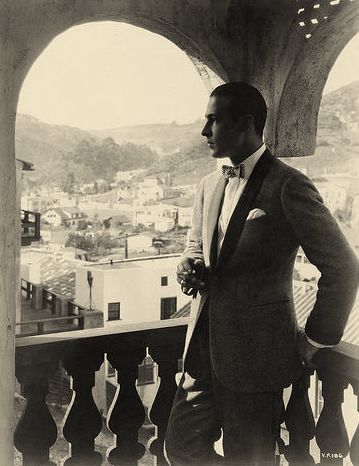

Rudolph Valentino at his home, Falcon Lair. Image Source: My Love of Old Hollywood.

Joan Crawford was famously accused by her adopted daughter, Christina, of obsessive, controlling abuse in the 1940s and early 1950s. What is less discussed in relation to this disputed depiction of the star is Christina's assertion that Crawford's house was haunted. Later inhabitants, up to 2005, also claimed that it was haunted:
Extreme punishments involving wire hangers, outbursts, a razor sharp tongue and a dark shadowy side that the public rarely witnessed. That tongue now quieted, Joan Crawford's daughter Christina tells of the dark supernatural events that were naturally drawn in and manifested themselves within her family home, despite the many exorcisms that were performed to remove the ornery and cantankerous spirits. The movie Mommy Dearest rattled the nation with tales so horrendous that even the most open-minded person questioned the possibilities of such terrifying acts against innocent children. Joan Crawford was a force to be reckoned with and her iron fist told volumes when it came to the star's personality. Not surprisingly, Joan's Brentwood, California home possessed a sea of rumors where the paranormal was concerned, and reports of haunting manifestations and exorcisms held in the home came to light in 1989 that are far too vivid to Christina even still today. Apparitions were literally everywhere you looked. Frightened by them as a child, there was no help as Christina and her brother were always shushed. Dark, cold spots in the home where no frightened child dare to cross were easily explained away to the children as active imaginations by their mother. The movie star's strange dealings with the dark side remained up until her last breath was taken when Christina claims that just before Joan's death, she spoke to a ghost at the end of her bed, taunting it in her arrogant way, to dare not ask her for God's help.
Joan eventually sold the estate and years later it was purchased by a family that shared similar experiences in the home. Distraught, they sought the help of the Reverend Rosalyn Bruyere, a family friend who by all accounts claim that there were so many spirits living in the home, including underworld connections and ritual abuse that it literally gave her goosebumps. Every family that had ever lived in the home had suffered from some sort of illness, disease, death, divorce, addiction or mental instability. Christina claims that she wouldn't be surprised if the ghost isn't Joan herself, due to the nature of her being capable of the realest evil you can imagine. The family living in the Brentwood home during the 90's allowed HBO to film a segment on Haunted Hollywood, adding their own personal experiences to the growing list of ghostly adventures. They claimed that the cottage by the pool was the center for paranormal phenomenon and that they had seen a host of ghosts and other entities parading through the house. The couple eventually moved. A new decade has brought new life to the Crawford estate, as there have been no more reports of ghostly activity until renovations on the estate began in 2005. The general overall feeling from those involved is that Joan is very angry that her wallpaper is being torn to shreds and thrown into the dumpster. Location: 426 N. Bristol Avenue, Brentwood, California. http://www.legendaryjoancrawford.com/brentwoodhome.html
The idea that Hollywood is haunted, or that people drawn to Hollywood are haunted because they are sensitive and artistic, is so common that it became the basis of a television series, Celebrity Ghost Stories. Joan Rivers's account of her haunted New York City abode is probably the most well-told story on this series and therefore convincing (see it here).

Wednesday, October 9, 2013

All Hallows' Eve Countdown: Heroic Werewolves


Image Source: Symbolic Symmetry.

The further back you go, the more ambiguous the mythological treatment of werewolves or human-wolf chimeras. Quite clearly, there was a cultural conflict between the worshippers of prehistoric wolf deities and organizers of later established religions. The increasingly negative view of werewolves appears to mark points of transition from animism to institutionalized systems of human faith. This seems to have been as true for the Greeks and Romans as it was for later Christians: an archaic positive view of wolfmen was followed by newer gods inflicting lycanthropic curses.

From Symbolic Symmetry (via Ancient Worlds), here is a short description circulating online about the positive myths surrounding the Irish werewolf, or Faoladh (pronounced FuEH-luh or FWEE-luck or FWEE-luh depending on the Irish dialect):
The Irish werewolf is different from the Teutonic or European werewolf, as it is really not a "monster" at all. Unlike its continental cousins, this shapeshifter is the guardian and protector of children, wounded men and lost persons. According to some ancient sources, the Irish werewolves were even recruited by kings in time of war. Known in their native land as the faoladh or conroicht, their predatory behaviour is typical of the common wolf, not beneath the occasional nocturnal raid on local sheep or cattle herds. If attacked or surprised while in wolf form, they usually simply run off because this causes them to shift back into their more vulnerable human form. However, after changing back into a man or woman, evidence of their lupine adventure remains on their bodies. If wounded, the injury remains. If they kill a sheep or cow, the telltale bloodstains stay on their faces and hands.

The most famous of the mythical Irish werewolves are the people of Ossory (modern day Kilkenny) whose legends live on even today. Among other lingering tales, the Ossory folk were documented by none other than Giraldus Cambrensis who, in the year 1185 transcribed what was no doubt a much older, oral folktale. According to Giraldus, the Ossory werewolves worked in pairs, male and female. A chosen couple lived as wolves for seven years before returning to human form to be replaced by a matched set of two others. During their time as wolves, they fed from the herds but this was taken as their due for watching over wandering children, healing the wounded, and guiding lost strangers to safety.

Despite the fact that this is a pre-Christian folk belief, the Irish werewolves eventually gained a reputation for being under a curse from either St Natalia (St Nailè) or, naturally, St Patrick as punishment for some vague transgression committed long ago. If you read Giraldus' account of these creatures, it is easy to separate what may be the original tale from his preachy commentary at the end.
Faoladh. Image Source: Ancient Worlds.

Monday, October 7, 2013

All Hallows' Eve Countdown: Voodoo Dolls Alive


Image Source: Pixel Nitrate.

I wanted to do a post on voodoo for today's Countdown to Hallowe'en entry, and I found a very cool animated short, Sebastian's Voodoo. It was created by Joaquin Baldwin at the UCLA Animation Workshop, with music by Nick Fevola. The film dates from 2008 and has won many awards. The synopsis: "A voodoo doll must find the courage to save his friends from being pinned to death." See it below the jump.

Friday, October 4, 2013

All Hallows' Eve Countdown: Facial Asymmetry and the Other Self


20th century prophet and clairvoyant Saint Slava Sevrukova saw Jesus Christ in a religious time travel vision and claimed that his facial features were mesmerizingly symmetrical. Image Source: The New Oxonian.

Welcome to a new installment in this year's Hallowe'en Countdown! Today, I follow up on this post about Mark Twain's speculation that Satan was a metaphor for our dream selves - a manifestation of our deepest, most unruly instincts. Today's post is about the hidden sides of ourselves which lie in plain sight, quietly expressed through body language, posture, a nervous tic. Good tailors and seamstresses know that people's whole bodies are asymmetrical, and part of the artistry of their craft lies in making clothes which make a body appear balanced, when it really isn't.

Gwyneth Paltrow has highly unusual facial symmetry. Her regular appearance (center); her right side is mirrored on itself in the far left photo; her left side is mirrored on itself in the far right photo. Princess Diana also had a very symmetrical face (see here). Image Source: right reading.

The same goes for faces. Very few people have nearly perfectly symmetrical faces. Facial asymmetry is a feature known to artists, photographers and hairstylists. Half their battle is finding the flattering angle in an imperfect subject. You can see a professional photographer discussing how she lights her own face to make it look balanced, 'normal' and beautiful, here. But there are even deeper dimensions to the implicit metaphysical messages our unbalanced faces give. With every crooked smile, we supposedly betray the ghosts which lurk within us.

Thursday, October 3, 2013

All Hallows' Eve Countdown: Fake Saints from the Catacombs


Art historian Paul Koudounaris has just published a book about fake saints' skeletons. These macabre faux relics were created in the 1500s by Catholic authorities during the Counter-Reformation. They reveal the oddly literal-minded and powerful Catholic tradition with which Luther contended, since these jewel-encrusted skeletons were supposedly saintly remains (although they weren't), and the gold and jewel decorations were meant to show the wealth one would enjoy in the afterlife:
A relic hunter has lifted the lid on a macabre collection of 400-year-old jewel-encrusted skeletons unearthed in churches across Europe. Art historian Paul Koudounaris has photographed dozens of skeletons in some of the world's most secretive religious establishments. ...

Thousands of skeletons were dug up from Roman catacombs in the 16th century and installed in towns around Germany, Austria and Switzerland on the orders of the Vatican.

They were sent to Catholic churches and religious houses to replace the relics destroyed in the wake of the Protestant Reformation in the 1500s.

Mistaken for the remains of early Christian martyrs, the relics, known as the Catacomb Saints, became shrines reminding of the spiritual treasures of the afterlife.

They were also symbols of the Catholic Church's newly found strength in previously Protestant areas.
Each one was painstakingly decorated in thousands of pounds worth of gold, silver and gems by devoted followers before being displayed in church niches. ...

They were renamed as saints, although none of them qualified for the title under the strict rules of the Catholic Church which require saints to have been canonised.

But by the 19th century they had become morbid reminders of an embarrassing past and many were stripped of their honours and discarded.

Koudounaris' new book, Heavenly Bodies: Cult Treasures and Spectacular Saints from the Catacombs [out 8 October 2013], is the first time the skeletons have appeared in print. ...

[Koudounaris comments on his findings:]
"The skeletons would then be dressed and decorated in jewels, gold and silver, mostly by nuns. They had to be handled by those who had taken a sacred vow to the church - these were believed to be martyrs and they couldn't have just anyone handling them. They were made saints in the municipalities. One of the reasons they were so important was not for their spiritual merit, which was pretty dubious, but for their social importance. They were thought to be miraculous and really solidified people's bond with a town. This reaffirmed the prestige of the town itself. ... Tracking down the remaining skeletons involved lots of detective work, and for all the ones that are on display there are a lot that aren't. Some were in churches but others were hidden away in storage containers and lock-ups. I'm positive there are some out there that are yet to be discovered. I'm of the opinion these are the finest works of art in human bone ever made."
You can see Dr. Koudounaris's Website here; he has explored ossuaries, catacombs and charnel houses across Europe and published another book on the subject, The Empire of Death (2011). See my earlier post on creepy ossuary decor here. See more images below the jump. All images are taken from a HuffPo report, unless otherwise watermarked from Dr. Koudounaris's site; all images are © Paul Koudounaris and reproduced under Fair Use for non-commercial discussion and review.

Tuesday, October 1, 2013

All Hallows' Eve Countdown: Mark Twain's Young Satan


Mark Twain depicted Lucifer as ambiguous, attractive and psychopathic. Image Source: The House of Vines.

October marks the start of harvest season in the Northern Hemisphere. Hallowe'en is just around the corner. Every year, the site Countdown to Halloween runs a blogathon so that interested blogs can comment on the season in any way they see fit (I highly recommend Gothtober). This blog participated in 2011 and 2012 (see those posts here); this year I am participating again.

2013's All Hallows' Eve Countdown at Histories of Things to Come will offer horror-themed posts with a twist. These posts will mostly address how horror straddles the dotted line of acceptability: how horror can have non-horrific origins; how horror's marginal aspects become mainstream (not always in a good way); how horror carries mixed messages; or how horror stories convey moral messages. Posts in the countdown will be more or less every other day; there will also be some regular, non-countdown posts this month.

Mark Twain (pen name of Samuel Langhorne Clemens (30 November 1835-21 April 1910)). Image Source: University of California Press.

Today's post concerns some of the darker writings of the famous American writer Mark Twain. Twain's real name was Samuel Clemens; he took his pseudonym from sailing Missouri steamboats on the Mississippi river in the late 1850s, where mark twain was the call which meant 'safe water' at two fathoms, or twelve feet deep.

Sunday, September 29, 2013

Michaelmas


Today is Michaelmas, the day devoted to the Archangel Michael, chief of the angels, who threw Satan out of heaven. St. Michael is also an eschatological figure, who is supposed to play a prominent role in the end times. See a great discussion of the significance and old customs of the day in Britain, at Dark Dorset, including cooking a goose at dinner. There's a touch of ancient sacrifice to this festival: "'September, when by custom (right divine) Geese are ordained to bleed at Michael's shrine.'"

Michaelmas also marks the last day of the year for eating blackberries (which explains why an Italian friend put a picture of Bavarese alle more up on Facebook yesterday). Satan, according to religious legend, landed in a blackberry bush when he fell to earth, and cursed the berries after September 29.

September 29 is supposed to be the last day of the year to eat blackberries: Macarons alle more. Image Source: Cucinare Dolce.

Thus, the British holiday overlaps in its practical purpose with harvest festivals at this time of year, such as the secularized Thanksgiving in North America. In 2012, the BBC reported on a revival of the observance of Michaelmas:
The traditional goose meal is seeing a revived interest in the UK, the industry says, with between 5-10% of British geese now being reared for the autumn instead of Christmas, which is the traditional seasonal focus. ... 
Michaelmas celebrates St Michael and all angels, which falls on 29 September for most of the UK. There are anomalies though: It's 4 October in Suffolk, and 11 October in Norfolk.
It falls near the autumn equinox and also marks a medieval festival when harvest was finished and farmers paid rent to the landowners, often offering geese as part of the exchange.
Goose fairs became popular across the country, with farmers driving their geese for miles to get to market.
The Michaelmas goose itself became associated with paying off debts, and according to folklore eating one on the day would bring financial luck for the coming year.
But over the last century "the seasons' festivals we used to have, fell out of fashion", says food writer Karen Burns-Booth, who specialises in food history and traditional recipes.
"We lost a lot of the agricultural emphasis particularly just after WWI… people became more industrialised, started to move to cities, therefore all those festivals sort of fell along the wayside." ...
Michaelmas geese tend to be leaner than their Christmas cousins, because they are slaughtered earlier and have been fed on "lovely lush spring grass", while Christmas geese fatten up during the winter, explains Mr Hegarty [chairman of the British Goose Producers].
A traditional Michaelmas goose can be roasted and served in the same way as a Christmas goose, but a number of recipes instead use seasonal ingredients such as apples and blackberries, or marrow and runner beans.

Saturday, September 28, 2013

Facebook Users Pixelated


The Facebook composite. Image Source: Yahoo.

Yahoo reports that Facebook has made an interactive composite image of its nearly 1.3 billion users:
"Relax. We're not breaking any Facebook privacy rule because we don't store anyone's private information, pictures or names," [programmer Natalie] Rojas writes. "We've just found a harmless way to show 1,260,866,093 Facebook profile pictures and organize them in chronological order"
You can click here to see the composite and zoom in anywhere to see individual faces. If you move to the top left corner, you can see the earliest faces on Facebook, starting with Mark Zuckerberg at #1.