TIMES, TIME, AND HALF A TIME. A HISTORY OF THE NEW MILLENNIUM.

Comments on a cultural reality between past and future.

This blog describes Metatime in the Posthuman experience, drawn from Sir Isaac Newton's secret work on the future end of times, a tract in which he described Histories of Things to Come. His hidden papers on the occult were auctioned to two private buyers in 1936 at Sotheby's, but were not available for public research until the 1990s.


Saturday, November 4, 2017

Curios: An Early Integrated Circuit


Technology that Changed the World: First Integrated Circuit (19 October 2017). Video Source: Youtube.

Curios is my blog series on odd things that turn up at auction houses. This is LOT #72176 at Heritage Auctions, An Early Microchip Prototype, Precursor to the Integrated Circuit, Developed in Dallas, Texas in 1958. All images reproduced here are from the auction listing. The chip is on the block today:
"Technological advancements do not just happen, and they can even be the product of some accidents - or, at least, a 'trial and error' methodology. In most cases of evolutionary development, there are, and must be, stages of advancement. We all take for granted the 'micro technology' that runs our everyday devices - and indirectly dominates our lives - which would not exist today if it were not for the technology behind the Integrated Circuit (IC) microchip. From cell phones to computers, the semiconductor age has made an impact on everything we do and how we do it. In the late 1950s, this cutting-edge technology, at least at the time, was pioneered by industry giant Texas Instruments with the charge being led by the legendary Jack Kilby so associated with the advent of the semiconductor - 'the chip that Jack built' has been echoed, likely daily, at least somewhere, since this revolution occurred some nearly 60 years ago...

In the summer of 1958, Jack Kilby began to work on an alternative to the 'largess' problems of circuitry and started writing down thoughts and sketching out ideas until he was ready to show how an IC could be built on semiconductor material and function. The initial iteration of the component was a sliver of Germanium with several projecting wires attached to a glass brick. The first successful demonstration of a phase shift oscillator had occurred, and the foundation of what became future generations of micro technology had been born. The advancement made at that time would ultimately result in the silicon 'chip' so associated today with virtually every aspect of technology. Jack Kilby would eventually win a Nobel Prize for his unparalleled breakthrough, which literally changed the entire world as we know it.

Of course, Jack Kilby did not perform his 'magic' in isolation or without the help of others. During that same period of time, Tom Yeargan worked as a technician at Texas Instruments and assisted Jack Kilby with a number of projects that culminated in the working microchip prototype. Tom Yeargan personally retained some materials from the original era of this micro technology development, which has become part of the history of his deservedly proud family. Sadly, Tom Yeargan is no longer here to share stories of just how the creation of the microchip came to fruition, but, fortunately, his family has preserved his legacy and now wish to share his historical treasures with everyone.

This incredible Lot features both a Germanium wafer complete with leads and wires on the original glass brick as well as a second unit - a prototype of a silicon circuit featuring metallic leads attached to a plastic 'petri dish'rounding out this dynamic duo of technological history. In addition to the precursor engineering devices, this offering has related documentation including a formal statement by Tom Yeargan chronicling his role in developing the microchip with Jack Kilby. The Germanium unit is presented in a plastic case that has a label signed by Jack Kilby further authenticating the piece. Jack Kilby even mentioned Tom Yeargan by name in his Nobel Prize acceptance speech. Both Jack Kilby and Tom Yeargan are gone, but neither will ever be forgotten.

Measurements: 0.99 x 0.31 x 0.03 inches (2.52 x 0.8 x 0.1 cm)"

Tuesday, October 31, 2017

Luther's Hallowe'en


"A statue of 16th-century theologian Martin Luther stands on Marktplatz square on Oct. 20, 2016 in Wittenberg, Germany." Image Source: Time / Sean Gallup—Getty Images.

This Hallowe'en is very special, because it marks the 500th anniversary of the day when Martin Luther (1483-1546) nailed his Ninety-five Theses on the door of All Saints' Church in Wittenberg, Germany. You can read the Theses in English, here.

Although Luther followed in the footsteps of other late medieval religious reformers such as John Wycliffe (c. 1320s-1384) and Jan Hus (1369-1415), Luther's act is considered the central moment in the start of the Protestant Reformation.

Woodcut of indulgence selling in a church from title page of On Aplas von Rom kan man wol selig werden [One Can Be Saved Without the Indulgence of Rome]. From a 1521 pamphlet. Image Source: Wiki.

The catalyst of Luther's protest was the sale of indulgences by a Dominican friar named Johann Tetzel (1465-1519). The reason Luther acted on Hallowe'en was not because of the significance of October 31st, but because he was anticipating the day that follows: November 1st, All Saints' Day. On 1 November 1517, Tetzel planned to start selling indulgences near Wittenberg, and he was famous for his abuse of the practice. The following rhyme is attributed to Tetzel:

"As soon as a coin in the coffer rings
the soul from purgatory springs."

Indulgences were chits, authorized by the pope to draw upon the virtuous power of the saints to reduce God's punishments for sins. Indulgences were believed to absolve sins of those still alive, and of souls trapped Purgatory, a No Man's Land between heaven and hell where souls worked and waited to be purified.

Through papal relations with local princes, the sale of indulgences proved a way of gathering money quickly and efficiently from poor people in Europe. Indulgence monies funded wars and big infrastructure projects. The sale of indulgences provided the money to build the Gothic cathedrals of Europe, which tourists still visit today. The same sales also supported roads, bridges, and other important construction work.

This practice was an arcane precursor to our modern system, which still conveys private funds into semi-public foundations or governmental public coffers, all in the name of humanitarianism and the public good. Behind those slogans, there remains an enduring tension between the individual citizen and the growth of violent and powerful statecraft and its satellite entities.

Thus, the issues driving Luther and his protest were more complicated than indulgences. Luther's act was part of the evolution of the modern conscience (or lack of it). Unravel the discussions on faith, and the subsequent schism inside the Roman Catholic Church helped to herald the values driving our Millennial  political and economic systems.

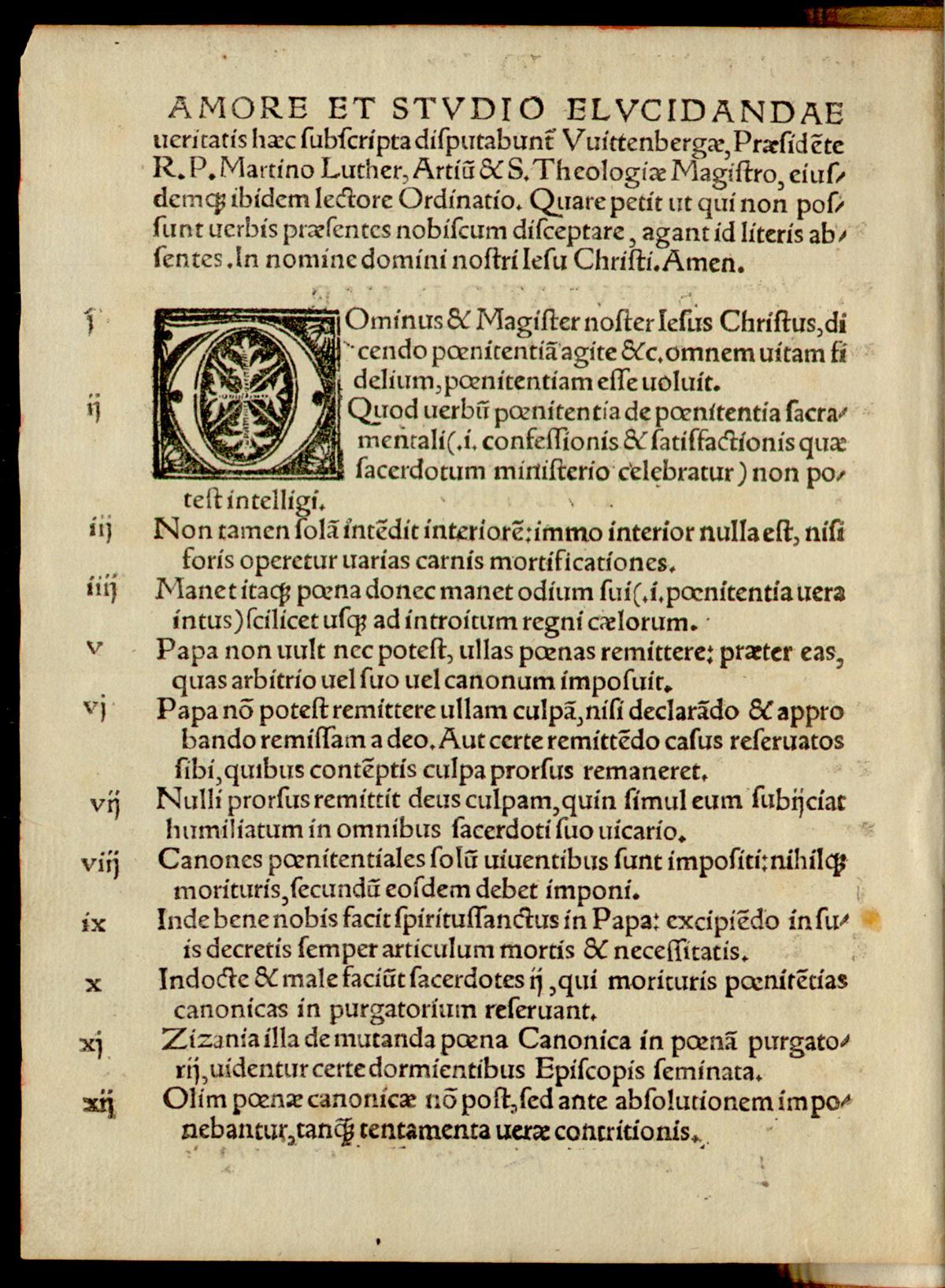
First page of the 1517 Basel printing of the Theses as a pamphlet. Image Source: Wiki.

This was the earliest glimmer of a democratic age. Several medieval critics had condemned venality in the Church prior to October 1517, but Luther's Theses sparked a shift in popular awareness.

Luther meant his complaints to launch a debate with Tetzel. He did not intend for his Theses to become a public manifesto, a rallying cry for the common people, and he wrote the Theses in Latin. However, they were translated into German and printed through a radical new technology - the printing press. The press had been invented in 1440 and spread thereafter through the German lands. This was how Luther's Theses were shared across Central Europe and sparked revolts by the peasants against their royal and ecclesiastical masters.

Luther, with his intent of taking worship back to the holy texts, also made the Christian faith more democratic. He translated the Bible from Hebrew and Greek into German, by-passing Rome's official Latin Vulgate. He wrote important hymns, such as Ein feste Burg ist unser Gott (A Mighty Fortress Is Our God), based on Psalm 46. And - in defiance of the Roman Catholic insistence on celibate priests - he got married.

This blog will discuss these issues, with an eye to showing how Luther's ideas still shape our world. I will be interviewing Andrew Wilson, who wrote Here I Walk: A Thousand Miles on Foot to Rome with Martin Luther. The book chronicles a fascinating effort by Andrew and his wife Sarah to retrace Luther's footsteps in 2010.

Andrew hypothesized that the real breach with Rome began when Luther actually visited that city in 1511. Sent on business on behalf of his order, Luther walked to Italy, starting in October 1510 from the Augustinian monastery in Erfurt.

It is obviously essential to know what Luther saw in Rome and what he thought of it, because it led to him being the Catholic Church's biggest critic in history, a mere six years later. The conventional interpretation has assumed that Luther found a cynical, corrupt and bellicose papacy, Rome as Babylon.

However, Andrew found that the documents about Luther's pilgrimage gave little solid evidence. He decided to retrace Luther's steps - in today's landscape - to find a story in the environment along Luther's pilgrim's path.

Andrew and Sarah Wilson with a statue of St. James at the Lutheran church in Oettingen-in-Bayern. Image Source: Andrew Wilson.

Together, Andrew and his wife walked over one thousand miles and documented their travels on their Website, here. Andrew explained what he discovered about Martin Luther in his book, published in 2016. That discovery, and how it relates to us now, will be the subject of upcoming posts in December.


For the whole Luther interview and all related posts, go here.

Countdown to Hallowe'en 2017: Happy Hallowe'en!


Still from John Carpenter's The Fog (1980). Image Source.

Happy Hallowe'en! For today, hear a video rip from a new-retro vinyl LP. This is the soundtrack for John Carpenter's The Fog (1980), which was released in 1984. This nostalgic Youtube channel has a whole playlist of classic horror movie soundtracks on vinyl LPs; to listen, go here.

The Fog Soundtrack (Blake's Gold Edition) [Full Vinyl Rip] Part 1 (this vinyl LP release edition 2013); by John Carpenter (1980; 1984) © Varèse Sarabande. Video Source: Youtube. Reproduced non-commercially under Fair Use.

See all my posts on Horror.
See all my posts on the Paranormal.
Posts on the Occult are here.
Click here for my posts on Ghosts.

Check out other blogs observing the Countdown to Hallowe'en!
Image Source: 4Chan.

Saturday, October 28, 2017

Countdown to Hallowe'en 2017: Latent Feline Infection


This meme dates from 2010. Image Source: Know Your Meme.

Today's post concerns how cats influence human health, based on the article: Influence of latent Toxoplasma infection on human personality, physiology and morphology: pros and cons of the Toxoplasma–human model in studying the manipulation hypothesis. That article concerns the often asymptomatic or latent disease, toxoplasmosis, caused by an intercellular parasite which is passed through cats to humans and is related to human depression, autism, cerebral calcification, sex addiction, and schizophrenia. It is a disease that affects rodents and makes them lose all fear of cats; this has allowed the parasitic protozoan to return to feline systems, where it can complete its life cycle. The parasite also affects the rodent brain's sexual impulses and reward centres.

Toxoplasma gondii parasitic protozoa. Image Source: Ke Hu and John Murray via Business Insider.

Scientists believe that toxoplasmosis infection similarly makes humans attracted to cats. The disease affects an enormous number of people, which may incidentally ensure the survival of the domestic cat, while also safeguarding the protozoan. Wiki:
"Up to half of the world's population are infected by toxoplasmosis but have no symptoms. In the United States about 23% are affected and in some areas of the world this is up to 95%. About 200,000 cases of congenital toxoplasmosis occur a year. Charles Nicolle and Louis Manceaux first described the organism in 1908. In 1941 transmission during pregnancy from a mother to a child was confirmed."
Perhaps those Walking Dead zombie stories are telling you the truth about a reality you suspect, but cannot see. If you think everyone around you is infected by some mysterious bug that makes them crazy, you may not be paranoid. You may be right. From Florence Robert-Gangneux and Marie-Laure Dardé in American Society for Microbiology (2012):
"Low seroprevalences (10 to 30%) have been observed in North America, in South East Asia, in Northern Europe, and in Sahelian countries of Africa. Moderate prevalences (30 to 50%) have been found in countries of Central and Southern Europe, and high prevalences have been found Latin America and in tropical African countries."
Approximate rates of infection by country below are almost all based on tests of pregnant women. Some studies only focus on particular regions, and the numbers change from year to year. Follow the links for years and details; not all countries conduct studies or keep statistics. Note that these statistics tend to show infection passed from mother to child in the womb. They do not include post-natal infection, in which people are infected directly by handling cats or eating raw or rare meat:
  • Argentina: sources for Buenos Aires 45.6%-57.2% infected
  • Australia: 28% infected; 23% found infected in pregnant women from Melbourne
  • Bahrain: 22.3% tested positive, from pregnant women in Manama only
  • Belgium: 48.7% infected
  • Brazil: 66.9% infected; other sources range 55.6%-77.8%, depending on region
  • Canada: unknown; extrapolated estimate 14%-22% infected
  • Chile: 40%-90% of the population, depending on region
  • China: Changchun only, 10.6% infected among pregnant women
  • Colombia: 43.1%-66.7%, different sources, depending on region
  • Costa Rica: approximately 55%, increases in rural areas and with poverty
  • Croatia: 38.1% infected
  • Cuba: different studies from Havana areas, 44%-66.3%
  • Czech Republic: 30%-40% infected; in Prague, 19.8% infected
  • Denmark: statistics for Copenhagen, 27.8% infected
  • Egypt: measured in women only, 46.5% in urban areas, 57.6% in rural areas
  • France: 45% infected
  • Germany: Western Pomeranian statistics only, 63.2% infected
  • Greece: depending on different studies and different regions, 20%-36.4% infected
  • Grenada: 57% infected, nationwide estimate
  • India: 11.6%-45%, depending on class and region
  • Iran: 29.4%-63.9%, depending on class and region
  • Iraq: 49.2% infected, statistics for pregnant women tested in Basra
  • Italy: 17.5%-34.4%, a range of averages, from different studies and different regions
  • Ivory Coast: 60% infected among pregnant women from Abidjan
  • Jordan: 47.1% infected in Amman
  • Kuwait: 45.7% infected among pregnant women
  • Malaysia: 49% infected among pregnant women from Kuala Lumpur
  • Mexico: extrapolated estimate 22% infected; another source found 6.1% of pregnant women infected in Durango
  • Morocco: Rabat statistics only, among pregnant women, 50.6% infected
  • Netherlands: 35.2% nationwide
  • New Zealand: statistics for pregnant women from Auckland, 35.4% infected
  • Poland: 35.8%-43.7% infected, based on pregnant women only in three cities, Warsaw, Lodz, Poznan
  • Romania: 57.6% infected in women of child-bearing age, Timisoara only
  • Serbia: 33% infected nationwide
  • Singapore: 17.2% infected among pregnant women
  • Slovakia: 22.1% among pregnant women, Bratislava data only
  • Slovenia: 34% infected nationwide
  • South Korea: 4.3% infected; other sources range 0.8%-3.7% infected in Daejeon and Suwon
  • Spain: 18.8%-43.8% infected, averages from certain regions only
  • Sudan: Khartoum and Omdurman only, pregnant women tested, 34.1% infected
  • Sweden: 18% infected from Stockholm and Skane only
  • Switzerland: 8.2%-35% infected, based on data from Lausanne, Geneva, Basel only
  • Thailand: 5.3%-21.5% infected among pregnant women from different regions
  • Turkey: 30.1%-60.4% average infected among pregnant women, from different classes and regions, impacted by regional culinary traditions (consumption of raw meat)
  • United Kingdom: 31% infected, 20 million people in 2012, with 80% of these asymptomatic; East Kent statistics for pregnant women showed 9.1% infected
  • USA: 15%-22.5% of the population, depending on demographic, 60 million+ infected; another source states 11% nationwide, with 7.76% for US-born and 28.1% for foreign born
  • Venezuela: 38% infected among pregnant women from Lara State
  • Vietnam: from Nha Trang only, 11.2% of pregnant women infected
In humans, the disease can remain latent until adulthood, or until the body experiences weakened immunity due to other causes. The non-latent form of the disease can feel like the 'flu' and spreads to the brain, eyes, and other organs; it creates cysts in the amygdala and nucleus accumbens, and changes the connections inside the brain which deal with fear responses, sexual attraction, decision-making and memory. The parasite also increases dopamine production, altering brain chemistry in the same ways cocaine - and schizophrenia - do. Those who are infected post-natally and directly through handling cats after birth are affected more severely than those who are infected congenitally.

Image Source: Twitter.

Thursday, October 26, 2017

Countdown to Hallowe'en 2017: This Is Real


"Ever wonder what you would do if you were kidnapped? This Is Real simulates a group abduction at a warehouse in Red Hook, Brooklyn." Image Source: Jessica Lehrman/NYT.

On 26 October 2016, the NYT reported on scary haunts organized for those seeking a fear-filled time on Hallowe'en. The most intriguingly unhealthy of their selection was This Is Real, a warehouse event in the neighbourhood of Red Hook, Brooklyn, New York City, where you can pay actors to treat you like a brutalized hostage in a psycho-torture film. [Although, in an update at the bottom of this post, the creators of the event corrected me on Twitter to say that they don't actually torture the patrons. They hire actors to pretend to torture each other, and then they chase the patrons through a Saw-like warehouse maze.]

Wednesday, October 25, 2017

Countdown to Hallowe'en 2017: Death in the Park


Image Source: Dan Bell/Twitter.

Today's post follows urban explorer Dan Bell again (see my earlier posts on him here, here and here), as he visited Gwynns Falls - Leakin Park, which spans 1,216 acres (492 hectares) in his native city of Baltimore, Maryland, USA. Leakin Park is famous as a murderers' dumping ground; it is estimated that some 80 people have been murdered there or their bodies have been abandoned there, and the number is probably higher.  The area is so heavily forested that it was the film location for The Blair Witch Project sequel, Book of Shadows (2000).

Baltimore’s Leakin Park : The Scariest Place in America / A Creepy Documentary Featurette (15 September 2017). Video Source: Youtube.

Sunday, October 22, 2017

Countdown to Hallowe'en 2017: Thy Love to Me was Wonderful


In February of this year, it emerged in the UK press that the guitarist of Pink Floyd, David Gilmour, owned Hook End Manor in Oxfordshire, UK. Now abandoned, the reports were an invitation to UK urban explorers to go have a look. Youtube now boasts a number of urbex videos giving us a peek into a rock star's life from thirty years ago. The description for the video below was adapted a report from The Daily Mail:
"David Gilmour bought the manor in 1980 from Alvin Lee of the blues band Ten Years After. He recorded some of Pink Floyd’s 1987 album A Momentary Lapse of Reason in a studio at the house. Horn recorded the hit single Video Killed The Radio Star and masterminded the success of the 1980s group Frankie Goes To Hollywood.

He bought Hook End Manor in the 1990s before placing it on the market for £10 million in 2007.

The house - thought to have been built for the Bishop of Reading around 1580 - boasted a gym, heated swimming pool, croquet lawn and tennis court, pergola and terracing.

The 11-bedroom Elizabethan manor house, set in 25 acres, boasted a state-of-the-art recording studio where Spandau Ballet and Jamiroquai also recorded hit tracks.

The home - worth around £12million - was sold by record producer Trevor Horn in 2007 after his wife Jill Sinclair, 55, was struck by a stray pellet fired from her son Aaron’s air rifle in the garden of the mansion.

The pellet lodged in Jill's neck, piercing an artery and she was rushed to hospital, but despite prompt medical attention she had to be put into a drug-induced coma. She died in 2014."
The house is currently on the site of RPA Architects as a slated refurbishment project.


Images Source: Daily Mail.

In the video below, see urban explorers go though the abandoned mansion. In the basement, they found a morbid memento, the tombstone of a small boy: LITTLE JACK. April 17th 1909. THY LOVE TO ME WAS WONDERFUL. Morrissey, lead singer of The Smiths, stayed in the house and reported that he (and other visitors) felt a ghostly hand on their chests, waking them each day at 4:10 in the morning.

PINK FLOYDS ABANDONED MILLIONAIRE 1580s MANSION (EVERYTHING LEFT BEHIND) DAVID GILMOUR LIVED HERE! (30 September 2017). At 10:48 (here) in the video, the urban explorers find a tombstone in the basement. Video Source: Youtube.


See all my posts on Horror.
See all my posts on the Paranormal.
Posts on the Occult are here.
Click here for my posts on Ghosts.

Check out other blogs observing the Countdown to Hallowe'en!
Image Source: 4Chan.


Thursday, October 19, 2017

Countdown to Hallowe'en 2017: The Highgate Vampire and the Hampstead Witch Hunt


These were the people in your neighbourhood: David Farrant's 1971 photograph of French occultist, Martine de Sacy, supposedly engaged in a Wiccan cleansing ritual performed at the scene of Necromantic rites in the Cory-Wright vault at Highgate Cemetery, UK. De Sacy's later comments on Farrant conflicted with Farrant's version of events. Image Source © David Farrant/Hampstead Christ Church.

One of the most disturbing political and social rumours to emerge in the past two years is the Pedogate story of worldwide child slavery, black magic, and ritual sacrifice. It was widely dismissed in the mainstream media as vicious disinformation, spread to bolster populism, nationalism, neo-fascism, and anti-Semitism. Indeed, it does revive the ugliest medieval anti-Semitic hoax, the blood ritual myth.

My interpretation does not consider Pedogate's counter-factual aspects to be true. That is, I do not believe in the anti-Semitic hoax. Rather, I consider more carefully how disinformation can be exploited and I have written here on the kernels of fact upon which the myths are based. I have argued that the Pedogate rumour has real underpinnings in the Internet's exacerbation of child porn and child sexual exploitation. And the rumour has had further practical applications in the new development of Internet politics. These stories are not without substance, as successive scandals demonstrate.

One aspect of this disinformation is a rage against, and dehumanization of, the upper tier of society in the post-2008 recession era. Today's example considers an incredibly damaging and frightening set of accusations leveled at the well-to-do inhabitants of Hampstead, London, from 2014 to 2017. The Hampstead case is part of the Pedogate moral panic, and concerns terrifying accounts of child abuse and Satanic practices. The locals in Hampstead have denied the whole story; all accusations remain unproven.