TIMES, TIME, AND HALF A TIME. A HISTORY OF THE NEW MILLENNIUM.

Comments on a cultural reality between past and future.

This blog describes Metatime in the Posthuman experience, drawn from Sir Isaac Newton's secret work on the future end of times, a tract in which he described Histories of Things to Come. His hidden papers on the occult were auctioned to two private buyers in 1936 at Sotheby's, but were not available for public research until the 1990s.


Saturday, October 3, 2015

Hallowe'en Countdown 2015: Post-it Note Enantiodromia


Images Source: tickld and John Kenn.

Danish children's television producer John Kenn Mortensen draws monsters on Post-it notes in his spare time under the alias Don Kenn. Obviously influenced by Edward Gorey, Mortensen's monsters are not Victorian or Edwardian, rather they are situated in the unconscious of the Millennial world, around suicide, child abuse, bullies, nightmares, a vengeful natural environment, ghosts of the past, and dreamlike beasts. Mortensen has a talent for capturing moments of extreme vulnerability and isolation in mundane circumstances, whether that involves nosy neighbours or a hike up a mountain. He also depicts situations in the everyday world where dangerous energy has accumulated. Some of Mortensen's Post-its remind me of Final Destination films, in which scares depend on hair-trigger coincidences, a vase left by a windowsill, a kettle boiling over near a sparking plug, the conversion of potential energy into kinetic energy.


To shed light on the messages behind Mortensen's doodles, consider the great Viennese psychoanalysts from the turn of the last century. Sigmund Freud (1856-1939) argued that most horrors stemmed from repressed sexuality. Alfred Adler (1870-1937) claimed they came from the will to power as an individual violently molded his or her personality. Adler's ideas inspired a typology to classify personalities as 'getters and learners'; 'avoiders' who are overtly successful but never take risks; 'leaders or dominants'; and the 'socially useful.'

Finally, Carl Jung (1875-1961), founder of the school of analytical psychology, believed that monsters emerged from conflicting opposites in our natures, some of which were confined to individual perception, some of which were universally shared. Jung defined these opposites as the conscious and unconscious, and hypothesized that in western culture, consciousness (associated with Freud's Ego) was dominated by thinking and sensory sensation. The remaining two impulses - emotional feelings and intuition - were repressed and driven underground into the western unconscious. In this way, a stark line was drawn in the west between body and heart. Even now, decades after Jung's death, those who bring elements of the psyche into the material world are deemed in the west to be artistic (at best) or insane (at worst). This was not the case, according to Jung, in eastern cultures. He ignored the "modernized east," but his work on traditional eastern religions and texts led him to conclude that the eastern cultures widely accept "psychic reality."

The unconscious - a pool of symbols shared by all cultures - became a paradox in the west. It could be harnessed and applied to creative endeavours and innovation. Or it could be repressed and unleashed to deal with threats. The Jungian western unconscious turned upon itself during the two World Wars; aimed outward, it could prove a hidden reserve of violent ruthlessness to ensure the survival of western societies. Either way, Jungian theory indicated that westerners remain obsessed with exploiting the constructive and destructive power of polarities. They define themselves in terms of inclusion and exclusion, in terms of an inner world and an outer world, ever mindful of the walls between.

Wednesday, September 30, 2015

Hallowe'en Countdown 2015: The Banality of Evil


Nazi Adolf Eichmann misused Kant's categorical imperative to defend himself at his 1961-1962 trial, stating that his atrocities were for his country's greater good, as legally defined by Hitler. Image Source: Wiki.

Welcome back after a blog break. At present, I am completing several projects, including a work of fiction. I want to thank readers of this blog who generously sent donations to support my attendance at the Bread Loaf Sicily writers' conference in September, as well as regular readers who support my writing here. Bread Loaf confirmed to me the value of the arts in times of transformation; when values change, traditions are overturned, and old political schools collapse, the arts find a new baseline in the chaos. The Italian Renaissance proved that an economy can expanded through renewed cultural vision; and thus the jump from prosperity to even greater prosperity depends upon perspectives enhanced by the arts. Critics have dismissed the arts and humanities as worthless luxuries in the past few years, but practitioners in these fields defeat misery, strife and exploitation by constantly seeking truths in the unknown.

Today, HoTTC starts another Countdown to Hallowe'en, the annual online event in which hundreds of blogs join together to count down the days of the harvest season in the northern hemisphere to mark the spooky end of October. In this fifth year that Histories of Things to Come joins the blogathon, the blog's ghosts and vampires will not always be present in their familiar forms. A ghost today might be a war zone freedom fighter, a political refugee, or a super soldier programme drop-out. A vampire could be a glamorous celebrity. A werewolf might manifest as an ISIS executioner. Most of my 2015 posts as Cryptkeeper - every third day this month - will examine darker sides of the commonplace. These are areas where the mundane drops away into uncertainty and fear. To start, here are some stories about the banality of evil from yesterday and today.

Sunday, August 2, 2015

Away from Blog


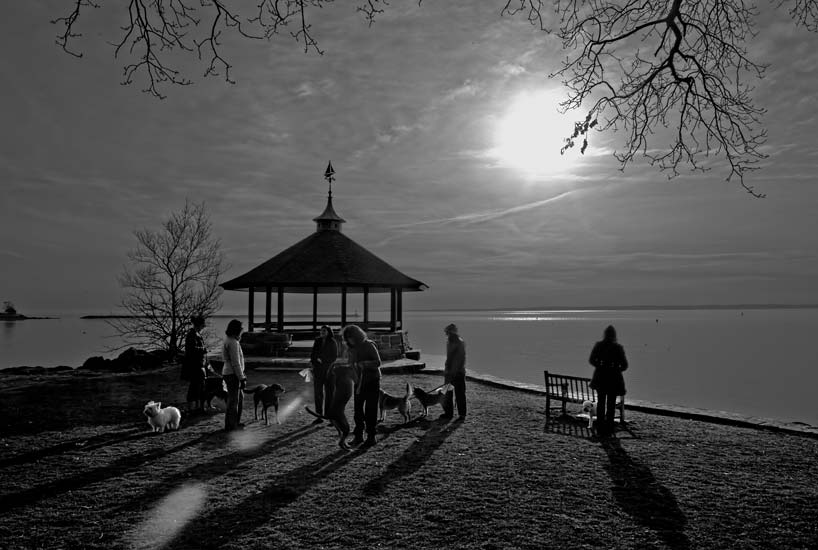
"Day for Night is a cinematographic technique used by movie makers to shoot a scene in day light and make it appear to be night time." Dog Walkers © (2013) by H. David Stein was taken in bright sunlight. Image Source: H. David Stein.

I will be away from the blog completing other projects until October 1. The blog's Best Posts have been updated, here. See my Late Summer Interlude music selections from 2011, here.

Thursday, July 30, 2015

Blue Moon Past: To Reincarnate, To Forgive?


The Omnipresence or Transcendent Reincarnation (2014) by George Grie. Image Source: neosurrealismart.

You cannot move into the future without first dealing with the past. And sometimes, you can only do that once in a blue moon. The glittering technology of the twenty-first century makes the past a persona non grata. It is a full time job to keep track of data in the present while dreaming of the future. There is no time to digest or assimilate past information and sort out how it relates to real life. Keep moving forward! Move into the eternal Now and discard the past as useless commodity, a broken toy. Even if that past was last week's past, get rid of it, dump it in the unsorted junkyard.

A blue moon refers to an extra full moon in the year. Twelve months normally have twelve full moons, but a blue moon (like tonight's) is a thirteenth moon in the calendar. In folklore, these moons are considered rare events which invite reflection, release and wishes. The 'blue' designation comes not from the colour, but from the Old English term 'belewe,' which meant 'blue' or 'to betray,' promising an intercalary or additional month, where there is none. Nevertheless, the appeal of the blue moon's pocket of hidden, extra time persists. Image Source: wallpapersinhq.

In the name of progress, the past is demonized and feared as a repository of unsolved or buried problems, atavism, regressive beliefs and reactionary politics which damage the Self and others. In the 1990s, it was popular for psychiatric patients to undergo therapies in which they suddenly remembered suppressed memories, manifested in the form of taboos such as incest. That anti-historical fashion 'proved' that the past is full of demons which bar our way forward; it is best to deny, erase and purge them so that we may constantly reinvent our identities en route to becoming shinier versions of ourselves.

No matter what future sirens call, you cannot reach them without facing the past. If you don't do the stock-taking and change course where necessary, human psychology has its little ways of transporting you back to the junkyard. The past will come alive again and pull you back on an eternal loop until you learn its lessons. The Hindus, Buddhists and Taoists call that loop Saṃsāra. The Christians call it Hell. The journey on the wheel rises or falls but always returns to square one: time becomes nihlistic, a flat circle. In the eastern tradition, iniquities repeat across many lifetimes. In the Christian view, iniquities repeat through the course of one life. In these belief systems, there are only two ways out of the loop: to reincarnate, or to forgive, in enlightened ways.

Summer's Nameless Emotions


Picture of man at night on Wall Street at night time. Photograph by Ashley Gilbertson. Image Source: National Geographic.

A heat wave here inspired today's collection of my best previous summer posts, along with Ashley Gilbertson's photo of Wall Street, above. All of these earlier posts explored summer's sultry, nostalgic or noir atmosphere and together illustrate one of the relationships between the environment and brain function, a cornerstone of cognitive science.
Psychoanalysts have particularly focused on nameless emotions as points at which experience moves past the capacity of language to describe it. See popsci's 2013 list by Pei-Ying Lin of twenty-one emotions for which there are no English words; and below, twenty-three emotions people feel, but cannot explain.

Image Source: Art of Manliness.

Happy Birthday, Emily Bronte

http://chatnoirco.wordpress.com/2012/01/13/psychological-profiles-of-wuthering-heights-characters/
http://marvmelb.blogspot.ca/2013/05/the-gun-alley-murder-part-1.html

Wednesday, July 29, 2015

Upgrade to Your New Personal Assistant


Image Source: imgur.

Microsoft is offering a free upgrade today to Windows 10 for all owners of Windows 7 and 8.1. Part of the free deal is Cortana, a virtual female personal assistant that collects all your data and sends it back to Microsoft. These are the paw prints of technocratic progress which may see states replaced by corporations, as described in this post. 

Tuesday, July 28, 2015

Quote of the Day: Earthworm Tribute


Man is but a Worm from Punch's Almanack (1882). Image Source: Tulane University via Wired.

From this week's Free Will Astrology, for anyone who still inches forward:
Charles Darwin is best known for his book The Origin of Species, which contains his seminal ideas about evolutionary biology. But while he was still alive, his best-seller was The Formation of Vegetable Mould Through the Action of Worms. The painstaking result of over forty years' worth of research, it is a tribute to the noble earthworm and that creature's crucial role in the health of soil and plants. It provides a different angle on one of Darwin's central concerns: how small, incremental transformations that take place over extended periods of time can have monumental effects.
You can read The Formation of Vegetable Mould, through the Action of Worms, with Observations on their Habits (1881) for free online here.