TIMES, TIME, AND HALF A TIME. A HISTORY OF THE NEW MILLENNIUM.
Comments on a cultural reality between past and future.
This blog describes Metatime in the Posthuman experience, drawn from Sir Isaac Newton's secret work on the future end of times, a tract in which he described Histories of Things to Come. His hidden papers on the occult were auctioned to two private buyers in 1936 at Sotheby's, but were not available for public research until the 1990s.
Today is the blog's sixth birthday! Thank you very much to everyone who has stopped here to read my posts. Over the past year, these were the most popular posts:
A tornado in Colorado, USA (7 May 2016). Image Source: Tori O'Shea.
This blog is skeptical of conspiracy theories because they are not consistent with the way reality is created. Conspiracy theories about current events - for example, regarding the disastrous situation in Syria - are examples of modern urban folklore, which impose exactly the same superstitious, deterministic logic onto the world that an established religion would. Many of today's orthodoxies are nominally secular, but they are no less based in blind faith. Actors on the international scene do try to impose strategic control on the world's hot spots; the media come to these hot spots with spin, preconceived ideas and even false flag agendas. However, the notion that anyone - governments, politicians, banks, shadowy cabals, unseen actors, evil establishments - controls the reality that ensues from fluid conditions is incorrect.
The Intercept: "New Study Shows Mass Surveillance Breeds Meekness, Fear and Self-Censorship" (28 April 2016). Image Source: The Intercept (Hat tip: Edward Snowden).
On 26 April 2016, the political commentator Fareed Zakaria, host of CNN's main foreign affairs programme, GPS, debated ex-NSA contractor Edward Snowden for NYU Wagner's Debates of the Century, on whether the American government should have access to privately-held technology and private data. Debates of the Century:
"Some people believe the recent dispute between the FBI and Apple over a locked iPhone marks the return of what privacy advocates called the 'crypto wars' of the 1990s, when federal authorities tried and failed to mandate government access to most forms of electronic communication. Although the FBI managed to decrypt the iPhone at issue without the company’s help, Apple and others are racing to build devices and messaging services that no one but their owners can unlock. The legal question remains unresolved in Congress, where competing bills have been introduced, and in dozens of cases pending in state and federal courts.
Law enforcement agencies believe their vital mission requires compulsory access, under valid court order, to any device or communications stream. Leading technology companies (backed by some other U.S. government voices) say they cannot meet law enforcement demands without undermining customer security and privacy against hackers and foreign adversaries. Edward Snowden and Fareed Zakaria disagree on which course better serves society at large. Should companies be required to break into their own encrypted products, and should they be allowed to sell encryption that no one can break?"
Professor Bruce Bueno de Mesquita spoke at LSE (Sheikh Zayed Theatre, New Academic Building) on 21 October 2009; the chair of the discussion was Professor Richard Steinberg. Video Source: Youtube.
Caption for the above video: "Bruce Bueno de Mesquita has been shaking the world of political science to its foundations with his predictions of world events. His systems based on game theory have an astonishing 90%+ ratio of accuracy and are frequently used to shape US foreign-policy decisions on issues such as the terrorist threat to America to the peace process in Northern Ireland. Considered by many to be the most important foreign-policy analyst there is, it is no surprise that he is regularly consulted by the CIA and US Department of Defence. In this lecture Professor Bueno de Mesquita will look at what is needed to reliably anticipate and even alter events in any situation involving negotiation in the shadow of the threat of coercion. He will demonstrate how to bring science to decision making in any situation from personal to professional."
In an earlier post, I discussed the work of NYU professor Bruce Bueno de Mesquita, who uses game theory to predict the future in international relations and advises businesses and the American government on major strategic policy concerns. In the 2009 talk above from the London School of Economics (at 53:00), he explained how he was hired to develop a fraud prediction model applied to banking regulations. At 55:32, he remarked:
"One of the best early warning indicators of fraud is that, relative to growth in market cap, compensation for senior management is under expectation for the size of the organization of the firm, not over. ... They're husbanding whatever resources they can to try to save the company."
"The fiction that human beings are 'rational actors' has been totally discredited. Establishment academics with tenure have a hard time accepting real [world] facts that most people on the street intuitively understand without ... study. Anyone who claims 90% prediction accuracy in working with any complex system - who has not made themselves a billionaire with such gifts - is a con man."
Two questions put to Bueno de Mesquita at the end of his talk suggested that the Youtuber's remark had some weight. Random events, as well as anti-rational or irrational impulses, fall outside the professor's model. This is the 10 per cent range of human behaviour extending into the future, where game theory meets chaos theory meets randomness.
At 56:40, a member of the audience asked about Nassim Taleb's The Black Swan: The Impact of the Highly Improbable (2007; 2nd ed. 2010). To paraphrase, the person asked if random, chance occurrences could drastically affect statistical models (Bueno de Mesquita corrected him: game theory models) due to unique expressions of human nature.
At 1:10:00, another member of the audience asked about Frederic Vester's (1925-2003) sensitivity model, which applied game theory to biology and behavioural ecology, and produces results similar Bueno de Mesquita's application of game theory to economics and politics. This similarity implies that organic systems mirror human systems in their predictability and unpredictability.
Both questions relate to the nature and impact of the Internet, especially as it is redesigned to endure and become a lasting edifice. Is the Web a techno-organic entity which reflects the rational and irrational impulses of its users, and to what degree? Can we describe peer-to-peer technological environments as 'ecosystems,' and if they are organic, to what degree are they chaotic and unpredictable? Or are the computer systems and technical designs of the Web and other peer-to-peer technologies, including cryptocurrencies, shaping the way we behave and think inside virtual realities? Are we driving the car or is the car driving us? This is a concern as Big Data analysts flock to predict, manipulate and control consumers' behaviours and voters' choices. In future posts, I will consider how these theories of predictability relate to decentralized behavioural psychology and the psychodynamics of peer-to-peer technologies.
Craig Steven Wright has revealed himself on his blog today, and in an exclusive scoop to the BBC, The Economist and GQ, that he is Satoshi Nakamoto, creator (with undisclosed other(s)) of Bitcoin. Wright claims he has the private key to Satoshi's digital signature for the first generated Bitcoin. Wright told the BBC that he was forced to come forward because rumours that he is Satoshi are affecting people in his personal life. He stated he is appearing before a camera once, and after today, he never, ever, ever wants to talk to the media again. But his weird choice to include GQin the scoop equates the invention of Bitcoin with a male-centric fashion statement.
Belgium's Doel nuclear power station: "A security guard at the Doel nuclear plant in northern Belgium was murdered on Thursday 24 March [2016]." Some reports maintain that there was no connection between the crime and the guard's place of work. Image Source: IB Times.
"Belgium has suffered a number of suspicious and alarming activities at its nuclear sites and against some of its nuclear technicians. In Aug. 2014, for example, someone with inside access at the Doel-4 nuclear reactor drained the lubricant for the reactor turbine, causing it to overheat and resulting in an estimated $100-$200 million in damage. The perpetrator and the motive remain unknown.
In Nov. 2015, Belgian police discovered that the terror cell that carried out the Paris attacks used a secret video camera to monitor an official at nuclear research sites with a wide range of nuclear and radiological materials, including enough highly enriched uranium for several nuclear bombs."
Of even greater concern is the fact that, according to reports from 28 and 29 April 2016, the Belgian government just planned to issue iodine tablets to all of its citizens. According to the BBC, these would be handed out next year. It may be a precautionary measure, or perhaps something has escaped the authorities. Meanwhile in Germany, surgeons are reportedly taking classes on how to operate on massive traumatic injuries, such as those sustained from gunshot wounds and bomb explosions.
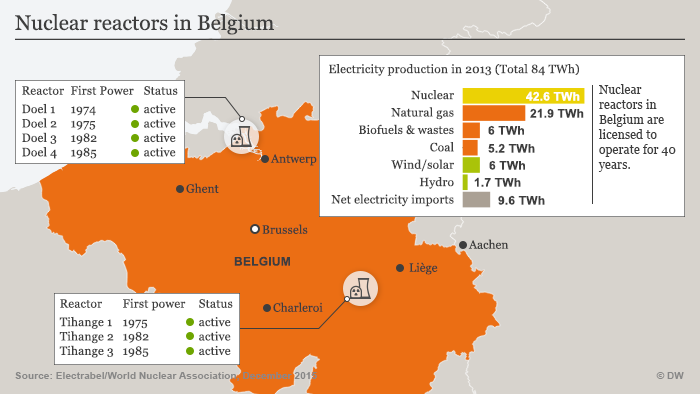
Doel-1 is currently down for repairs. ISIS had a follower working at one of the Doel plants. Image Source: DW.
The headlines:
Reuters: "UPDATE 2-Belgian Doel 4 nuclear reactor closed till year-end" (14 August 2014)
HLN: "Hoe kan zo iemand in Doel werken?" (21 October 2014)
Reuters: "Belgium find video of nuclear official in search for Paris attack clues" (17 February 2016)
IB Times: "Paris attacks: Jihadists secretly monitored Belgian nuclear scientist for potential Daesh dirty bomb" (18 February 2016)
The Center for Public Integrity: "A terrorist group’s plot to create a radioactive ‘dirty bomb’: ISIS was looking for nuclear materials, and Belgium was a smart place to hunt" (29 February 2016)
The Center for Public Integrity: "Belgium orders immediate security upgrade at its nuclear sites: After long relying on unarmed guards, Belgium decides to send soldiers with weapons to safeguard its reactors from a terrorist attack" (11 March 2016)
DH: "Exclusif: les frères El Bakraoui visaient nos centrales nucléaires!" (24 March 2016)
RT: "Brussels terrorists planned nuclear plants attack, changed target after accomplice’s arrest – report" (24 March 2016)
Time: "The Terrorist Threat From ISIS May Be About to Get Worse" (24 March 2016)
The Times: "Brussels cell ‘was plotting radioactive bomb attack’" (25 March 2016)
The Washington Post: "Brussels attacks stoke fears about security of Belgian nuclear facilities" (25 March 2016)
NYT: "Belgium Fears Nuclear Plants Are Vulnerable" (25 March 2016)
Time: "ISIS Attackers May Have Targeted Nuclear Power Station" (25 March 2016)
Politico: "Armed police on guard at Belgian nuclear facilities" (25 March 2016)
Reuters: "Belgian nuclear guard shot, prosecutor rules out militant link" (26 March 2016)
DH: "Un agent de sécurité dans le nucléaire tué à Charleroi: la piste terroriste démentie par le parquet de Charleroi" (26 March 2016)
Daily Mail: "Two Belgian nuclear power plant workers have joined ISIS leading to fears the jihadis have the intelligence to cause a meltdown disaster" (27 March 2016)
BGR: "Brussels attackers were looking to make radioactive ‘dirty bomb’" (28 March 2016)
The World Post: "Belgium Highlights the Nuclear Terrorism Threat and Security Measures to Stop it" (29 March 2016)
IB Times: "ISIS To Attack Germany? Islamic State Lists German Targets For Brussels-Style Terrorism" (31 March 2016)
Reuters: "Islamic State urges attacks on German chancellery, Bonn airport: SITE group" (31 March 2016)
CNN: "Nuclear terrorist threat bigger than you think" (1 April 2016)
Ecologist: "Dirty bomb' security risk at Belgian nuclear power plants" (4 April 2016)
IB Times: "ISIS Threat To Germany: Spy Chief Says Security Situation Is ‘Very Serious’ Amid Islamic State’s Attack Plans" (10 April 2016)
DW: "A nuclear terrorism threat made in Belgium?" (15 April 2016)
Die Welt: "Chirurgen sollen sich auf Anschläge vorbereiten" (27 April 2016)
Breitbart: "Surgeons Receiving Military Bomb Trauma Training For Future Terror Attacks" (28 April 2016)
IB Times: "Belgium Nuclear Radiation Threat? Iodine Pills Supplied To Belgian Citizens After Germany Expresses Concern" (28 April 2016)
The Telegraph: "All Belgian residents issued with iodine tablets to protect against radiation" (28 April 2016)
RT: "Iodine pills for all: Nuclear plant security worries prompt new Belgium health plan" (28 April 2016)
Daily Mail: "Belgium to provide its entire population with iodine pills in case of a nuclear accident at one of its ageing power plants" (28 April 2016)
DW: "Belgium says its nuclear plants are safe but here are some iodine pills - just in case: Belgium's health ministry has said it will provide iodine pills to its population in case of an accident at one of its atomic plants. Technical problems with its aging reactors have caused tension with neighbor Germany" (29 April 2016)
New Indian Express: "Belgium Issues Anti-radiation Tablets to Whole Country After Isil 'Dirty Bomb' Threat" (29 April 2016)
IB Times: "Belgium distributes anti-radiation iodine tablets to entire population following nuclear meltdown fears" (29 April 2016)
Happy Lunar New Year! Come on over to Patreon and Substack , where I am sharing selections from my new novel in progress, Vampire Daddy. ...
CROWDFUND HIGHLIGHTS
Followers
Translate
Tip Jar
Tips always welcome! Please support the blogger.
CRYPTO TIPS
BTC:bc1qn64kr0wr2ste54v300hufqk39ymtmws5rnf0r2
ETH:0x33E14ef754CAdc113A409211fbd6Ea42544aA4A1
For all my crypto wallets, crypto exchange and trade referral links, go here.
Readers Say
"Turns out this was insanely prescient. " (27 Feb. 2025)
"I was [s]truck by the thought that another dominant illusion that bewitches the poor, the r[i]ch, the powerful and the weak equally is that tomorrow will look like yesterday... It is happening again... In so many ways we continue to hold onto past pains, to refu[s]e to look at and truly feel what has happened, to not notice that we act from a place of fear in the face of some distant echo. Nothing will ever be the same." (7 May 2020)
"A haircut is as emblematic of fascism as the Hakenkreuz? That's absolutely ridiculous, good God!" (5 October 2019)
"This was a truly amazing and inspired blog post. I do hope you are able to publish a book that further delves into these cyber resistance and cultural movements. I'd buy it today." (26 December 2017)
"I've shared many of your blogs on my facebook page over the past few years -- I think your blog's one of the best on the internet." (19 October 2017)
"I like your blog. Interesting content. Deep thoughts, well formed and presented." (21 June 2017)
"This blog is a goldmine and a beacon. Deep, clear, multiperspectivist and enlightened. Congratulations." (23 June 2015)
"I'm definitely a lurker. You have the greatest blog on the internet. ... You are a lighthouse." (26 August 2013)




 Posts
Posts